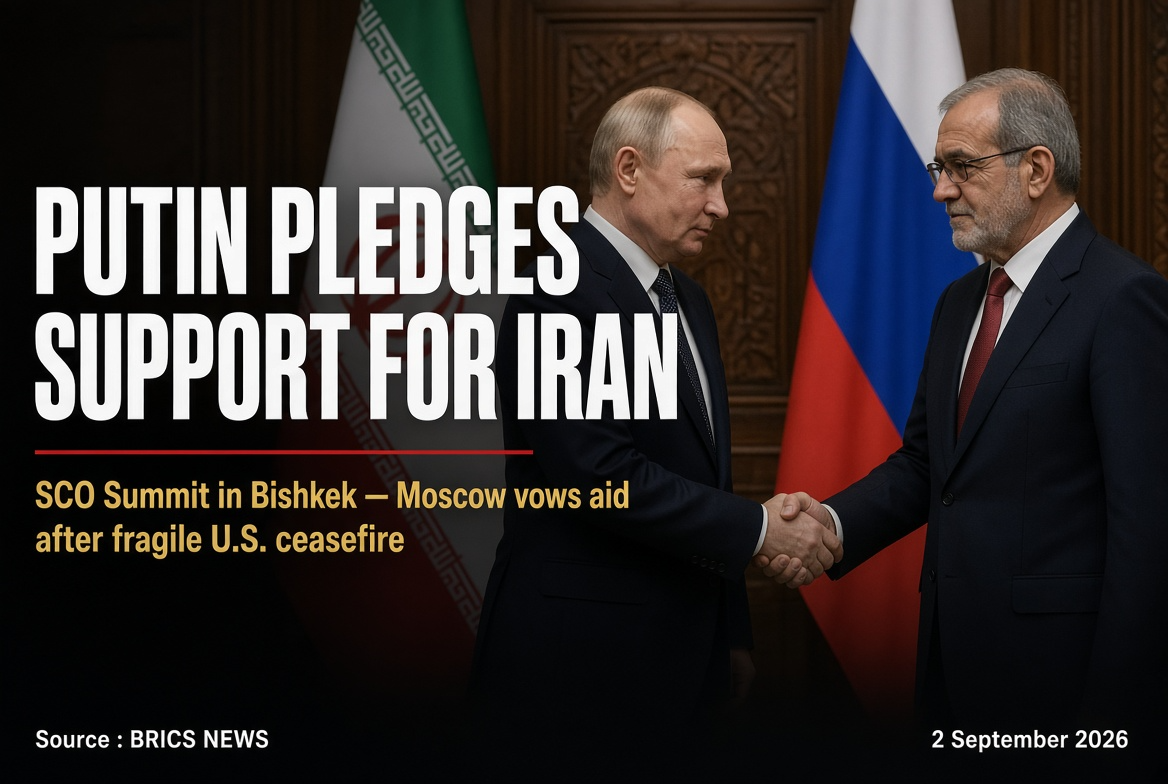
BISHKEK Sept 1, 2026 — Russian President Vladimir Putin told Iranian President Masoud Pezeshkian on Tuesday that Moscow stands in “full solidarity” with Iran and is supplying Tehran with essential goods, as the two leaders met on the sidelines of the Shanghai Cooperation Organisation summit in Kyrgyzstan.
The talks, held September 1 in Bishkek, came as both countries seek to deepen a comprehensive strategic partnership under heavy Western sanctions and amid a U.S.-Iran confrontation that a June ceasefire memorandum failed to settle.
“Russia is standing in full solidarity with the people of Iran. We admire your courage and resilience in your fight for your national interests,” Putin said, according to a Kremlin transcript. He asked Pezeshkian to convey his regards to Iran’s Supreme Leader Mojtaba Khamenei.
Putin said Russia had welcomed the Iranian-American ceasefire memorandum signed in June, but added: “Unfortunately, the ceasefire proved to be unstable and too fragile. During this difficult period, we try to render the necessary support to you. We have discussed your needs with you and continue to provide the goods and commodities you require.”
He said trade and economic ties had held last year’s momentum despite the “current military and political situation,” citing the work of a bilateral intergovernmental commission and the Eurasian Economic Union–Iran free trade agreement. Humanitarian links were also expanding, he said, with nearly 9,000 Iranian students in Russia in the 2025–2026 academic year.
Pezeshkian thanked Putin for Russia’s stance “during the war, the conflicts, the US sanctions and all the rest,” including support at the United Nations. He described the relationship as strategic rather than ordinary.
“They have no right to impose sanctions, violate international law and act aggressively whenever they want,” Pezeshkian said. “They have killed our scientists, innocent schoolchildren and our commanders.” He said Iran and Russia could resist “US bias and the rightless sanctions” and “fight against this unilateralism.”
The Iranian president said Tehran would honor the June memorandum if Washington returned to its commitments, and expressed confidence that Iran would “win” and “stand our ground.”
The Russian delegation underscored the breadth of the relationship. Officials present included Foreign Minister Sergei Lavrov, Energy Minister Sergei Tsivilev, Rosatom CEO Alexei Likhachev, and Dmitry Shugayev, director of the Federal Service for Military-Technical Cooperation.
The meeting took place as SCO leaders adopted the Bishkek Declaration, which condemned attacks and sanctions on Iran and reaffirmed support for Iran’s sovereignty and its rights under the Nuclear Non-Proliferation Treaty. The grouping’s members include Russia, China, India, Iran, Pakistan and several Central Asian states.
The June memorandum had sought to halt more than 100 days of fighting, reopen the Strait of Hormuz, and open a 60-day window for a broader settlement that included sanctions relief and reconstruction talks. Putin’s remarks and Pezeshkian’s account indicated that both sides now treat that truce as broken.
For Moscow and Tehran, the Bishkek encounter was another public display of alignment between two heavily sanctioned states that present their partnership as a counterweight to U.S. pressure in the Middle East and beyond.
About The Author