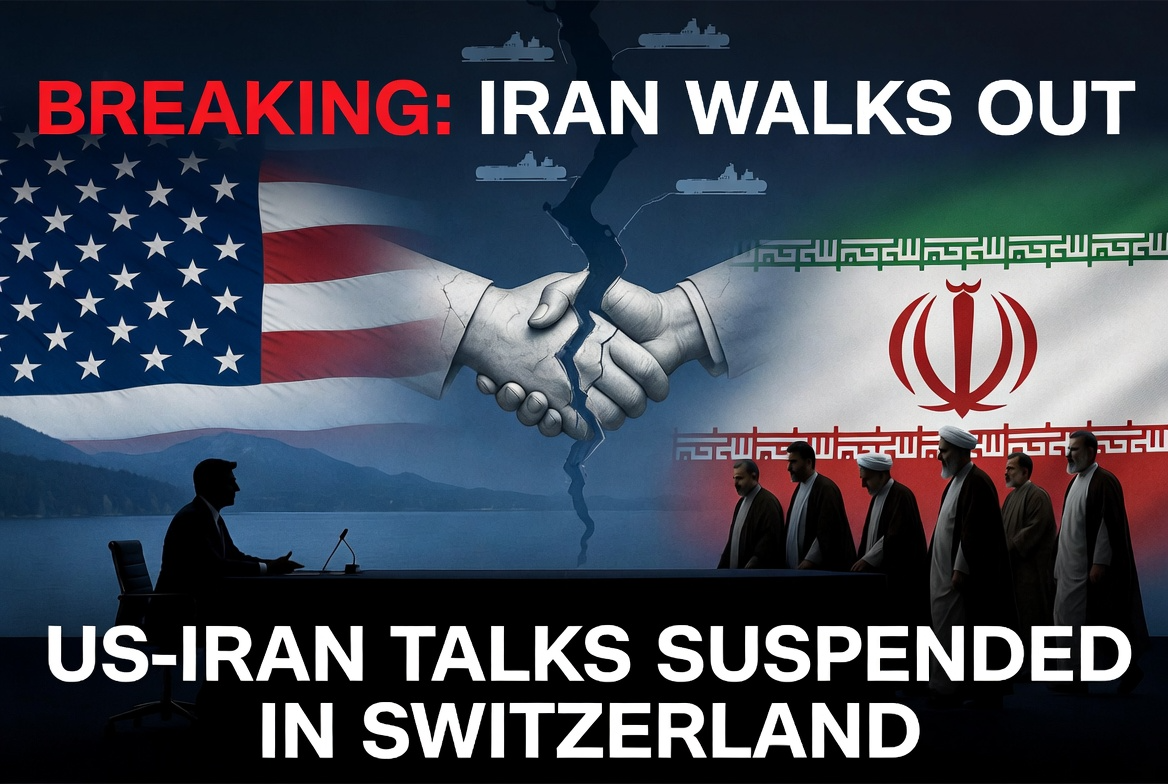
SWITZERLAND June 21, 2026 – Iran has suspended negotiations with the United States in Switzerland, citing President Donald Trump’s recent threats as a major obstacle, according to Iranian state-affiliated media. The move comes just as high-level talks aimed at solidifying a preliminary ceasefire agreement appeared to get underway.
Iranian outlets Tasnim and Fars reported that the delegation halted official meetings and left the venue in protest, conditioning any resumption on a US apology and concrete action to rein in Israeli operations in Lebanon. The reports follow Trump’s public warnings that the US would “hit Iran very hard again” if Tehran fails to curb its proxies, particularly Hezbollah, and his suggestion of imposing American tolls on the Strait of Hormuz if a final deal isn’t reached within the 60-day window.
The tensions erupted shortly after a US-Iran Memorandum of Understanding was signed to pause direct hostilities, open the Strait of Hormuz for toll-free shipping for 60 days, and begin discussions on Iran’s nuclear program and regional de-escalation. Vice President JD Vance traveled to the Bürgenstock resort for in-person talks, accompanied by mediators from Qatar, Pakistan, and Oman, expressing hope to “turn over a new leaf.”
However, ongoing clashes between Israel and Hezbollah in Lebanon — which Iran views as a violation of the ceasefire spirit — have derailed momentum. Iranian officials insist that violations on one front invalidate the broader truce.
While Iranian media portrayed a full suspension, some Western reports indicate that lower-level or indirect contacts may continue, with negotiators still engaged despite the public friction. US officials have downplayed the walkout claims, and Trump has maintained that Iran “really wants to make a deal.”
The Strait of Hormuz, through which about 20% of global oil passes, remains a flashpoint. Iran has threatened to close it in response to Israeli actions, prompting Trump’s sharp rhetoric on potential US control or fees for “guardian angel” services in the region.
Analysts warn that the diplomatic setback risks unraveling the fragile 60-day framework, potentially reigniting wider conflict involving proxies across the region. Markets are watching closely for any disruption to energy flows.
No immediate comment from the White House or Iranian foreign ministry has confirmed a permanent end to talks. The situation remains fluid as both sides navigate deep mistrust rooted in decades of hostility, recent military exchanges, and competing regional interests.
About The Author