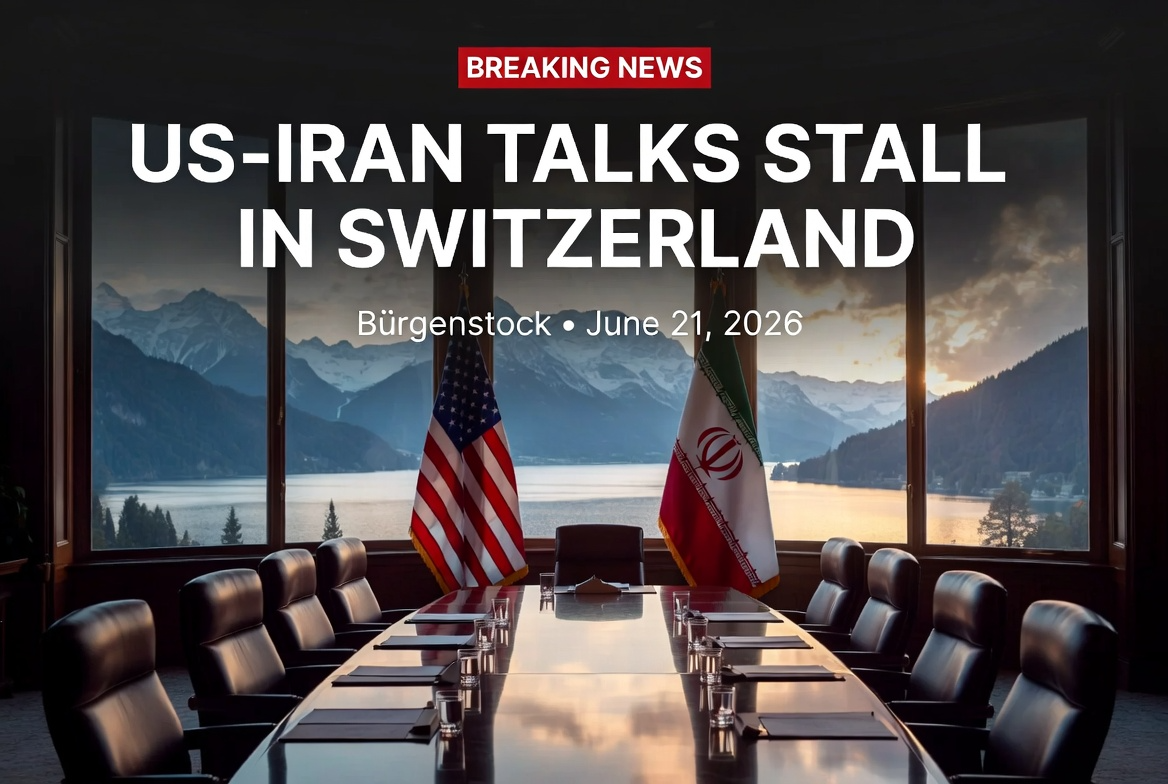
SWITZERLAND June 21, 2026 – High-level talks between the United States and Iran, aimed at implementing a fragile memorandum of understanding (MoU) signed earlier this week, encountered significant hurdles on Sunday, according to multiple reports, even as delegations met briefly at the Bürgenstock resort.
The discussions, mediated by Pakistan and Qatar, were intended to address key issues including Iran’s nuclear program, a ceasefire in Lebanon, reopening of the Strait of Hormuz for oil traffic, and broader sanctions relief. US Vice President JD Vance led the American side, joined by envoys such as Steve Witkoff, while Iran’s delegation included Parliamentary Speaker Mohammad Bagher Ghalibaf and Foreign Minister Abbas Araghchi.
However, social media accounts and some Iranian state-affiliated outlets reported that negotiations had stalled shortly after beginning. Iranian negotiators reportedly insisted on an immediate end to Israeli actions in Lebanon and a full withdrawal of forces from southern Lebanon as a precondition for further progress. They also pushed back against perceived threats from US President Donald Trump.
The talks follow the June 17 MoU, which established a 60-day window for negotiations toward a lasting peace after direct US-Iran hostilities. The agreement outlined steps on nuclear limitations (including down-blending enriched uranium under IAEA oversight), de-escalation in Lebanon involving Hezbollah, and secure maritime access through the Strait of Hormuz.
Earlier plans for in-person meetings on Friday were postponed after renewed clashes between Israel and Hezbollah in Lebanon killed soldiers on both sides, prompting Iran to delay its delegation. Talks resumed Sunday, with Switzerland confirming arrivals and facilitating the discreet venue overlooking Lake Lucerne.
Vance expressed optimism before sessions, stating the US sought to “fundamentally transform” relations with Iran if Tehran abandoned nuclear weapons ambitions and regional destabilization. He claimed “great progress” in early hours. Iranian officials, however, highlighted disagreements over uranium enrichment rights—Iran insists on maintaining civilian capabilities—and demanded US apologies for threats alongside Israeli pullbacks.
Trump’s public statements, including renewed warnings of severe consequences if no deal materializes, reportedly complicated the atmosphere, with some Iranian media claiming they prompted a temporary halt.
Key Sticking Points
- Nuclear Program: Iran demands recognition of its enrichment rights; the US and allies seek strict limits and verification.
- Lebanon Ceasefire: Persistent Israel-Hezbollah fighting remains a major irritant.
- Strait of Hormuz: Iran has signaled possible renewed closures in response to regional developments.
- Sanctions and Assets: Discussions touched on frozen assets and oil relief, but details remain limited.
UN nuclear chief Rafael Grossi met Swiss officials in Bürgenstock to support the process. Both sides held separate sessions with mediators, but the first direct round lasted roughly 60-80 minutes before apparent difficulties.
Analysts caution that the 60-day timeline is ambitious given deep mistrust and external factors like Israeli operations. Pakistan’s Prime Minister Shehbaz Sharif and Qatar’s mediators remain engaged in shuttle efforts. Switzerland has reiterated its role as a neutral host without commenting on substance.
No immediate resumption schedule was announced as of late Sunday. Markets may react to perceived instability, particularly around energy routes. Further updates are expected in the coming days as parties assess next steps in what remains a high-stakes diplomatic push.
About The Author