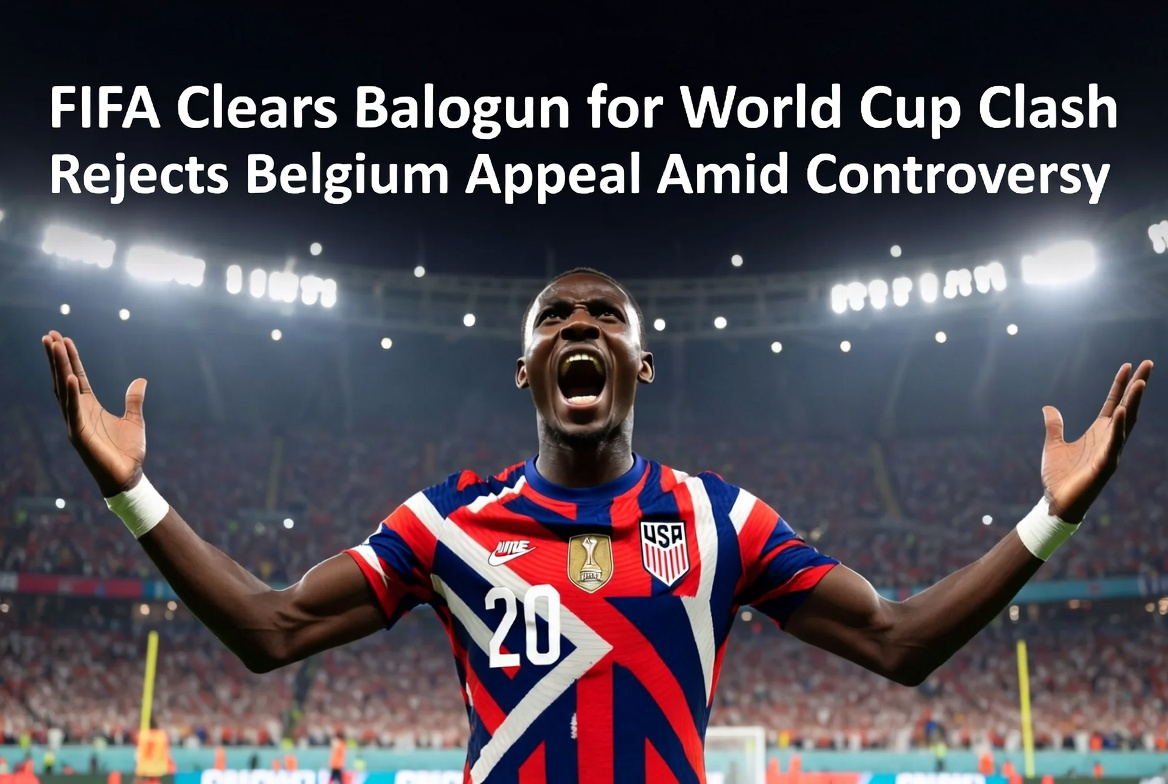
SEATTLE July 6, 2026 — FIFA has ruled Belgium’s challenge to its decision suspending U.S. forward Folarin Balogun’s one-match ban as “inadmissible,” clearing the striker to play in Monday’s round-of-16 clash against Belgium.
The ruling follows FIFA’s earlier move to suspend the automatic one-game ban Balogun received after a red card in the United States’ 2-0 round-of-32 victory over Bosnia and Herzegovina on July 1. Belgium’s Royal Belgian Football Association (RBFA) had sought an explanation and challenged the player’s eligibility, but FIFA’s Appeal Committee determined the RBFA had no standing to appeal because it was not a party to the original disciplinary proceedings.
Balogun was sent off in the 64th minute for serious foul play after a challenge on Bosnia defender Tarik Muharemović. Under standard FIFA rules, a direct red card triggers an automatic one-match suspension for the next game. However, FIFA’s Disciplinary Committee opted to suspend the ban for a one-year probationary period, citing provisions that allow for such discretion in certain cases.
Reports indicate the reversal came after U.S. President Donald Trump contacted FIFA President Gianni Infantino to request a review of the red card and resulting suspension. Trump later confirmed to reporters that he had made the call.
Belgium expressed astonishment at the process, stating it received no detailed explanation or reasoned decision from FIFA before the appeal window effectively closed. The RBFA had requested the disciplinary committee’s full reasoning but was instead informed that its correspondence was being treated as a formal appeal, which was then quickly ruled inadmissible.
UEFA issued a strongly worded statement, describing the decision as unprecedented and saying it “crossed a red line.” The European governing body emphasized that a minimum one-match suspension following a red card is not discretionary and cannot be waived mid-tournament without clear justification.
The United States will benefit from Balogun’s availability as they prepare to face Belgium in the knockout stage. The match is set for Monday in Seattle as part of the 2026 FIFA World Cup, co-hosted by the U.S., Canada, and Mexico.
Balogun, who plays his club football in Europe, has been a key attacking threat for the U.S. team. His inclusion adds firepower to a side that advanced from the group stage and secured a historic knockout victory over Bosnia.
The episode has sparked debate over FIFA’s decision-making process and perceived political influence. While some U.S. supporters welcomed the outcome, critics — including figures in European football — have raised concerns about transparency and consistency in applying disciplinary rules.
FIFA has not issued an expanded public explanation beyond confirming the appeal was inadmissible and reiterating that Balogun remains eligible.
The controversy adds another layer of drama to what is already a high-stakes round-of-16 matchup between two teams with contrasting styles and ambitions at the expanded 2026 tournament.
About The Author