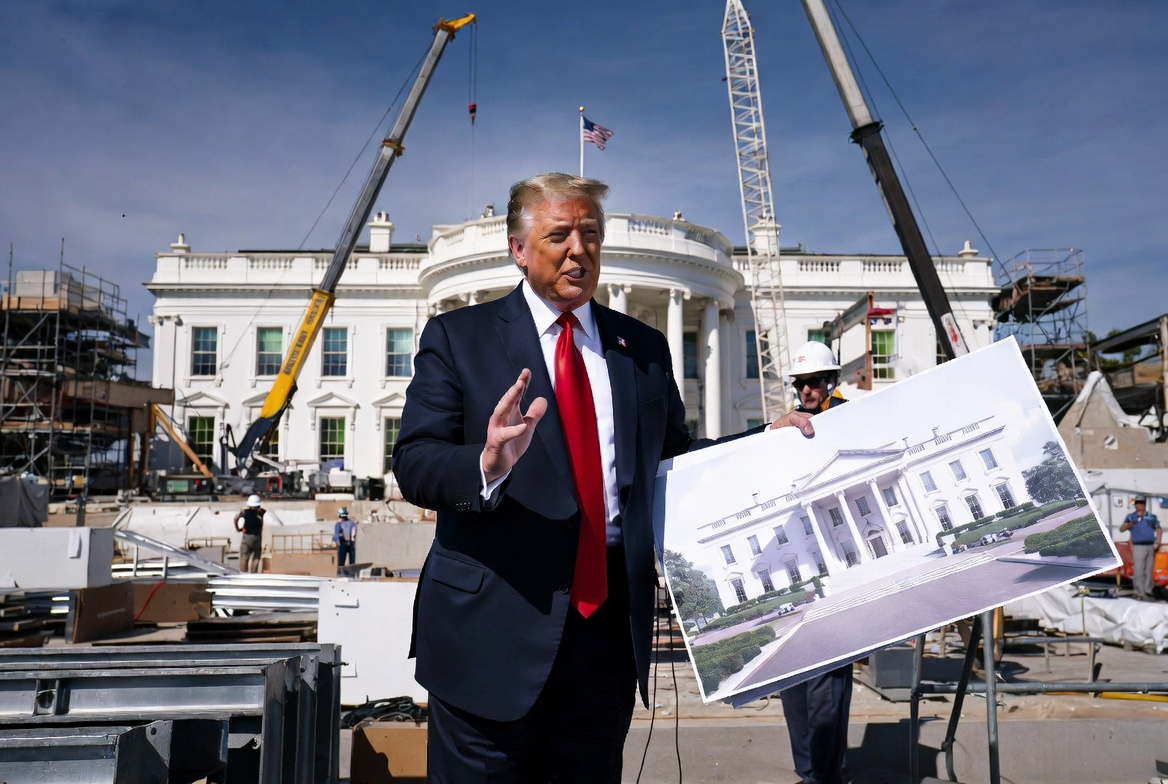
WASHINGTON D.C. — May 20, 2026 — President Donald Trump led reporters on a tour of the ongoing construction site for a new $400 million neoclassical ballroom at the White House on Tuesday, May 19, emphasizing its advanced security features, including a missile-proof and drone-proof rooftop designed as a “drone port” to protect the capital.
The project replaces the former East Wing, which was demolished to accommodate the approximately 90,000-square-foot expansion. Trump, speaking over the noise of construction equipment while holding architectural renderings, described the ballroom as a “gift” to the nation and future presidents, privately funded with “not one dime of government money.”
“The entire roof is developed for military,” Trump said. “Not only is it drone-proof — if a drone hits it, it bounces off, it won’t have any impact — but it’s also meant as a drone port, so it protects all of Washington.” He added that the structure features 360-degree sightlines, sniper positions, and underground facilities including bunkers, a research center, and a military hospital.
Construction began in late 2025 following the announcement earlier that year. The ballroom aims to provide a larger venue than the existing East Room for state dinners and major events, with neoclassical design elements to match the White House aesthetic. Trump noted the project is ahead of schedule, with completion targeted around 2028.
The initiative has drawn significant controversy. Critics, including some historic preservation groups and Democrats, have called it a “monument to himself,” while Republicans in Congress have faced pushback over related security funding requests. A recent proposal for about $1 billion in Secret Service enhancements tied to the project was blocked by the Senate parliamentarian, prompting revisions to budget legislation.
Trump defended the project as essential for hosting world leaders and enhancing national security amid global threats. “This is really for other presidents,” he stated during the tour.
The National Capital Planning Commission approved the final design in April 2026, though legal challenges from preservation advocates continue. Supporters view it as a necessary upgrade for modern presidential functions.
The tour comes as Trump navigates domestic and international challenges, including economic concerns and ongoing foreign policy matters.
About The Author