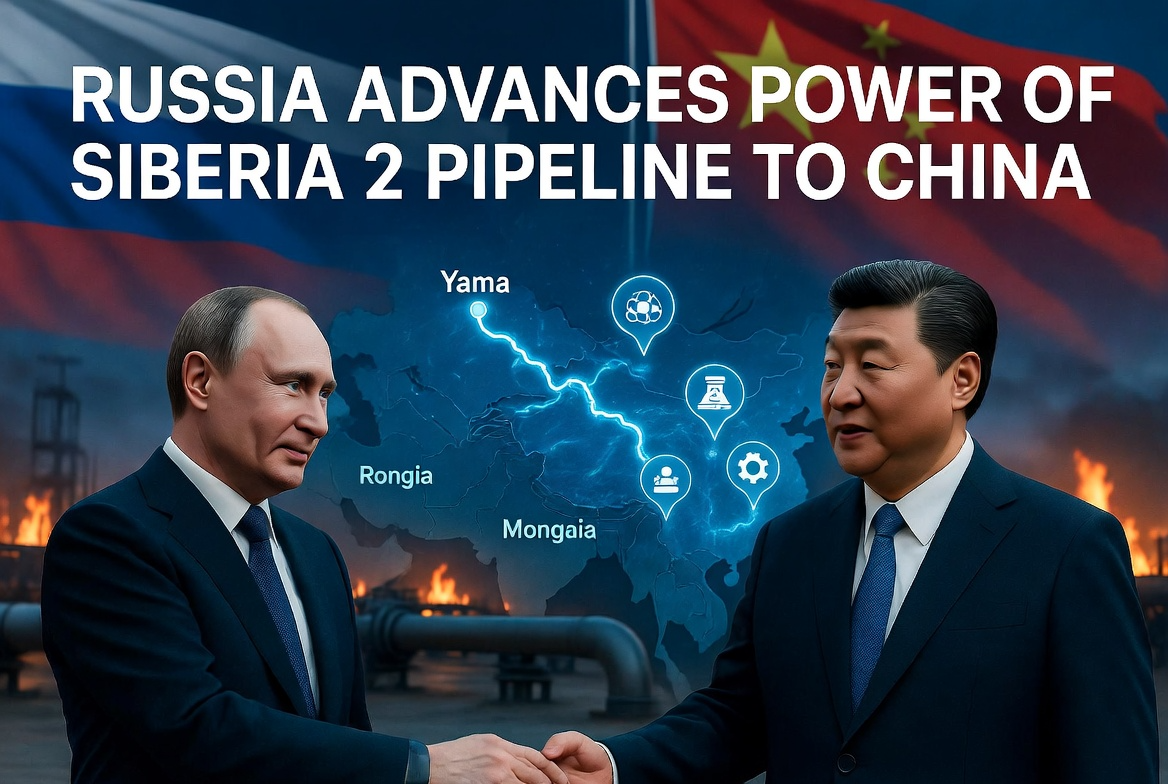
BEIJING May 20, 2026 — Russian officials announced today that progress is being made on the long-discussed Power of Siberia 2 (PoS-2) natural gas pipeline to China, as President Vladimir Putin holds talks with Chinese President Xi Jinping in Beijing.
The project, a key element of Russia’s energy pivot away from Europe, involves a roughly 2,600-kilometer (1,616-mile) pipeline designed to transport up to 50 billion cubic meters (bcm) of natural gas annually from Russia’s Yamal Peninsula fields to northern China, routing through Mongolia.
A Kremlin aide indicated that the pipeline would feature prominently in detailed discussions during Putin’s visit, his first foreign trip of 2026. Russia hopes recent energy market volatility from Middle East tensions could accelerate negotiations.
Background and Current Status
Gazprom and China’s CNPC signed a “legally binding memorandum” for the project in September 2025, outlining a potential 30-year supply deal. However, key commercial terms—including gas pricing, volumes, financing, and construction timelines—remain under negotiation.
- Power of Siberia 1, already operational, delivered around 38-39 bcm to China last year and continues to expand.
- PoS-2 would significantly boost total Russian pipeline gas exports to China, potentially exceeding 100 bcm annually when combined with other routes in the early 2030s.
Russia views the pipeline as critical for redirecting volumes previously sold to Europe, while China seeks enhanced overland energy security to reduce reliance on seaborne LNG imports.
Strategic Implications
For Russia, the deal secures a major long-term buyer amid sanctions and lost European markets. For China, it diversifies supplies and supports industrial demand in northern regions, especially amid global supply uncertainties.
Analysts note that China holds leverage in pricing talks, preferring competitive rates, while Russia pushes for terms that ensure project viability. Construction timelines, if a full contract is signed, could see first gas in the early 2030s.
The announcement comes as both nations deepen broader economic and strategic ties within frameworks like BRICS. No final contract details have been released, and observers caution that substantial hurdles in commercial negotiations persist.
This development underscores the ongoing realignment in global energy flows, with infrastructure projects strengthening Eurasian connectivity. Further updates are expected following the conclusion of the Putin-Xi meetings.
About The Author