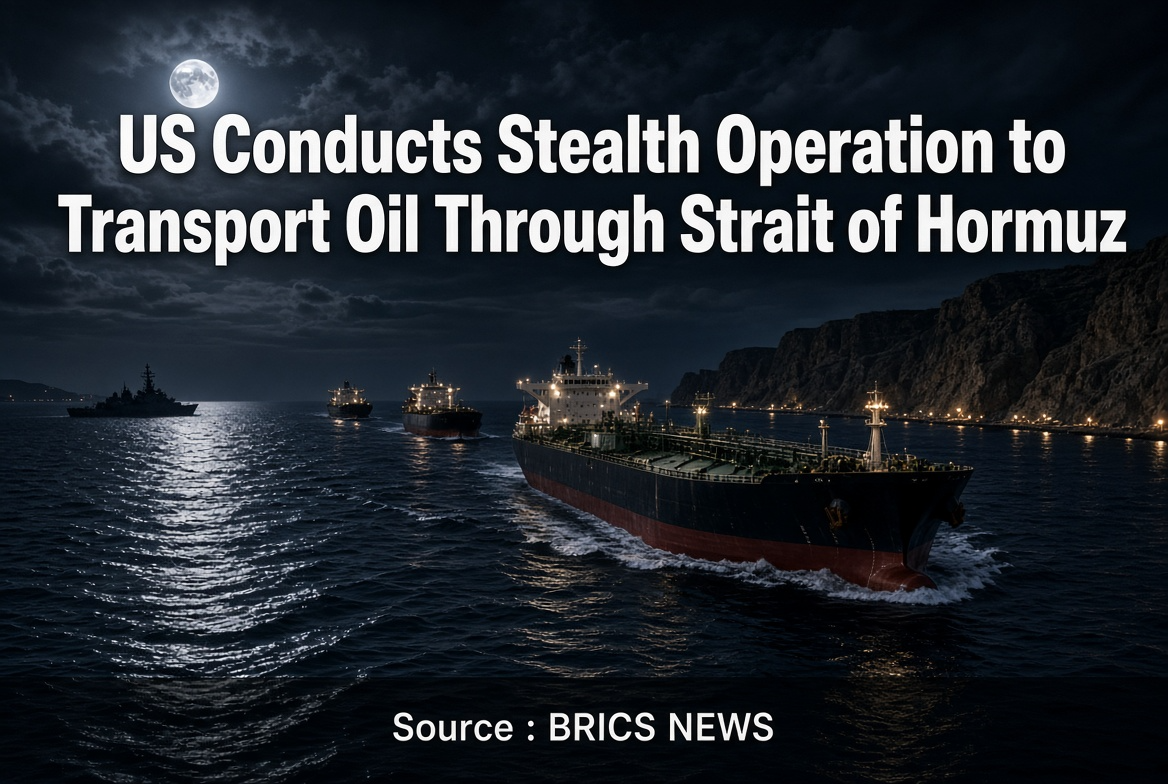
WASHINGTON D.C Aug 19, 2026 – The U.S. military is conducting a covert operation to guide oil tankers through a secure southern channel of the Strait of Hormuz along the coast of Oman, allowing millions of barrels of crude to reach global markets despite ongoing conflict with Iran, according to multiple reports citing U.S. officials.
Two U.S. officials told Axios that the operation, underway for several weeks, involves 15 to 20 tankers transiting the strait each night. Officials estimate roughly 10 million barrels of oil per day—about half the pre-war volume—are now exiting the waterway and entering international markets. On some nights, volumes have reached as high as 15–20 million barrels, with more than 20 vessels scheduled on at least one recent night.
The effort goes beyond simply escorting loaded outbound tankers. U.S. forces also facilitate empty tankers entering the Persian Gulf from the Arabian Sea so they can load oil at ports in countries including the United Arab Emirates, Kuwait, and Bahrain before returning through the same southern corridor. Ships are organized into scheduled inbound and outbound groups under U.S. military guidance, with designated time windows for night transits.
A U.S. official with direct knowledge of the mission stated: “We have been controlling the southern lane of the Strait of Hormuz for two months now. The Islamic Revolutionary Guard Corps can be a nuisance, but they don’t control the strait. We do.” The operation was enabled in part by a prior CENTCOM campaign that degraded Iranian radar and maritime surveillance systems, leaving Iran with limited monitoring capabilities through reconstructed radars and IRGC fast boats. U.S. Air Force fighters, drones, helicopters, and other assets provide protection and intercept attacks.
A separate New York Times report described the U.S. Navy’s role in shepherding tankers along routes close to Oman. It noted that tankers using the protected southern corridor carried about 5 million barrels per day in July, up from roughly 4 million in June. Analysts have described the southern corridor as a surprising success despite repeated Iranian attacks. CENTCOM has assisted more than 1,000 ships since the conflict began, according to the military. Some vessels turn off transponders to reduce detection risk.
U.S. Energy Secretary Chris Wright has cited higher daily figures closer to 9 million barrels in some assessments. Independent analysts, however, have expressed skepticism about the upper-end estimates of 10 million barrels per day, pointing to visible shipping data that more consistently supports flows in the 5–6 million range and limited public evidence of corresponding loadings or deliveries.
The corridor is coordinated by a task force operating from Army headquarters at Fort Bragg, North Carolina, working with regional Gulf partners. President Donald Trump has publicly acknowledged that significant volumes of oil are moving through the strait, stating there is “a tremendous amount of oil coming out.”
The operation has helped prevent sharper spikes in global oil prices amid the prolonged U.S.-Iran conflict, though flows remain well below the roughly 15–20 million barrels per day that typically transited the strait before hostilities. Iran continues to claim control over the waterway and has conducted attacks on shipping, some of which have damaged vessels and caused casualties. U.S. forces report intercepting multiple drones and missiles in recent days.
The reports, first detailed by Axios and corroborated by The New York Times and other outlets on August 19–20, 2026, highlight one of the more effective logistical efforts to mitigate energy disruptions in the ongoing regional conflict.
About The Author