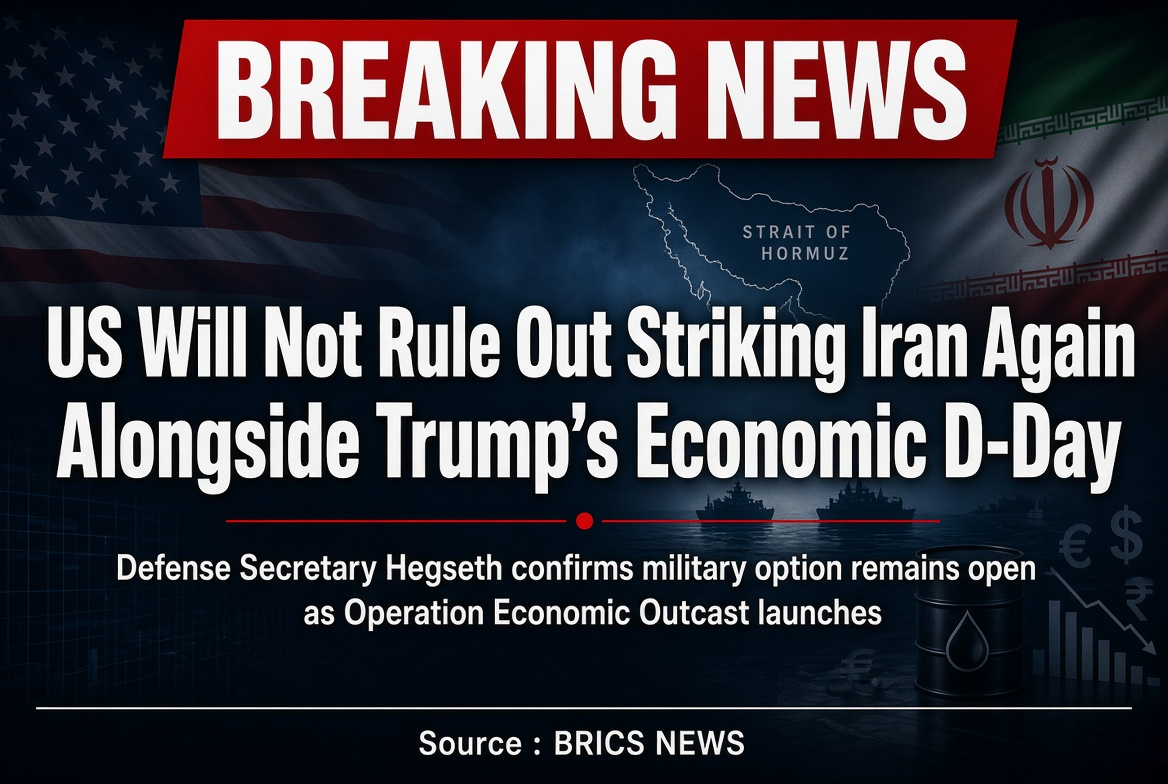
WASHINGTON D.C August 24, 2026 — The Trump administration is not ruling out further military strikes on Iran even as it launches a sweeping new campaign of economic sanctions designed to isolate the Iranian regime, U.S. officials confirmed on Monday.
Defense Secretary Pete Hegseth told reporters that the United States is “by no means” foreclosing the use of kinetic force in the Strait of Hormuz or around Iran. His comments came hours after Treasury Secretary Scott Bessent formally unveiled Operation Economic Outcast, which the administration has framed as an “economic D-Day.”
“By no means are we foreclosing using kinetic strikes anywhere in the Strait of Hormuz or around Iran,” Hegseth said, adding that Iran cannot withstand the economic pressure now being applied.
Bessent described the new operation as an unprecedented effort to sever every remaining economic lifeline sustaining the Islamic Republic. “Today, at President Trump’s direction, the United States Treasury has begun Operation Economic Outcast — an unprecedented campaign against the Islamic Republic of Iran and its enablers,” he said. “We are launching an economic onslaught against Iran’s financial connections around the globe. Our objective is to sever every economic lifeline that sustains this tyrannical regime until Tehran stands alone.”
The measures expand secondary sanctions risk for any country, company, or individual doing business with Iran. New sectoral determinations target five key areas Iran has used to generate revenue and evade earlier restrictions: digital assets, technology, gold, aviation, and shipping. The Treasury Department’s Office of Foreign Assets Control simultaneously sanctioned more than 60 entities, individuals, and vessels linked to oil smuggling, nuclear and missile procurement, cyber operations, and other regime activities.
President Trump had previewed the campaign last week, calling it the “most crushing economic operation ever taken against any country” and warning that any nation providing a “lifeline” to Iran through financial institutions, businesses, airports, or government entities would face “tremendous economic consequences.”
The dual-track approach — maximum economic pressure paired with an explicit military option — comes amid a conflict that began earlier in 2026 over freedom of navigation in the Strait of Hormuz. U.S. forces have conducted repeated strikes that American officials say have significantly degraded Iran’s military capabilities, including air defenses, naval assets, missile storage, and coastal surveillance systems. A naval blockade of Iranian ports remains in place.
Iranian officials have dismissed the new sanctions campaign. Foreign Minister Abbas Araghchi previously called Trump’s “economic D-Day” a distraction from America’s own fiscal challenges and predicted it would fail.
Bessent framed the choice facing Tehran in stark terms: complete global isolation and a subsistence economy, or a return to normalcy and reintegration into the world economy. “The clock is ticking,” he said.
The announcement marks the latest escalation in a strategy that pairs sustained military pressure with what the administration describes as the single greatest financial offensive ever marshaled against an adversary.
About The Author