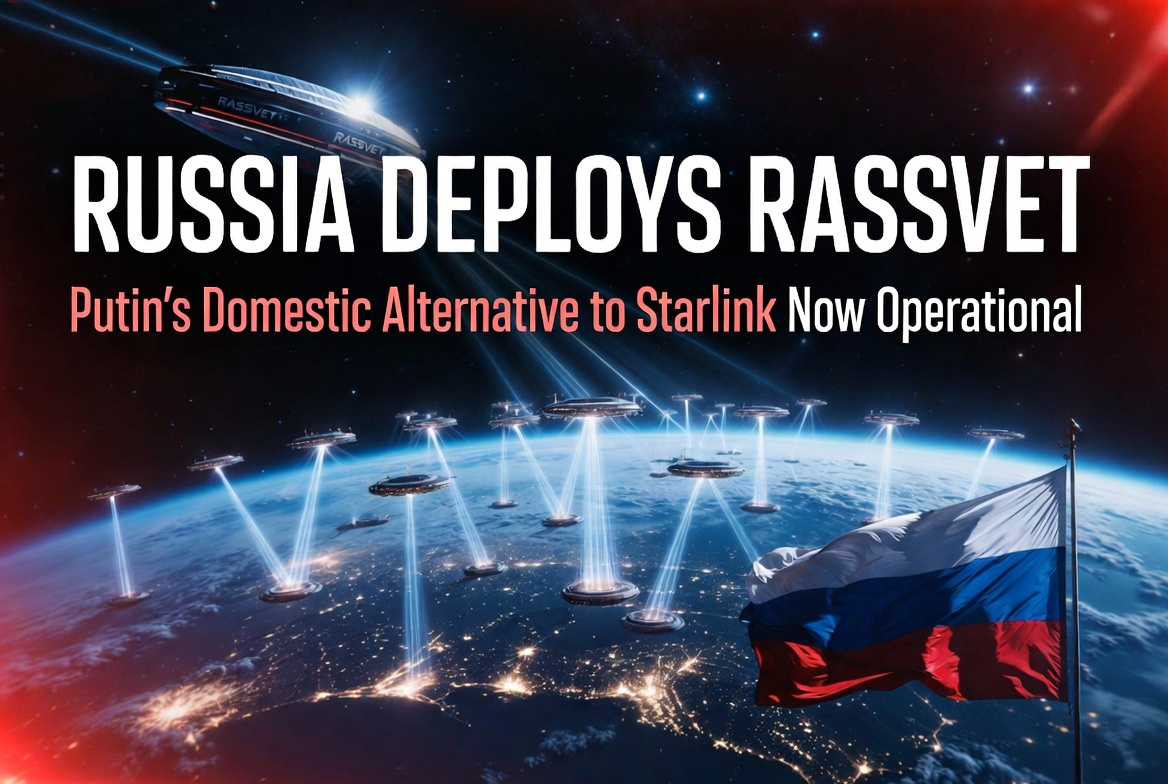
MOSCOW, June 13, 2026 — Russian President Vladimir Putin has stated that Russia now operates its own low-Earth orbit (LEO) satellite system comparable to SpaceX’s Starlink, known as the Rassvet (“Dawn”) constellation. The announcement highlights Moscow’s push for technological sovereignty amid ongoing restrictions on Western satellite services.
Developed primarily by the private Russian aerospace company Bureau 1440 (with significant state backing and an estimated total investment of around $5.7 billion), Rassvet aims to provide high-speed broadband internet across Russia’s vast territory and potentially to allied nations. The system uses 5G Non-Terrestrial Network technology and inter-satellite laser links.
- March 23, 2026: The first batch of 16 operational (“serial production”) Rassvet-3 satellites launched aboard a Soyuz-2.1b rocket from Plesetsk Cosmodrome. These joined earlier experimental prototypes (Rassvet-1 and Rassvet-2 missions in 2023–2024).
- Plans call for rapid scaling: over 250 satellites by 2027 for initial commercial operations, expanding toward 900+ by 2035.
The project gained urgency due to the Ukraine conflict. Russia previously faced limitations after losing reliable access to Starlink terminals. Rassvet is intended to support battlefield communications, drone control, and secure data links independent of Western infrastructure.
As of late May 2026, only the initial 16 satellites were operational in test mode, far short of the 200–250 needed for stable, continuous coverage. One satellite was reported lost after about 75 days in orbit, marking an early technical setback, though the company stated the remaining 15 continue functioning normally.
While Rassvet represents a significant step for Russia’s space ambitions, it remains in its early stages compared to Starlink’s thousands of operational satellites. Russian officials promise eventual speeds up to 1 Gbps and coverage for remote regions, transport (trains, aircraft), and commercial users. Full global-scale capability is still years away.
Bureau 1440 and Russian authorities frame the project as a strategic necessity for national security and economic development, reducing dependence on foreign technology.
Commercial broadband services are targeted for 2027. Success will depend on launch cadence, satellite reliability, and overcoming sanctions-related challenges in production and components. The initiative adds to the growing international competition in LEO satellite mega-constellations.
This development underscores the accelerating militarization and commercialization of space amid geopolitical tensions.
About The Author