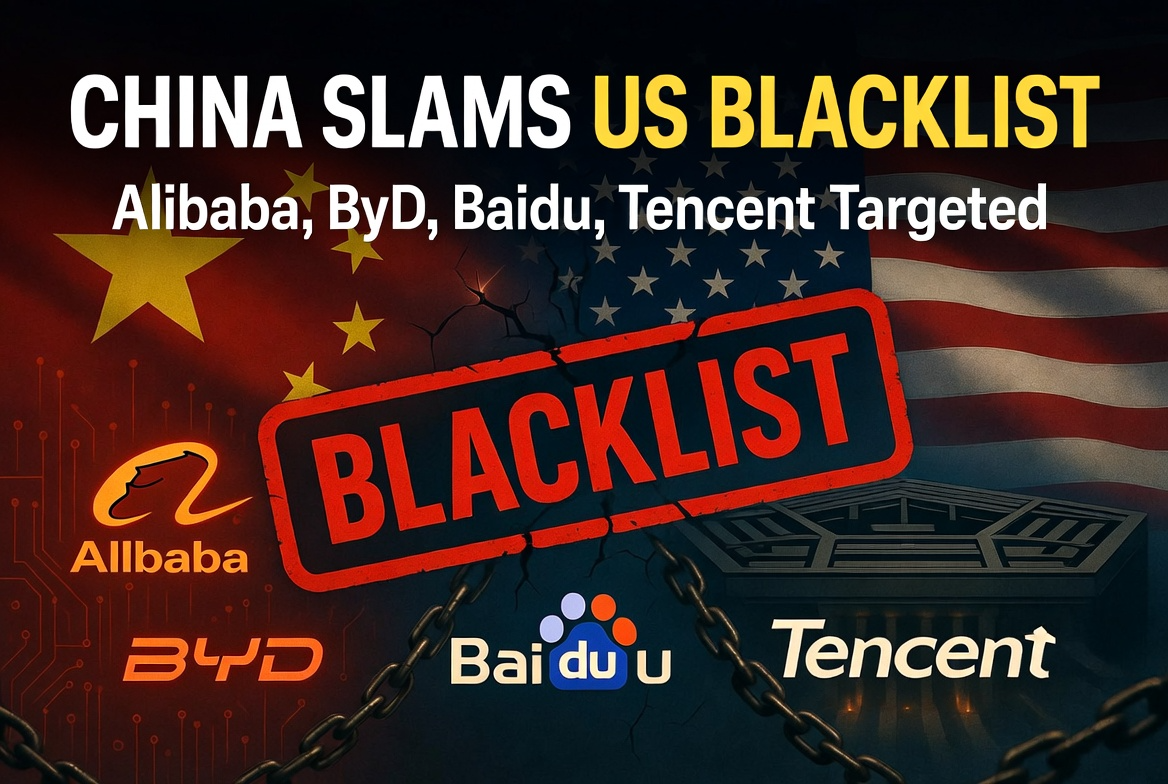
BEIJING, June 13, 2026 — China has strongly condemned the United States for adding several of its leading technology and manufacturing firms to a Pentagon blacklist, claiming the move represents an abuse of national security concerns to stifle Chinese businesses.
The criticism follows the U.S. Department of Defense’s update on June 8–9, which expanded its list of “Chinese military companies” under Section 1260H of the National Defense Authorization Act. The additions include major players such as e-commerce giant Alibaba Group, search and AI leader Baidu, electric vehicle powerhouse BYD, NIO, and others like Tencent (added earlier). The list now encompasses around 188 entities.
The Pentagon alleges these companies support China’s People’s Liberation Army through affiliations with state entities, dual-use technologies, and military-civil fusion programs. Inclusion on the list bars the firms from U.S. defense contracts and signals broader national security risks, though it does not impose full sanctions.
Chinese Foreign Ministry spokesperson Lin Jian stated that Beijing “firmly opposes” the U.S. practice of “overstretching the concept of national security, creating various discriminatory lists, and unreasonably suppressing Chinese companies.” He urged Washington to “correct its erroneous practices” and warned that China would “take necessary measures to firmly safeguard the legitimate rights and interests of Chinese companies.”
The Chinese Embassy in Washington echoed these sentiments, emphasizing that Chinese firms operating abroad strictly comply with local laws and calling for a “fair, just, and non-discriminatory environment.”
Several targeted companies have rejected the allegations. Baidu described the designation as lacking “credible justification,” while others have pushed back against what they view as unjustified targeting of commercial success in AI, EVs, and other strategic sectors.
This development adds friction to U.S.-China relations amid ongoing technological and economic rivalry, even as diplomatic engagements continue, including reported summits between the leaders. Analysts see the expanded blacklist as part of Washington’s broader effort to counter perceived risks in critical technologies.
The Pentagon’s list, which has grown significantly in recent years, now spans traditional defense firms to cutting-edge sectors like semiconductors, robotics, solar energy, and pharmaceuticals.
The situation remains fluid, with potential implications for global supply chains, investment flows, and bilateral trade.
About The Author