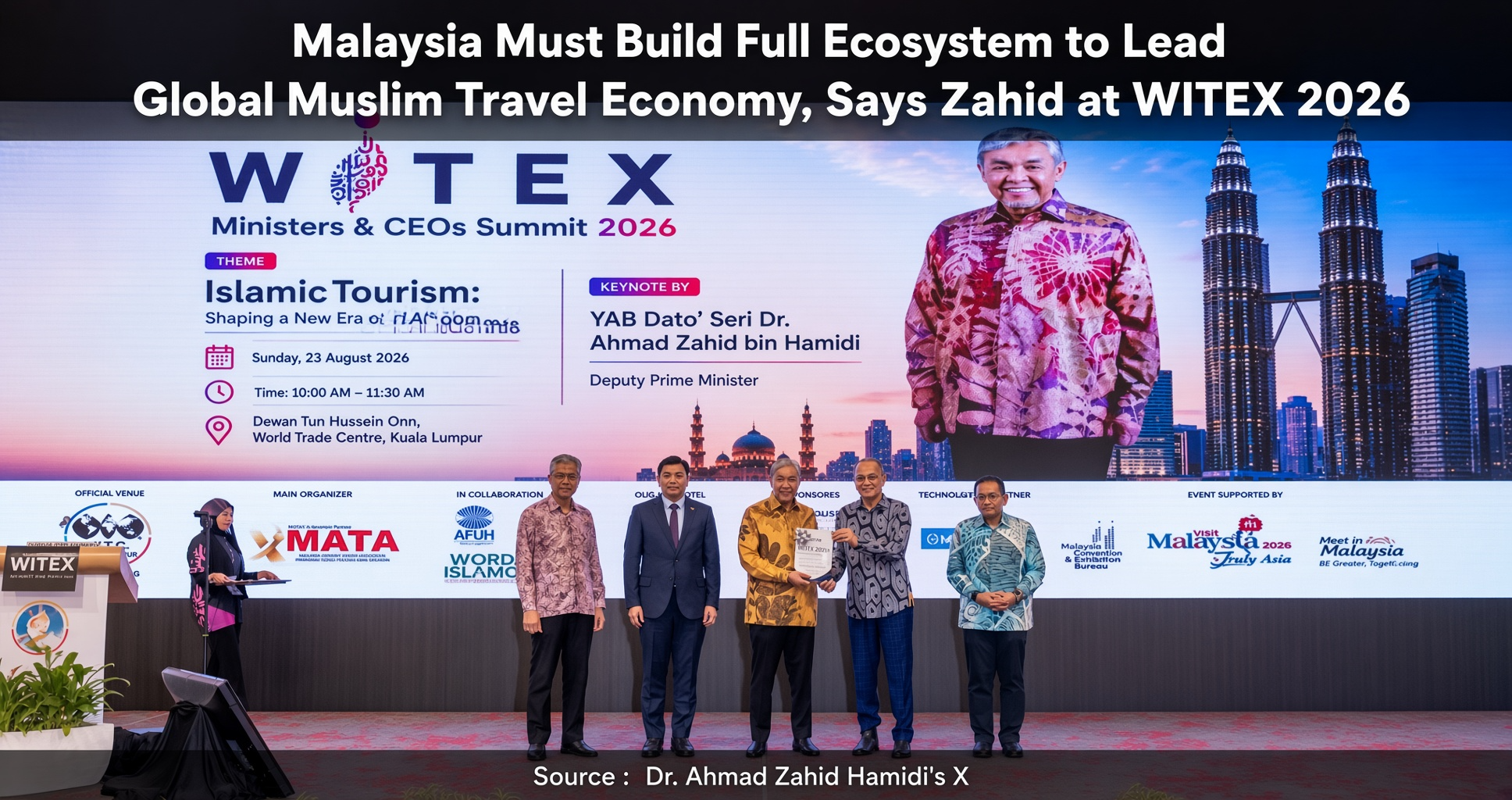
KUALA LUMPUR, Aug 23 2026 — Malaysia must go beyond its status as the world’s top Muslim-friendly destination and develop a complete ecosystem to become a global hub for the Muslim travel economy, Deputy Prime Minister Datuk Seri Dr Ahmad Zahid Hamidi said today.
Delivering the keynote address at the Ministers & CEOs Summit of the World Islamic Tourism & Trade Expo (WITEX) 2026 at the World Trade Centre Kuala Lumpur, Zahid urged stakeholders to treat every tourist visit as an opportunity to expand the halal industry, support local entrepreneurs, small and medium enterprises, and rural communities.
“Come and visit Malaysia, but more importantly, come and build with Malaysia,” he said, echoing the central message of the event.
Zahid noted that Malaysia has been recognised as the leading Muslim-friendly destination for 11 consecutive years. However, the country should not stop at rankings or visitor numbers alone. Instead, tourism must act as a catalyst for trade, economic growth, technology, and investment.
He highlighted the scale of the global opportunity: international Muslim traveller arrivals reached 196 million in 2025 and are projected to grow to 262 million by 2030, with total travel expenditure estimated at USD 310 billion. Muslim travellers increasingly seek experiences beyond halal food, prayer facilities, and accommodation — including business, wellness, culture, nature, and adventure travel.
The fourth edition of WITEX, organised by the Malaysia Tourism Agency Association (MATA), runs from August 21 to 23 and brings together government leaders, industry players, and international stakeholders in Islamic tourism, the halal sector, investment, innovation, and culture.
Zahid stressed that platforms such as WITEX will help Malaysia strengthen its position as a leader in the global Muslim tourism ecosystem, connecting tourism with trade, halal standards, technology, and investment for the wider benefit of the people.
The summit’s theme focused on shaping the future of the global Islamic tourism and trade ecosystem towards 2030, with discussions on digital tools, supply-chain integration, and regenerative destination development.
About The Author