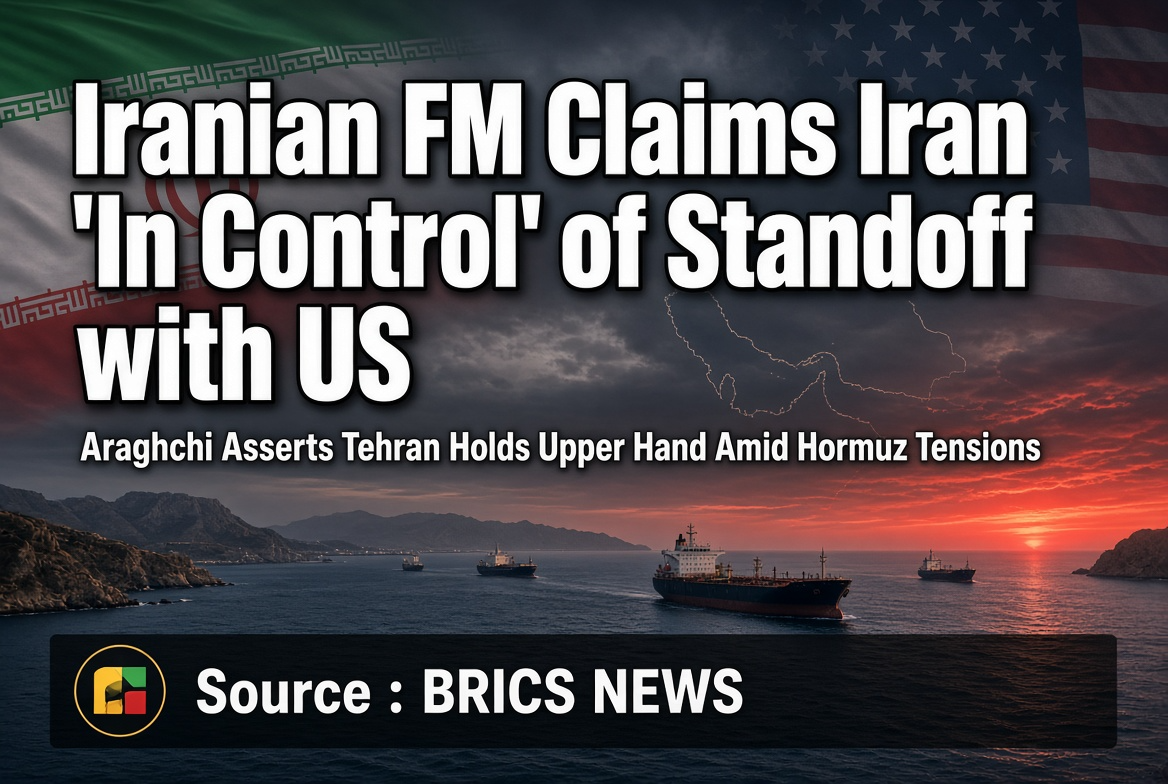
TEHRAN Aug 19, 2026 – Iranian Foreign Minister Abbas Araghchi has stated that “Iran is in control” of the situation against the United States, according to a report published Wednesday by BRICS News and widely shared on X.
The brief but assertive remark, accompanied by a portrait of Araghchi, comes amid ongoing high tensions between Tehran and Washington centered on the Strait of Hormuz—the critical waterway through which a significant portion of the world’s oil supplies normally transit.
The conflict, which began with U.S. and Israeli strikes on Iran in late February 2026, saw a temporary de-escalation under a June memorandum of understanding (MoU) and ceasefire. That arrangement quickly frayed over disagreements about control and management of the strait. Iran has asserted authority to regulate shipping routes and has targeted vessels it deems non-compliant, while the United States has enforced a naval presence it describes as a “wall of steel” or blockade and claimed full control of the waterway.
President Donald Trump has repeatedly insisted the U.S. Navy holds “100 percent” or “total control” of the Strait of Hormuz and has ruled out certain talks or extensions of interim deals. Iranian officials, including Araghchi in prior statements, have rejected those claims as miscalculations based on flawed intelligence and maintained that the strait remains under Iranian management.
Recent days have seen further friction: reports of vessels being struck in or near the strait, Iranian warnings of a shift to a more offensive posture if diplomacy stalls, and statements from Araghchi indicating that the track for direct U.S.-Iran negotiations is closed. Shipping traffic has been significantly disrupted, raising concerns about global energy markets and oil prices.
Araghchi’s latest reported comment reinforces Tehran’s public posture of confidence and resilience following months of exchanges. No immediate official response from U.S. authorities to this specific statement was available at the time of reporting. The situation remains fluid, with both sides continuing to assert competing narratives over who holds the upper hand in the strategic waterway and the broader confrontation.
About The Author