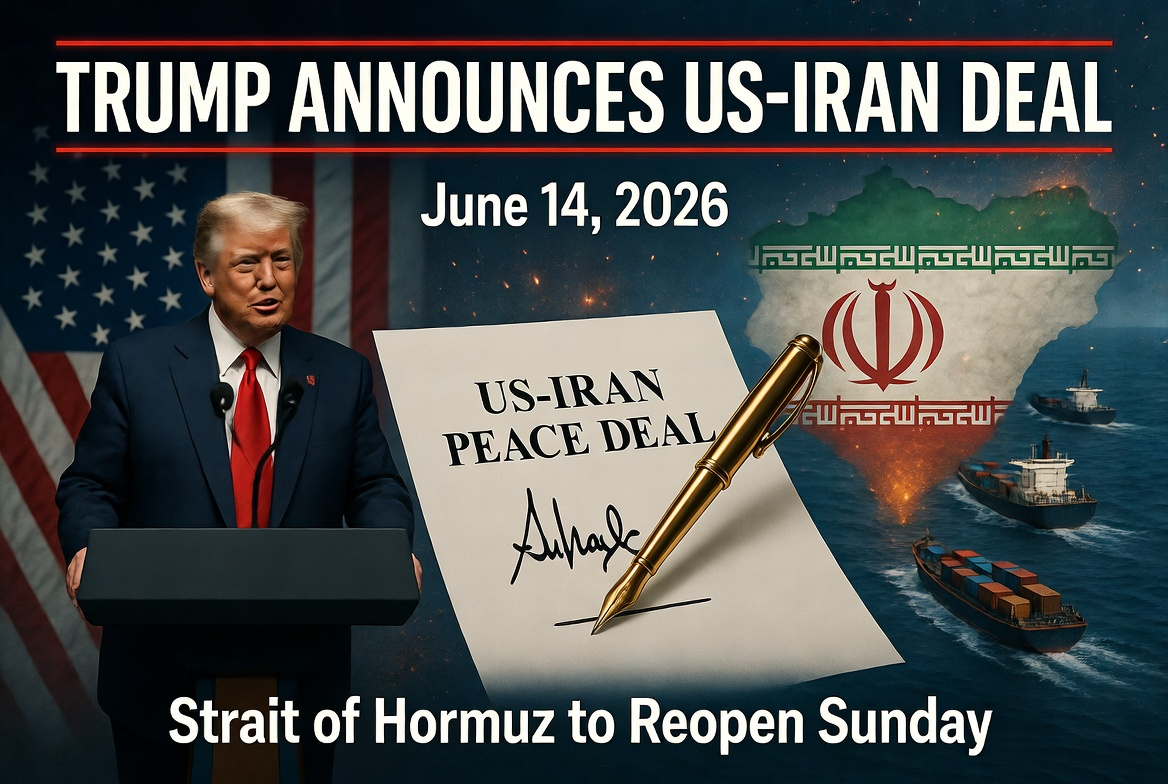
WASHINGTON D.CJune 13, 2026 — President Donald Trump announced on Truth Social that a memorandum of understanding with Iran will be signed on Sunday, June 14, reopening the Strait of Hormuz to international shipping and addressing key elements of the ongoing conflict.
In the post, Trump highlighted that Iran has agreed to forgo nuclear weapons development. He reiterated plans for the U.S. to eventually retrieve Iran’s enriched uranium stockpile — which he has repeatedly called “nuclear dust” — buried deep in fortified mountain sites. No cash payments or major sanctions relief without compliance are expected from the U.S. side.
The announcement comes amid weeks of indirect negotiations, mediated in part by Pakistan and Oman, following military escalations that included U.S. and Israeli strikes on Iranian targets and Iranian disruptions in the Strait of Hormuz, a critical chokepoint for global oil shipments.
According to U.S. officials and reports:
- The Strait of Hormuz would reopen immediately upon signing, with no tolls imposed on shipping.
- A 60-day ceasefire extension would take effect, potentially renewable.
- Nuclear issues, including the fate of Iran’s enriched uranium, would be handled in subsequent talks rather than the initial memorandum.
- Iran has claimed victory in some statements, asserting continued control over the strait in coordination with Oman.
Trump has described the framework as meeting core U.S. objectives and suggested a signing could involve Vice President JD Vance in a European venue such as Geneva.
Iranian officials have repeatedly rejected claims of an imminent signing. The Foreign Ministry stated that “nothing is finalized” and dismissed reports of a Sunday ceremony as speculative. Foreign Minister Abbas Araghchi and other voices in Tehran have emphasized that while talks have progressed, no final decision has been made.
This is not the first time Trump has signaled an imminent breakthrough. Observers note he has made similar optimistic statements multiple times since March 2026 without a finalized agreement.
Oil markets have fluctuated on the news, with traders watching for confirmation. The reopening of the Strait of Hormuz could ease global energy prices if implemented.
Regional players, including Israel and Gulf states, remain cautious. The deal does not fully resolve long-term nuclear concerns, and technical challenges around securing or destroying buried enriched uranium remain significant.
As of Saturday evening, no joint confirmation from both governments has emerged, leaving the exact timing and details of any signing uncertain. Developments are expected over the coming 24-48 hours.
About The Author