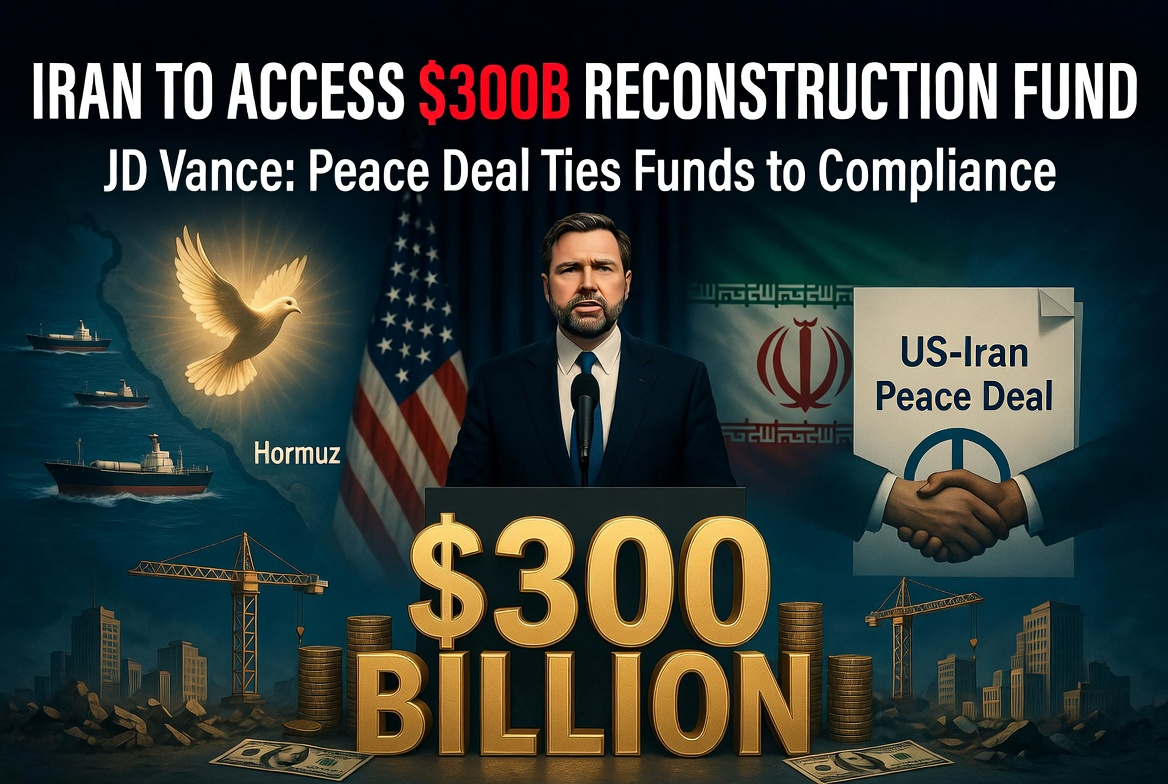
WASHINGTON, D.C. – June 15, 2026 — Vice President JD Vance stated Monday that Iran could gain access to a massive $300 billion reconstruction fund if it fully honors the terms of the newly signed US-Iran peace agreement, which ended more than four months of conflict in the Middle East.
In a CBS News interview, Vance clarified that the fund would not come from US taxpayers but would instead be financed primarily by Gulf Cooperation Council (GCC) states and private investors. He emphasized that no money would be released upfront.
“That’s the sort of thing they could have access to, funded by the Gulf Coast Coalition, so long as they honor their end of the obligation,” Vance told CBS’s Ed O’Keefe.
The comments come one day after President Donald Trump and Iranian officials digitally signed a memorandum of understanding (MoU) to formalize a ceasefire. Key elements include:
- Immediate reopening of the Strait of Hormuz to international shipping, managed jointly with Oman.
- Lifting of the US naval blockade on Iranian ports.
- A 60-day ceasefire extension covering all fronts, including Lebanon.
- Commitments on Iran’s nuclear program, including limits on uranium enrichment, disposal of highly enriched uranium stockpiles, and enhanced IAEA inspections.
- Phased sanctions relief and potential release of frozen Iranian assets, all tied to verifiable performance.
Administration officials stressed that the $300 billion fund is performance-based and contingent on Iran dismantling aspects of its nuclear program and ceasing support for regional proxies. No direct US payments are involved.
Iranian sources have portrayed the deal more favorably, claiming access to reconstruction funds and asset releases as significant wins. However, US officials pushed back against narratives of direct cash transfers or unconditional payouts.
The four-month war disrupted global energy markets and raised fears of broader regional escalation. The deal has been hailed by Trump administration supporters as “peace through strength,” while critics question whether Iran will comply long-term.
Social media reactions were sharply divided. Some users mocked the arrangement as Iran “winning” despite military setbacks, while others noted that Gulf-funded investment — conditional on good behavior — represents leverage rather than a giveaway.
A senior Trump administration official told reporters: “We already signed the deal digitally yesterday, and there’s been no money released. And that won’t change. You’ll see in the MOU… all of these things are going to be tied to performance.”
Full details of the memorandum are expected to be released in the coming days. Further negotiations on Iran’s nuclear program and long-term sanctions are anticipated during the 60-day window.
This breakthrough marks a significant de-escalation after months of intense fighting that began earlier in 2026. Markets are expected to react positively to the reopening of the Strait of Hormuz, a critical chokepoint for global oil shipments.
About The Author