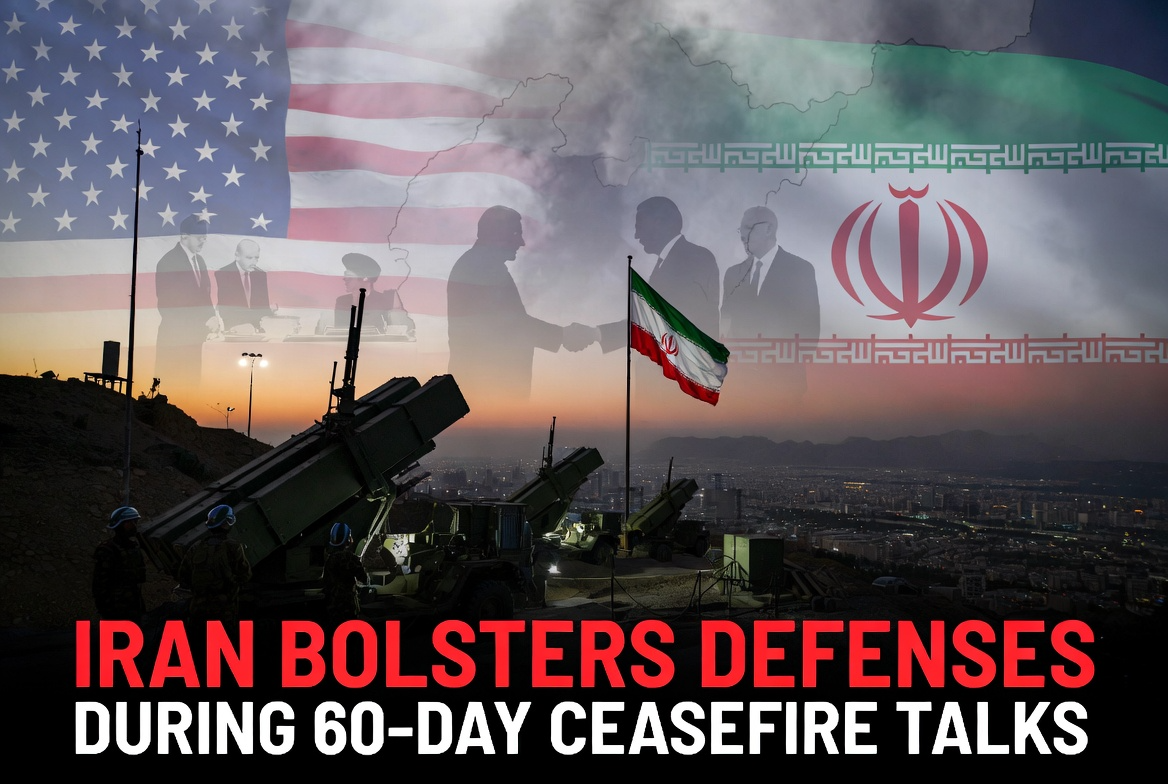
TEHRAN June 15, 2026 — Iran has stated it will strengthen its defenses throughout the upcoming 60-day ceasefire negotiation period with the United States, signaling deep distrust amid fragile truce talks aimed at ending months of conflict.
The announcement comes shortly after the US and Iran reached a framework agreement for a 60-day ceasefire. Key elements include reopening the Strait of Hormuz to commercial shipping, lifting the US naval blockade on Iranian ports, and initiating technical negotiations on Iran’s nuclear program, including its stockpile of highly enriched uranium.
A memorandum of understanding is scheduled to be signed on June 19 in Geneva, Switzerland. In exchange for compliance, Iran could receive phased sanctions relief and access to frozen assets, though major economic incentives remain tied to a final comprehensive deal.
Iranian officials framed the defensive measures as a necessary precaution. “Khamenei does not trust and must never trust Trump and Netanyahu,” one response to the announcement reflected widespread sentiment in Iranian circles. Analysts note that US-Israeli strikes earlier in the war significantly degraded Iran’s military and naval capabilities, leaving Tehran wary of potential violations.
The 2026 Iran war erupted on February 28 with massive US-Israeli airstrikes targeting Iranian military sites, nuclear facilities, and leadership. The conflict disrupted global oil flows after Iran restricted access through the Strait of Hormuz — a chokepoint carrying about one-fifth of the world’s oil and gas trade — causing energy market volatility.
Previous short-term ceasefires, including a two-week pause in April mediated by Pakistan, broke down amid tit-for-tat strikes. The current framework aims to de-escalate by restoring pre-war shipping conditions in the strait within about 30 days.
Israel has voiced strong opposition. Prime Minister Benjamin Netanyahu reportedly vowed that Iran would never acquire nuclear weapons “with or without an agreement,” emphasizing that recent strikes delayed Tehran’s program by years.
Experts remain skeptical about the deal’s durability. “Both sides have burned through weapons,” one analysis noted, highlighting vulnerabilities for all parties. Iran retains influence through regional proxies, while unresolved issues like its ballistic missile program and support for groups in Lebanon and elsewhere were sidelined in the initial framework.
Markets reacted positively to the ceasefire news, with oil prices easing and global stocks rising on hopes of stabilized energy flows. However, analysts warn that any perceived lack of commitment — such as Iran’s defensive buildup — could complicate talks or trigger reciprocal actions.
The next 60 days will test whether this fragile truce can lead to a lasting peace or merely serve as a pause before renewed tensions. Both Washington and Tehran are now engaged in a high-stakes narrative battle to shape perceptions of the agreement.
About The Author