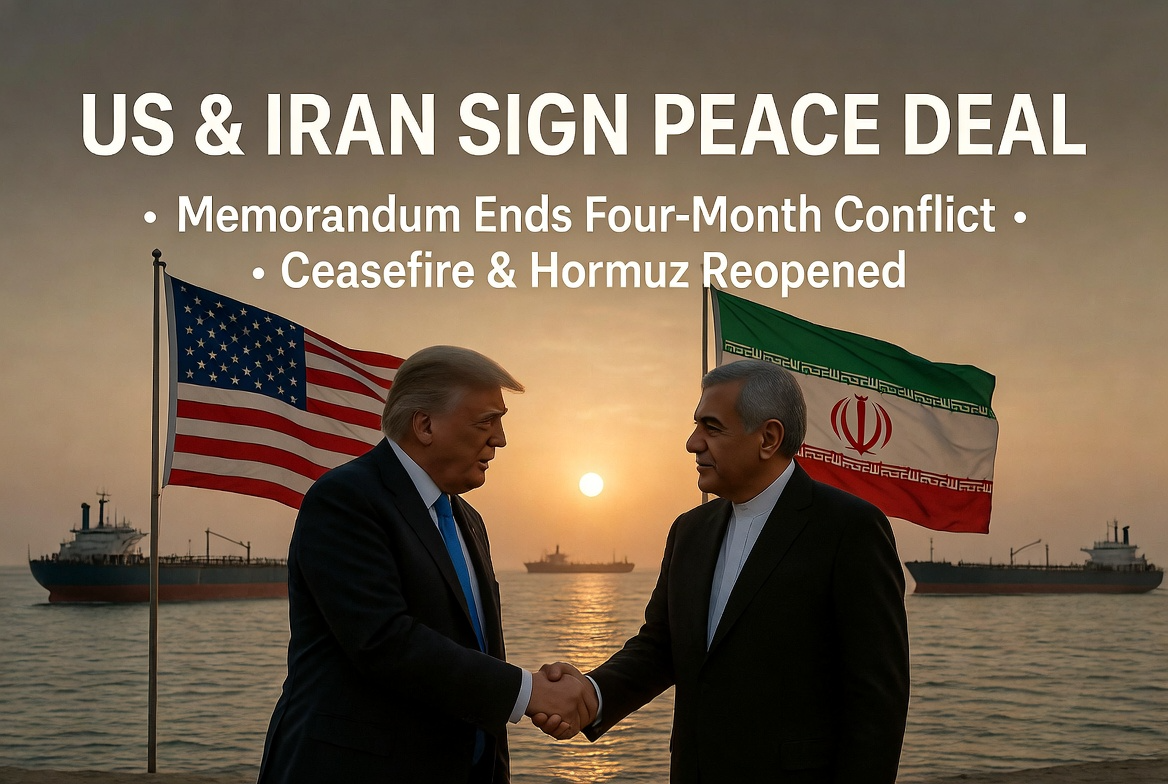
WASHINGTON D.C June 15, 2026 — President Donald Trump, Vice President JD Vance, and Iranian Parliament Speaker Mohammad Bagher Ghalibaf have electronically signed a Memorandum of Understanding (MoU) aimed at ending nearly four months of direct US-Iran hostilities that began on February 28, 2026, according to senior US officials and multiple international reports.
The agreement, described as a non-binding framework rather than a full treaty, extends an existing ceasefire for 60 days and sets the stage for detailed negotiations on Iran’s nuclear program, sanctions relief, and regional security issues. A formal in-person signing ceremony is scheduled for Friday in Geneva, Switzerland, with US officials indicating Vice President Vance is expected to attend.
Key Provisions
- Immediate Ceasefire and Blockade Lift: The deal calls for an immediate and permanent end to military operations across all fronts, including Lebanon. The US will lift its naval blockade of Iranian ports.
- Strait of Hormuz Reopening: Iran has committed to reopening the critical waterway to commercial traffic (initially toll-free for the 60-day period), with traffic expected to ramp up gradually. US officials anticipate a significant increase in shipping within days to two weeks, though full normalization may take longer.
- Nuclear Talks: The 60-day window will focus on Iran’s nuclear program, including commitments to forgo nuclear weapons, address enriched uranium stockpiles, and potential IAEA oversight. Details remain subject to further negotiation.
- Sanctions and Economic Relief: The US has emphasized a “pay-for-performance” approach. No immediate cash payments or full sanctions relief will occur; any unfreezing of Iranian assets or easing of sanctions will be tied to verified compliance. Iranian state media claims have differed on timelines and amounts (e.g., references to $24 billion in frozen funds), but US officials have pushed back on those characterizations.
The full text of the MoU is expected to be released publicly within the next 24-48 hours.
Trump hailed the development on social media, authorizing the reopening of the Strait and declaring, “Let the oil flow!” Markets reacted positively, with stocks rising and oil prices falling on expectations of restored energy flows.
Israeli officials have expressed strong reservations, stating Israel is not bound by the agreement and will continue operations against threats like Hezbollah. Domestic US critics have questioned the deal’s enforceability and potential concessions.
Iranian officials, via mediators and state channels, described the MoU as a step toward ending the war while preserving key national interests. Pakistani and Qatari mediators played significant roles in brokering the framework.
The conflict, which escalated into direct US-Iran clashes following initial Israeli strikes, disrupted global oil shipping through the Strait of Hormuz — a chokepoint for about 20% of world oil trade — and raised broader regional tensions. This MoU represents a de-escalation but leaves many core disputes unresolved for the upcoming talks.
US officials stressed that the military posture in the region remains unchanged during the 60-day period, with warnings that failure to reach a comprehensive deal could lead to renewed action. Both sides have acknowledged deep distrust but expressed hope that the framework provides a path forward.
This story is developing. Details may evolve as the full MoU text is released and negotiations progress.
About The Author