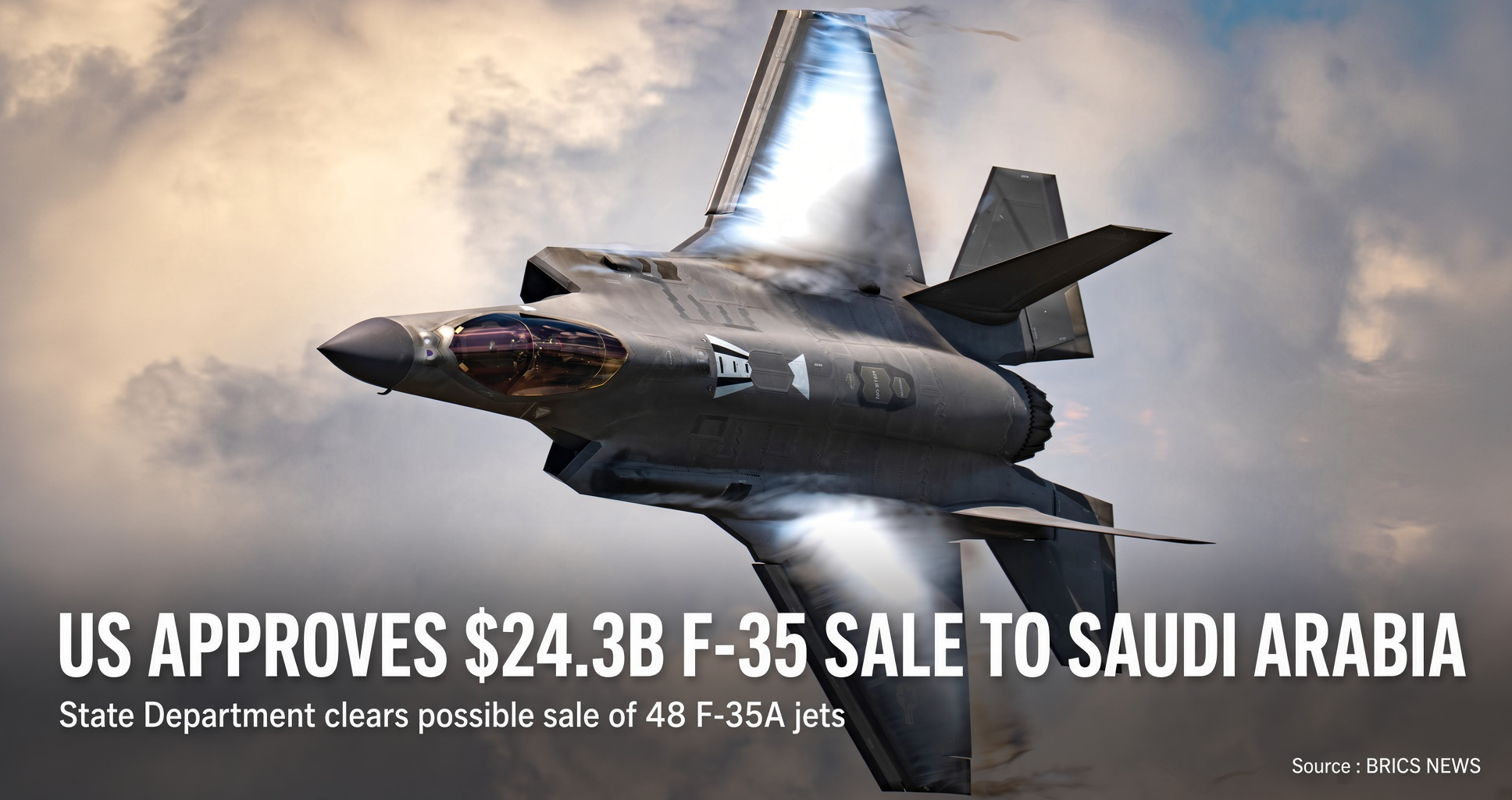
WASHINGTON D.C Sept 17, 2026 — The U.S. State Department on Thursday notified Congress that it has approved a possible foreign military sale of 48 F-35A Lightning II stealth fighters and related equipment to Saudi Arabia, valued at an estimated $24.3 billion.
The package covers 48 conventional takeoff and landing F-35As and 49 Pratt & Whitney F135-PW-100 engines — 48 installed and one spare — plus secure communications, cryptographic gear, electronic-warfare support, simulators, spare parts, training, and logistics. Lockheed Martin Aeronautics in Fort Worth, Texas, and Pratt & Whitney Military Engines in East Hartford, Connecticut, are listed as the principal contractors.
The notification, Transmittal No. 26-69, is not a signed contract. It starts a 30-day congressional review under the Arms Export Control Act. Lawmakers can still try to block the deal with a joint resolution of disapproval, though a presidential veto would be difficult to override.
Washington said the sale would strengthen a major non-NATO ally, improve Saudi homeland defense, and increase interoperability with U.S., regional, and NATO forces. The State Department also stated that the transfer “will not alter the military balance in the region” and that Riyadh can absorb the aircraft without difficulty. No extra U.S. government or contractor personnel would be required in the kingdom, and the department said U.S. readiness would not be harmed.
The move fulfills a commitment first signaled by President Donald Trump in November 2025, around Crown Prince Mohammed bin Salman’s visit to Washington and a broader U.S.–Saudi defense package. Saudi Arabia has sought the fifth-generation jet for years to modernize the Royal Saudi Air Force and deter regional threats, particularly from Iran. If completed, the kingdom would become the first Arab operator of the F-35 and only the second in the Middle East after Israel.
The sale remains politically sensitive. U.S. policy requires that Israel keep a qualitative military edge. Reuters and others noted that transferring stealth fighters to Riyadh tests that standard, even as the administration insists the regional balance would be unchanged. U.S. intelligence officials have also warned that China could try to exploit Saudi facilities, Chinese telecom infrastructure, or security partnerships to gain access to F-35 technology. A Defense Intelligence Agency assessment circulating before the notification flagged those risks.
Deliveries, configuration limits, and any offsets have not been finalized. The State Department said it is not aware of an offset agreement at this stage; any such deal would be negotiated between Saudi Arabia and the contractors. No timeline for first aircraft was included in the public notice.
For now, the announcement is a major policy step rather than a completed purchase: Congress has 30 days to object, and contract talks would follow only if the notification stands.
About The Author