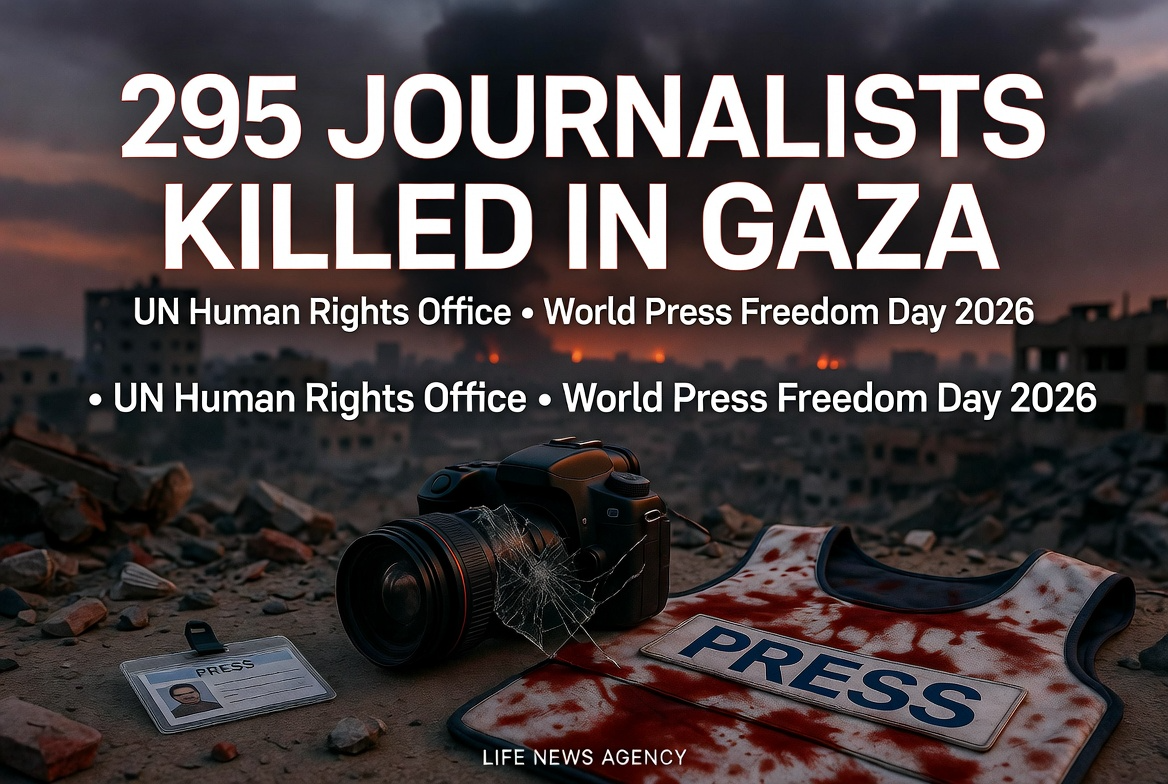
GAZA May 3, 2026 – The United Nations Human Rights Office in the Occupied Palestinian Territory (OHCHR Palestine) marked World Press Freedom Day by releasing a video statement claiming it has “verified the deaths of 295 journalists in Israeli attacks in Gaza” since October 2023. The office described Gaza as “the deadliest place in the world for journalists” and urged global action “beyond words of condemnation and solidarity” to ensure accountability, protect journalists, and allow independent access for international media.
In the post on X (formerly Twitter), OHCHR Palestine public information officer Yusra Jamous stated:
“This is the deadliest place in the world for journalists. At the UN Human Rights Office here, we have verified the deaths of 295 journalists in Israeli attacks in Gaza. And we call the world to action beyond words of condemnation and solidarity. To ensure accountability. To protect journalists. To allow independent access for international media.”
#WorldPressFreedomDay
The claim comes amid ongoing scrutiny of casualty figures in the Israel-Hamas war. While OHCHR has progressively raised its verified toll—from around 211 in May 2025 to higher estimates in later reports—independent journalism watchdogs report lower but still historically high numbers. The Committee to Protect Journalists (CPJ), which uses rigorous verification standards, documented at least 205 Palestinian journalists and media workers killed in Gaza by Israeli forces as of late April 2026, with a global total of 258 journalists killed by Israel across the conflict (including operations in Lebanon, Yemen, and Iran). Other groups like the International Federation of Journalists (IFJ) and Reporters Without Borders (RSF) cite figures ranging from 220 to 262 Palestinian media workers killed since October 7, 2023.
Discrepancies and Context Spark Debate
Critics of the UN figures point to a lack of full transparency in verification methods and note that OHCHR relies heavily on local Palestinian sources in Hamas-controlled Gaza. Multiple investigations by Israeli authorities, independent researchers, and media outlets have identified dozens of the deceased “journalists” as active members or affiliates of Hamas, Palestinian Islamic Jihad, or other militant groups. Some wore press vests while participating in combat or operating from dual-use media infrastructure tied to terrorist operations.
Israel maintains it does not target journalists as such and investigates incidents involving civilian casualties. The Israeli Defense Forces (IDF) state that strikes are directed at legitimate military targets, including Hamas command centers, rocket launchers, and fighters embedded in civilian areas. Hamas has a documented history of using media facilities, hospitals, and civilian infrastructure for military purposes, complicating the battlefield environment. International journalists have been barred from freely entering Gaza for security reasons, leaving local reporters—who often work for outlets aligned with Hamas—as primary sources.
The UN has not released a detailed public list of the 295 names with independent corroboration of their journalist status or circumstances of death. In contrast, CPJ and other NGOs emphasize that even confirmed journalists are protected civilians under international law unless they directly participate in hostilities.
Broader War Context
The Israel-Hamas war began with Hamas’s October 7, 2023, attack that killed approximately 1,200 Israelis (mostly civilians) and took over 250 hostages. Since then, the conflict has resulted in tens of thousands of Palestinian deaths, according to Hamas-run health authorities, with Israel reporting the elimination of over 20,000 Hamas and Islamic Jihad fighters.
On World Press Freedom Day, the OHCHR statement echoes longstanding UN criticism of Israel while drawing accusations of institutional bias. Pro-Israel voices on X highlighted examples of Hamas intimidation of journalists and the group’s control over information flow in Gaza, arguing the high death toll reflects the dangers of reporting from an active war zone where militants blend with civilians rather than deliberate targeting.
Life News Agency will continue monitoring developments and calls for fully independent, transparent investigations into all journalist deaths to separate legitimate press casualties from combatants exploiting media credentials.
About The Author