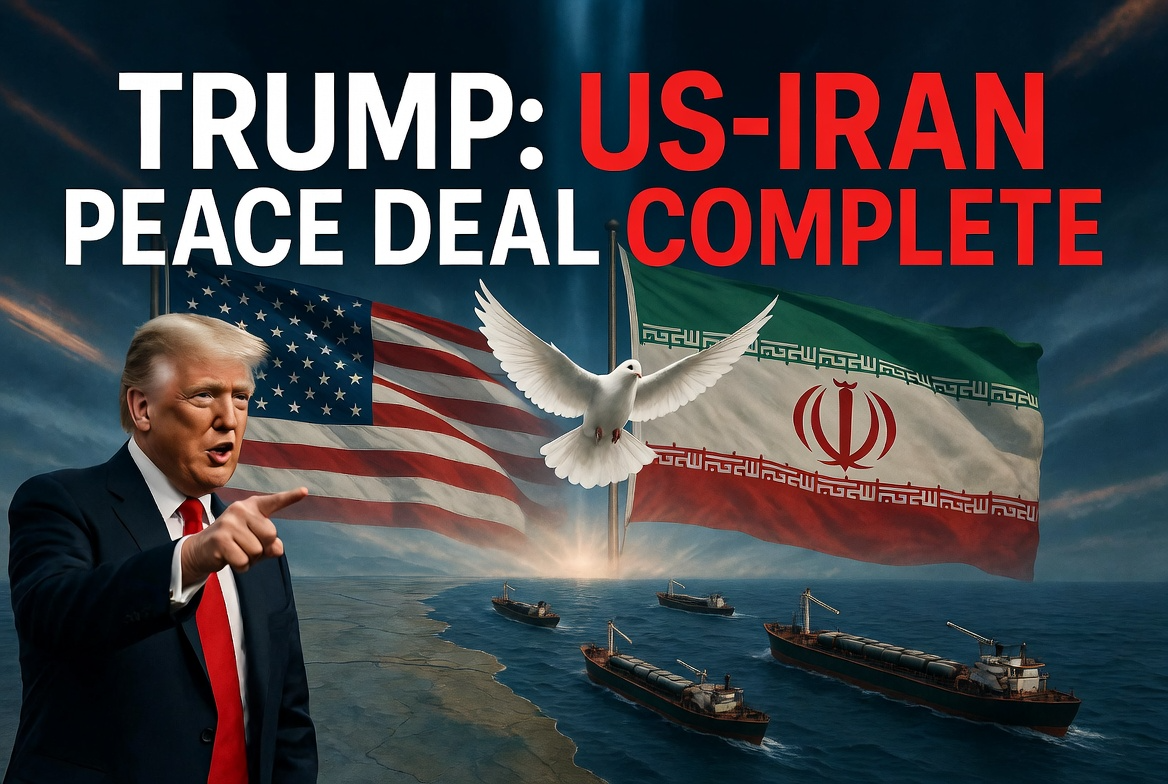
WASHINGTON D.C. June 14, 2026 — U.S. President Donald Trump declared on Sunday that a peace agreement with Iran is “now complete,” marking a potential end to months of conflict that began with U.S. and Israeli strikes on Iranian targets earlier this year.
In a post on Truth Social, Trump stated: “The Deal with the Islamic Republic of Iran is now complete.” He authorized the immediate toll-free reopening of the Strait of Hormuz and the lifting of the U.S. naval blockade on Iranian ports, urging global shipping to resume: “Ships of the World, start your engines. Let the oil flow!”
The announcement follows mediation efforts led in part by Pakistan. Pakistani Prime Minister Shehbaz Sharif confirmed that the “final text” of the peace deal has been agreed upon, with a formal signing ceremony scheduled for Friday, June 19, in Switzerland. The agreement includes the “immediate and permanent termination of military operations on all fronts,” including in Lebanon.
Key Elements of the Reported Deal
- Ceasefire Extension: A 60-day extension of the current ceasefire, during which broader negotiations on Iran’s nuclear program would take place.
- Strait of Hormuz: Full reopening without tolls, allowing the critical waterway — which carries about 20% of global oil — to resume normal operations. Iran had mined parts of the strait during the conflict.
- Nuclear Commitments: Iran is expected to commit indefinitely against developing or procuring nuclear weapons, with U.S. verification measures.
- Sanctions and Blockade: Potential easing of sanctions and removal of the U.S. naval blockade; no immediate cash payments to Iran.
- Regional Scope: Halt to operations involving Lebanon, though Israel has expressed reservations about certain terms.
Oil prices dropped sharply on the news, with crude falling over 4% toward $90 per barrel amid expectations of restored energy flows.
Leaders from Germany, the UK, France, Italy, and Qatar have welcomed the breakthrough. However, reactions remain mixed. Iranian state media has urged caution, noting that while the text is finalized, Tehran has not yet made a final public confirmation on all timing details. Some online observers and critics recall Trump’s repeated earlier claims of an imminent deal (at least 38 times since March), tempering optimism until the signing occurs.
The conflict escalated in early 2026 following U.S.-Israeli strikes on Iranian facilities, prompting Iran to close the Strait of Hormuz and triggering a naval blockade. A temporary ceasefire was announced in April, but negotiations dragged on amid high tensions, economic disruption, and significant military losses on multiple sides.
This latest development represents the most significant diplomatic progress since the war began. Analysts note that while the framework offers a path to de-escalation, implementation challenges — particularly around nuclear verification, regional proxies, and enforcement — remain.
Further details are expected in the coming days as both sides prepare for the Switzerland signing. Markets and global energy supplies will be closely watching for confirmation that the Strait of Hormuz is fully operational once more.
About The Author