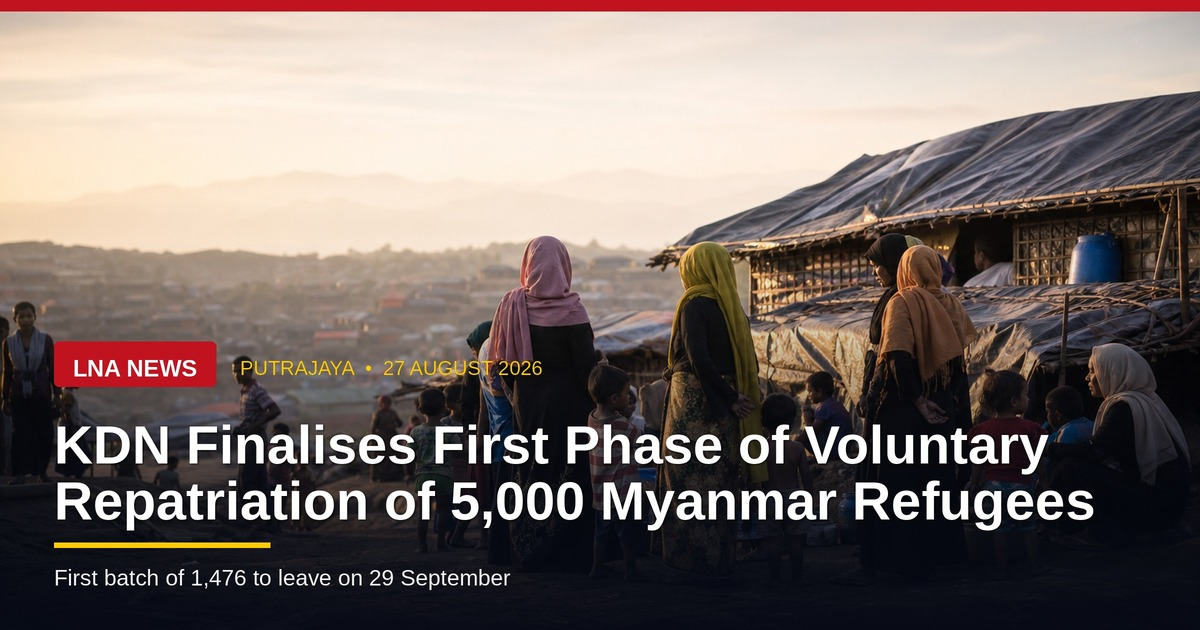
PUTRAJAYA August 27, 2026 — The Ministry of Home Affairs (KDN) has finalised the first phase of a voluntary repatriation programme for 5,000 eligible Myanmar refugees, with the first batch of 1,476 people scheduled to leave on 29 September 2026.
In a statement issued in Putrajaya, KDN said the MADANI Government would carry out the programme safely, responsibly and according to procedures agreed with the Government of Myanmar.
The 1,476 Myanmar nationals were identified by the Government of the Republic of the Union of Myanmar through Diplomatic Note No. 649/47 01(2026) dated 13 August 2026. The 29 September date was agreed at a coordination meeting involving KDN, the Ministry of Foreign Affairs, the National Security Council and the Ministry of Defence, after taking into account logistics and coordination requirements, compared with Myanmar’s original proposed date of 28 August 2026.
The repatriation will be carried out using two warships and one hospital ship belonging to the Myanmar Navy.
For 2026, KDN said 4,008 individuals, mainly of Rohingya ethnicity, will be channelled into the Refugee Registration Document (Dokumen Pendaftaran Pelarian — DPP) programme, while 5,000 others will undergo staged voluntary repatriation to Myanmar as agreed with the Myanmar government.
As of 15 August 2026, there were 10,388 Myanmar nationals in immigration detention depots. KDN stressed that the figure covers all detained Myanmar nationals and must not be treated as the number of refugees.
The Immigration Department of Malaysia, together with the Royal Malaysia Police, is carrying out the DPP process to verify identity, citizenship, immigration status, refugee claims and the security background of each individual. Registration of this group is expected to be completed in the fourth quarter of 2026.
Two-Pronged Strategy
KDN said the government’s strategy has two complementary tracks. The first is diplomatic negotiations with Myanmar to ensure the staged, orderly and responsible take-back of its nationals. The second is the registration and data collection of individuals claiming to be refugees or asylum seekers through the DPP programme, to give the government complete and accurate information for monitoring, enforcement and long-term solutions, including repatriation when conditions allow.
The ministry said both tracks must proceed together. Repatriation requires accurate, up-to-date data, while DPP registration must be backed by a clear end-state so that it is not merely a registration exercise.
The DPP programme will next be expanded to all undocumented migrants outside immigration depots, including UNHCR card holders and individuals claiming refugee status. Registration will be mandatory so that the government can obtain complete biometric and personal data for monitoring, control and enforcement in the interest of national security.
Those who meet the criteria and complete DPP registration will be issued a DPP card allowing them to remain temporarily, subject to conditions, controls and monitoring set by the government. KDN will continue to identify individuals who are eligible and willing to return voluntarily, while the Ministry of Foreign Affairs will coordinate the repatriation with Myanmar or other countries involved, in stages.
More than 95 per cent of refugees in Malaysia are from Myanmar, including the Rohingya, Chin, Karen and Mon communities. KDN said a solution therefore cannot be pursued unilaterally, and the MADANI Government would continue direct diplomatic talks with Myanmar to ensure the process is orderly, dignified and agreed by both countries.
The ministry said the presence of refugees, whether registered with UNHCR or not, had been left unresolved for decades by previous administrations, becoming a major financial burden, a serious social problem and a real security threat. The MADANI Government, it said, was taking a firm and responsible step to end this legacy problem.
Malaysia is not a party to the 1951 Convention Relating to the Status of Refugees or the 1967 Protocol. KDN said the DPP programme must not be interpreted as Malaysia’s recognition of, or accession to, those instruments.
“The implementation of the DPP instead reflects the MADANI Government’s Ihsan approach in addressing the refugee and asylum-seeker issue in an orderly, humane manner, consistent with the law, national interest and sovereignty,” the statement said.
KDN described the DPP as a multi-pronged mechanism to protect the country from an undocumented demographic crisis, strengthen security through accurate biometric data, reduce space for a shadow economy, and ensure the welfare and interests of Malaysians remain the priority.
“The MADANI Government is firm that this issue must be addressed comprehensively, prudently and humanely, and at the same time firmly, transparently and in accordance with the law, in the interest of national security, sovereignty and the Malaysian people,” the statement said.
About The Author