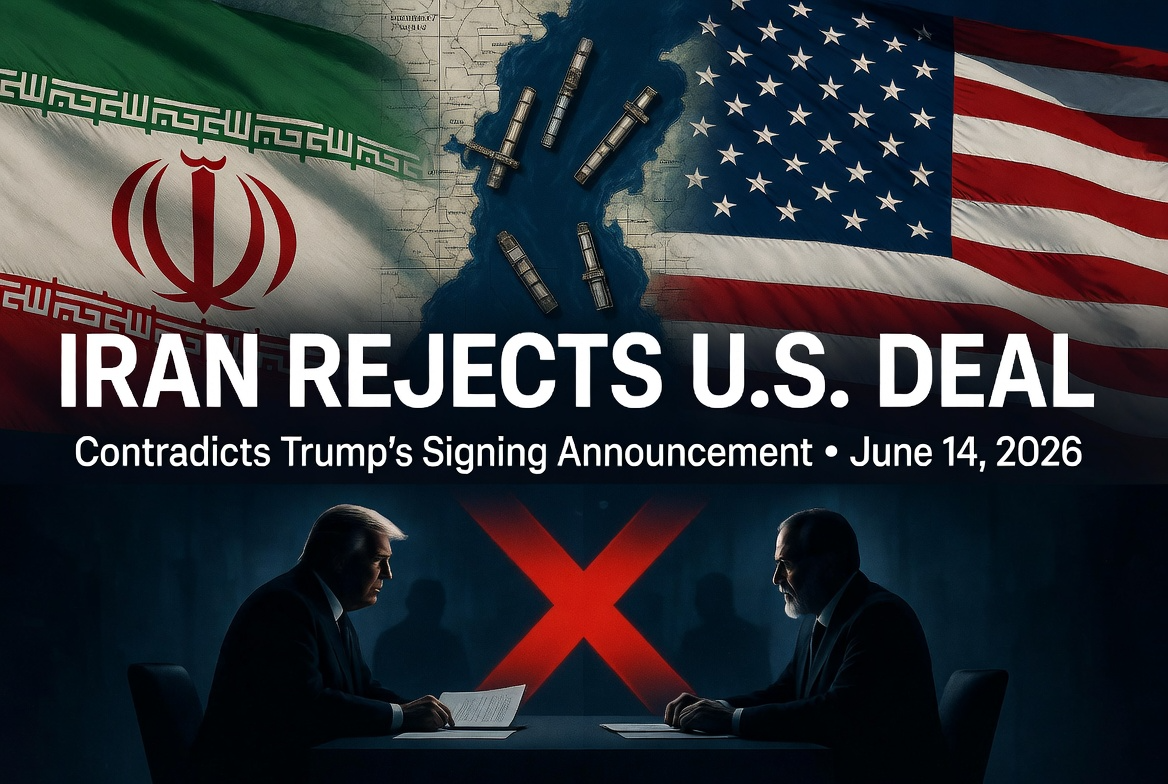
TEHRAN, June 14, 2026 — Iran’s Foreign Ministry has firmly stated that no agreement with the United States will be signed today, pushing back against President Donald Trump’s claim that a memorandum of understanding to pause the conflict and reopen the Strait of Hormuz was set for immediate finalization.
Iranian Foreign Ministry spokesperson Esmaeil Baghaei told state media that while talks have made progress, the exact timing of any signing remains undecided. “As for the exact timing of the memorandum’s signing, we must wait,” Baghaei said, adding that a deal in the coming days “cannot be ruled out” but is not imminent.
The statement directly contradicts Trump’s Saturday declaration that the deal was “largely negotiated” and scheduled to be signed on Sunday. Trump had said the agreement would immediately reopen the strategically vital Strait of Hormuz to all shipping, allow Iran to sell oil more freely, and set the stage for further nuclear negotiations, while preventing Tehran from acquiring nuclear weapons.
Negotiators, including mediators from Pakistan and Qatar, have been working on a framework that includes:
- A temporary ceasefire extension.
- Reopening the Strait of Hormuz, a critical chokepoint for global oil supplies that Iran has restricted amid the conflict.
- Partial sanctions relief and access to frozen Iranian assets.
- Broader regional issues, including de-escalation involving Lebanon and Hezbollah.
However, significant gaps persist. Iran has emphasized the need for concrete commitments on sanctions relief and frozen funds before any signing, while the U.S. side has ruled out major immediate financial concessions. Tehran also seeks to link any deal to a ceasefire between Israel and Hezbollah, a demand complicated by recent Israeli strikes in Beirut’s Dahiyeh area.
Iranian officials, including Parliament Speaker Mohammad Bagher Ghalibaf, have criticized what they describe as “bad cop, good cop” tactics between Washington and Israel, arguing that U.S. inability or unwillingness to restrain Israeli actions undermines trust in the negotiations.
The back-and-forth highlights a familiar pattern in U.S.-Iran diplomacy: optimistic statements from Washington often meet cautious or contradictory responses from Tehran. Trump has repeatedly framed the talks as nearing completion, while Iranian sources stress that no final text has been agreed upon and timelines are fluid.
Markets have reacted with volatility to the mixed signals, with oil prices fluctuating on hopes and doubts about the Strait’s reopening.
No immediate comment from the White House was available following Iran’s latest statement, but U.S. officials continue to describe the negotiations as advanced.
This developing story underscores the fragile nature of indirect talks amid ongoing regional tensions. Further updates are expected in the coming days as mediators push for a breakthrough.
About The Author