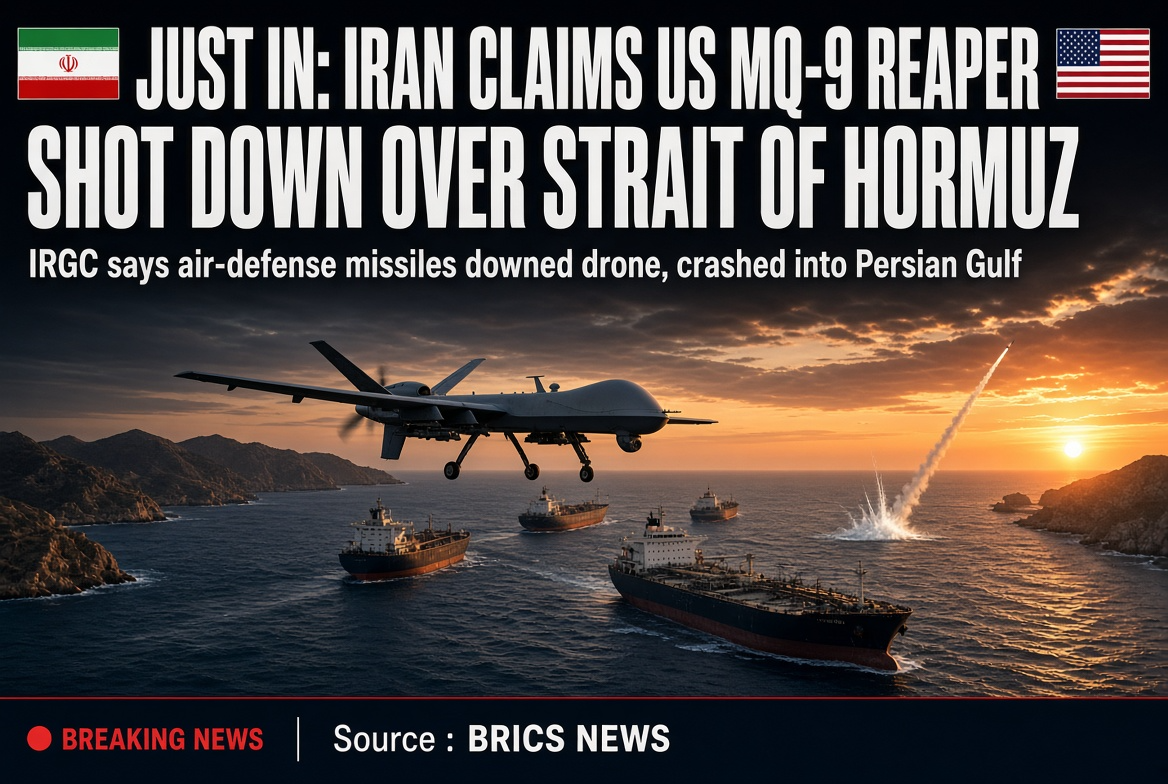
TEHRAN Aug 31, 2026 – Iran’s Islamic Revolutionary Guard Corps said Monday that it shot down a U.S. MQ-9 Reaper drone over the Strait of Hormuz, with the aircraft crashing into the Persian Gulf.
An IRGC statement, cited by Iran’s Mehr news agency, said the drone was struck by air-defense missiles. The announcement was quickly amplified by accounts including BRICS News, which posted a file photograph of an MQ-9 in flight rather than imagery from the alleged incident.
The claim followed U.S. strikes the previous night on two Iranian launchers on Larak Island. American officials said the launchers were being prepared to fire toward the strait. An IRGC spokesperson described those strikes as a “strategic and fatal error” and vowed retribution.
There was no immediate public confirmation or denial from U.S. Central Command or the Pentagon.
The Strait of Hormuz is one of the world’s most important energy chokepoints. A large share of global seaborne oil passes through the narrow waterway between Iran and Oman. Persistent U.S. surveillance and Iranian air-defense coverage have made the area a recurring site of confrontation throughout 2026.
The MQ-9 Reaper is a long-endurance remotely piloted aircraft used for intelligence, surveillance, reconnaissance, and precision strikes. Individual airframes typically cost about $30 million depending on sensors and weapons. Iranian forces have repeatedly claimed to have downed Reapers this year using both established and newly fielded systems, including the mobile Arash-e Kamangir interceptor.
U.S. officials have previously acknowledged substantial losses. Reports citing American sources have placed the number of MQ-9s lost in the Iran campaign at around 45 aircraft by mid-August — roughly a quarter of the pre-war fleet — at a hardware cost exceeding $1.3 billion. Not every loss has been attributed to enemy fire; some aircraft crashed after communications links failed. Production of new Reapers had already been halted, so replacements are limited.
Iranian claims have often outpaced independently verified incidents, and wreckage or flight data from specific shootdowns is rarely released in real time. The United States has generally been reluctant to confirm individual losses, citing operational security around surveillance orbits near the strait.
The latest report fits a months-long pattern of tit-for-tat military actions, fragile ceasefires, and competing narratives over control of the waterway. Commercial shipping has been disrupted at times, and both sides have accused the other of violating earlier understandings aimed at de-escalation.
As of early Monday, neither side had released video or other forensic evidence that would independently confirm whether an MQ-9 was destroyed in the latest incident or where exactly it was flying when it was allegedly engaged.
About The Author