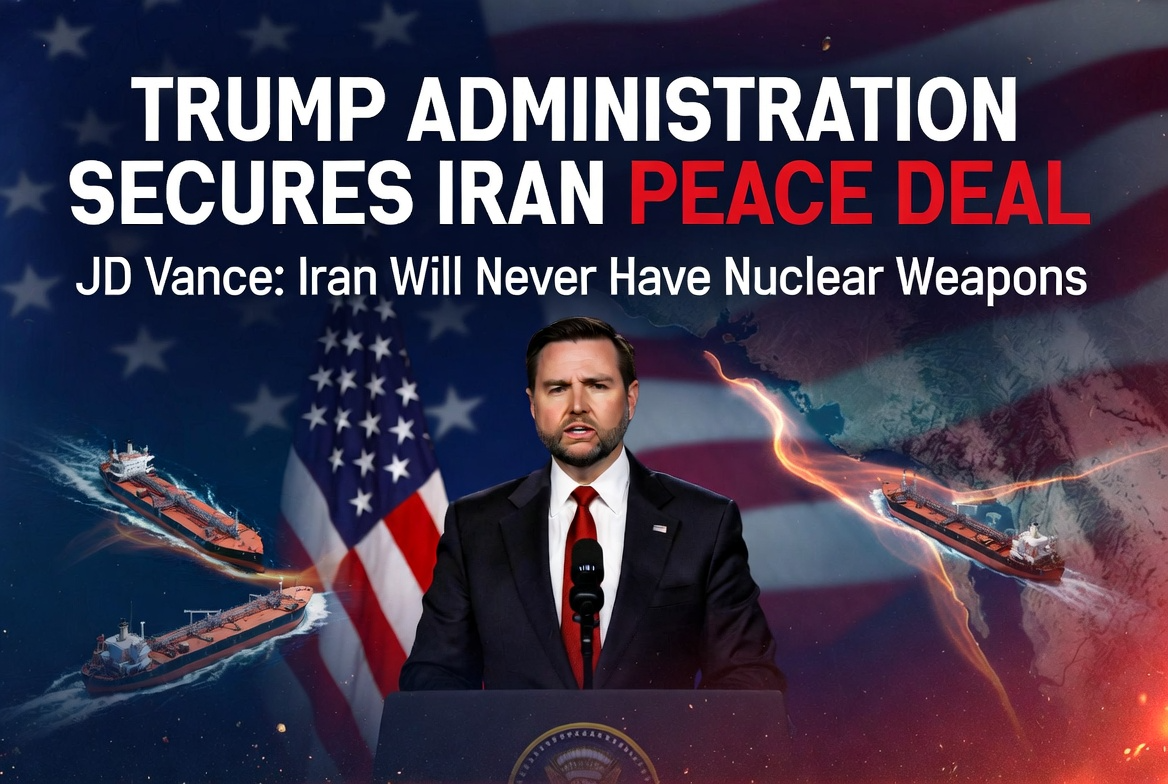
WASHINGTON D.C June 15, 2026 – Vice President JD Vance praised President Donald Trump’s diplomatic efforts Monday, announcing that a preliminary U.S.-Iran memorandum of understanding will prevent Iran from ever obtaining a nuclear weapon while reopening the Strait of Hormuz to unrestricted commercial shipping.
In a post on X accompanying a video statement, Vance declared: “The President has been clear from day one: Iran will never have a nuclear weapon. Once again, President Trump’s efforts to establish peace have paid off for the American people, despite countless attempts to thwart it by people who hate America and President Trump.”
The agreement, reached after months of conflict that included U.S. military actions and a naval blockade, marks an initial framework to end hostilities. Key elements include:
- Immediate reopening of the Strait of Hormuz for toll-free oil and commercial shipping, with the U.S. lifting its naval blockade.
- A 60-day ceasefire extension and pause in military operations, paving the way for further talks on Iran’s nuclear program.
- Iran’s commitment to forgo nuclear weapons development, with verification mechanisms and potential phased sanctions relief discussed in upcoming negotiations.
Administration officials have emphasized that no direct U.S. taxpayer funds are being transferred upfront, though reports of frozen Iranian assets and regional reconstruction support (potentially from Gulf states) have circulated. A formal signing is expected later this week in Geneva, Switzerland.
Tensions escalated earlier in 2026 amid Iranian threats to close the Strait of Hormuz — a critical chokepoint for global oil supplies — leading to U.S. and allied military responses aimed at neutralizing Iran’s nuclear capabilities and proxy networks. Trump has framed the approach as “peace through strength,” combining military pressure with diplomacy.
Vance has repeatedly stressed in recent interviews that the deal prioritizes long-term prevention of Iranian nuclear weapons while restoring economic stability through open shipping lanes.
The announcement has drawn mixed responses. Supporters celebrate it as a decisive win avoiding prolonged war. Critics, including some in replies to Vance’s post, question the terms, alleging excessive concessions, potential financial costs, and insufficient curbs on Iran’s missile programs or regional proxies. Israel has expressed ongoing concerns and vowed to maintain security operations in certain areas.
Full details of the memorandum remain under review as negotiations continue. Markets reacted positively to the prospect of stabilized oil flows, though uncertainty lingers over the durability of the agreement.
This development comes as President Trump prepares to engage with international leaders at the G7 summit, carrying momentum from the Iran framework.
About The Author