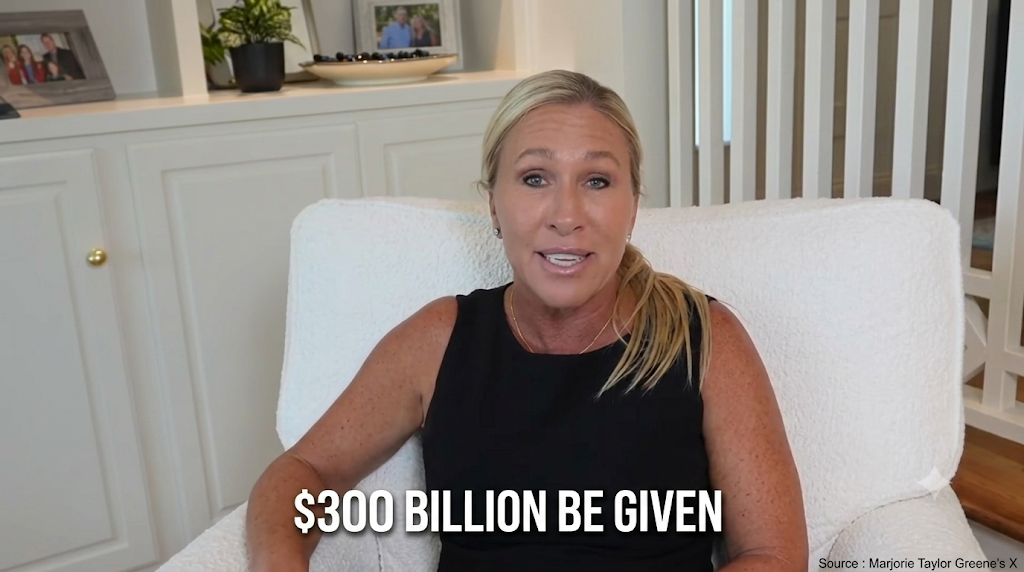
WASHINGTON, D.C. June 15, 2026 — A reported U.S.-Iran peace memorandum of understanding (MOU) has sparked sharp divisions within Republican ranks, with former Rep. Marjorie Taylor Greene publicly criticizing provisions involving potential reconstruction support for Iran following recent military strikes.
In a viral X post on Monday, Greene condemned what she described as a $300 billion commitment to Iranian reconstruction after U.S. and Israeli strikes on Iranian targets. “$300 BILLION DOLLARS TO IRAN??!!! Trump agreed to give Iran $300 BILLION dollars for reconstruction cost after Trump bombed Iran. Are you kidding me? What an embarrassment! Americans are getting screwed again!!” she wrote, accompanying the post with a video.
Vice President JD Vance pushed back on Iranian claims during a CBS interview, emphasizing that no U.S. taxpayer funds would flow directly to Tehran. He described the $300 billion figure as potential access to an investment fund backed by Gulf nations and regional partners, strictly conditional on Iran ending its nuclear weapons program, eliminating enriched uranium stockpiles, and submitting to robust inspections.
“That is the sort of thing they could have access to, funded by the Gulf Coast Coalition, so long as they honor their end of the obligation,” Vance stated. He added that hardline Iranian voices were likely overstating benefits while downplaying concessions.
According to multiple reports, the draft MOU includes:
- A 60-day ceasefire extension across fronts, including Lebanon.
- Reopening of the Strait of Hormuz for unrestricted commercial shipping (critical for ~20% of global oil transit).
- Phased sanctions relief tied to compliance.
- Negotiations on Iran’s nuclear program, with a goal of permanent renunciation of nuclear weapons.
- Potential international investment/reconstruction program valued around $300 billion, primarily from Gulf states and private investors — not direct U.S. appropriations.
President Trump has touted the framework as delivering “peace through strength,” predicting lower global oil prices. A signing ceremony is reportedly anticipated in the coming days.
The deal follows months of regional conflict involving U.S./Israeli strikes on Iranian nuclear and military sites. Iranian officials have framed the reconstruction fund more expansively, while U.S. sources stress conditionality and no direct American funding.
Critics like Sen. Lindsey Graham have called the fund idea “tone deaf,” comparing it to a Marshall Plan for a regime still in power. Some MAGA voices echo Greene’s concerns about any perceived concessions. Others defend it as leveraging Gulf wealth to create economic incentives for Iranian restraint without U.S. costs.
The agreement remains a draft, with final terms subject to negotiation and verification. Details on implementation, enforcement mechanisms, and Israeli concerns continue to evolve.
This story is developing.
About The Author