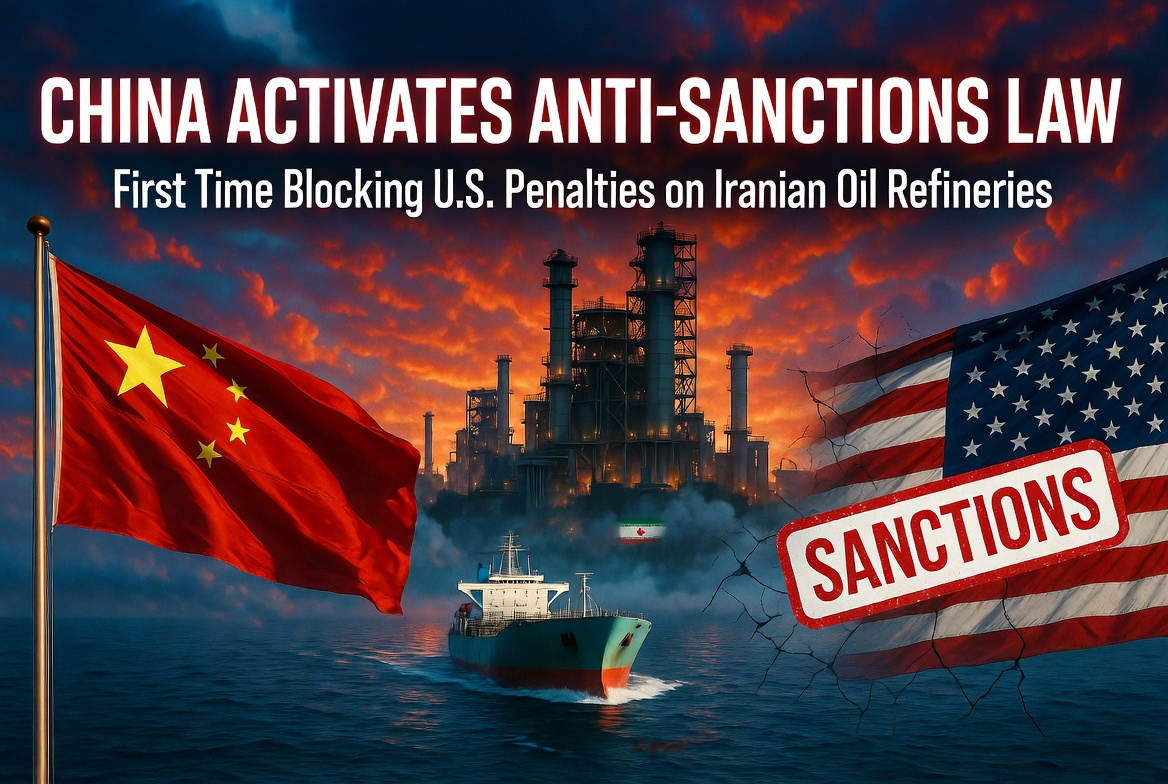
BEIJING May 6, 2026 – China’s Ministry of Commerce has issued its first-ever prohibition order under the 2021 Blocking Rules, directing all domestic companies and individuals not to recognize, enforce, or comply with U.S. sanctions imposed on five Chinese oil refineries accused of purchasing Iranian crude.
The move, announced on May 2, 2026, marks the inaugural use of the “Rules on Counteracting Unjustified Extraterritorial Application of Foreign Legislation and Other Measures.” It directly counters recent U.S. Treasury Department sanctions targeting the refineries for allegedly helping Iran bypass American restrictions and generate revenue for Tehran.
The five affected entities are:
- Hengli Petrochemical (Dalian) Refinery Co. (one of China’s largest private refiners, sanctioned by the U.S. on April 24, 2026)
- Shandong Jincheng Petrochemical Group
- Hebei Xinhai Chemical Group
- Shouguang Luqing Petrochemical
- Shandong Shengxing Chemical
These so-called “teapot” refineries — smaller, independent processors concentrated in Shandong province — have become major buyers of discounted Iranian oil in recent years. U.S. officials have accused them of processing billions of dollars’ worth of Iranian crude, often through complex shipping arrangements involving shadow fleets.
In a statement, China’s Ministry of Commerce described the U.S. measures as an “unjustified extraterritorial application” of foreign law that violates international norms. The prohibition order legally shields Chinese firms from penalties if they continue business with the sanctioned refineries, creating a direct legal conflict for any multinational banks, shippers, or traders caught between the two jurisdictions.
Analysts note the timing is significant: the order comes just weeks before a planned summit between U.S. President Donald Trump and Chinese President Xi Jinping in Beijing. It underscores Beijing’s determination to protect its energy security and strategic imports amid escalating U.S. pressure on Iran’s oil trade.
China has long argued that unilateral U.S. sanctions lack legitimacy under international law. The Blocking Rules, first introduced in January 2021 and recently strengthened, give Beijing tools to retaliate against what it views as abusive foreign legal overreach — including potential countermeasures such as fines, trade restrictions, or lawsuits against companies that over-comply with U.S. sanctions at the expense of Chinese interests.
For Iran, the development provides critical economic relief. China remains the largest buyer of Iranian oil, with imports estimated at 1.0–1.3 million barrels per day, helping Tehran offset the impact of long-standing U.S. sanctions.
U.S. officials have warned that continued Chinese purchases of Iranian oil finance activities they consider destabilizing in the Middle East. Washington has intensified enforcement actions in recent months, including additional designations of shipping entities and alerts to financial institutions about risks tied to China’s teapot refineries.
The Chinese order does not extend to other parties sanctioned alongside the refineries (such as vessels or ports) and applies specifically to the five named entities. However, legal experts say it creates a high-stakes compliance dilemma for global companies operating in both markets.
This is the latest flashpoint in the broader U.S.-China economic and geopolitical rivalry, where energy trade, sanctions enforcement, and supply chain security increasingly collide.
Life News Agency will continue to monitor developments, including any potential U.S. response or further escalation ahead of the Trump-Xi meeting.
About The Author