BEIJING May 6, 2026 – Beijing is persisting with the supply of critical drone components to both Iran and Russia, according to a widely circulated post on X (formerly Twitter) from the account @BRICSinfo, which described the development as “JUST IN.”
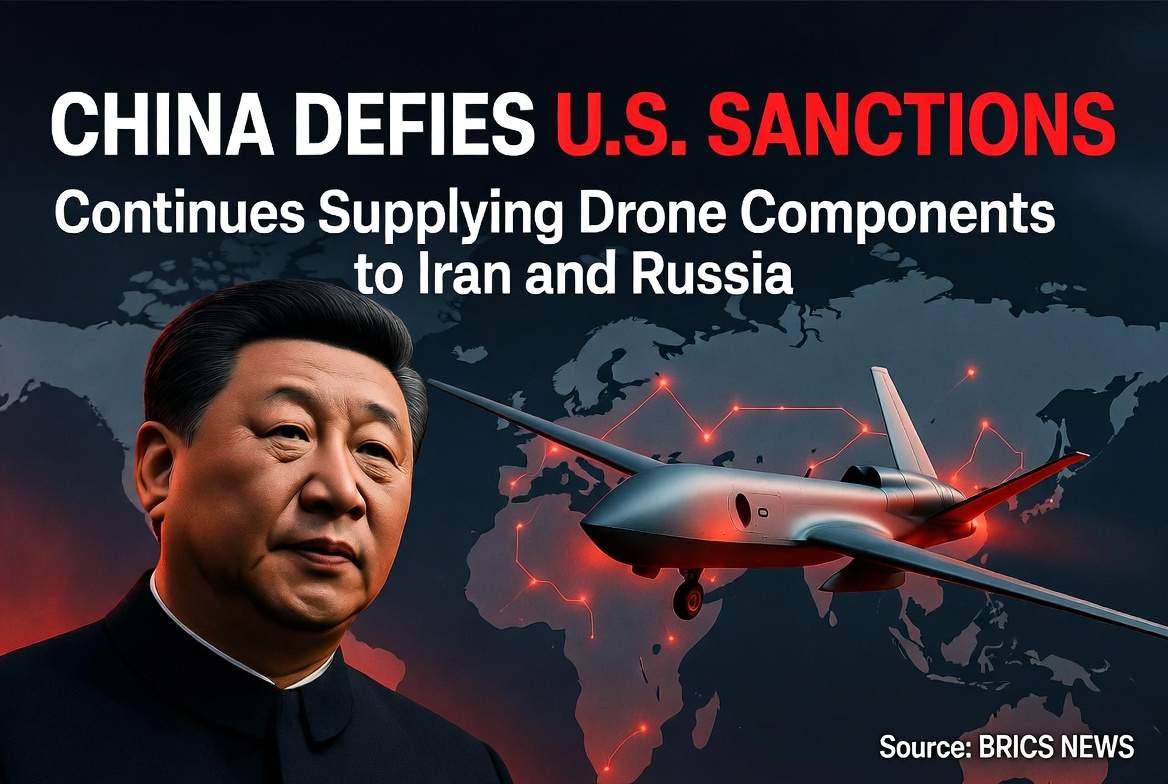
The post, which has garnered over 117,000 views in hours, features a portrait of Chinese President Xi Jinping alongside an image of a military-grade unmanned aerial vehicle (UAV) in flight — a design resembling the Shahed-series kamikaze drones used in ongoing conflicts.
While the claim is not entirely new, independent analyses and recent Western intelligence reports confirm that Chinese networks continue to route dual-use electronics, engines, sensors, batteries, and other components essential for drone production to Iranian and Russian programs. These supplies occur despite multiple rounds of U.S. sanctions targeting Chinese firms involved in the trade.
According to a March 2026 Atlantic Council dispatch, China has provided Iran with drones, anti-ship cruise missiles, surface-to-air missiles, and related components. Western-origin parts frequently reach Iranian manufacturers via Chinese distributors and trading companies, enabling evasion of export controls. Similar patterns support Russia’s production of Geran-2 (Shahed-136 variants) drones used extensively in Ukraine.
A Wall Street Journal report published just days ago noted that China dominates global drone production supply chains, making Russia, Ukraine, and Iran heavily reliant on Chinese parts for military UAVs. Forensic analysis of downed Russian FPV quadcopters and Iranian drones has repeatedly identified Chinese-made motors, batteries, and unmarked “brain” chips.
The U.S. has responded with targeted sanctions. In recent years, the Treasury Department and Bureau of Industry and Security (BIS) have blacklisted dozens of Chinese and Hong Kong-based front companies for procuring UAV components on behalf of Iran’s Islamic Revolutionary Guard Corps (IRGC) and Russia’s military industry. Examples include firms accused of shipping engines disguised as refrigeration units or rerouting Western electronics through shell companies. Yet officials acknowledge that evasion tactics — including mislabeling, transshipment via third countries, and rapid restructuring of procurement networks — have limited the effectiveness of unilateral controls.
China has consistently denied supplying weapons to either country, maintaining that it engages only in “normal trade relations” compliant with international law. Beijing has also criticized U.S. sanctions as extraterritorial overreach that harms global supply chains.
The development underscores deepening ties within what some analysts call an “Axis of Evasion” involving China, Russia, and Iran. These partnerships allow the three nations to bypass Western restrictions through integrated production networks: Iran provides designs, China supplies components and procurement channels, and Russia scales manufacturing capacity.
The implications extend beyond the battlefield. Drones assembled with these parts have been used in attacks on U.S. bases in the Middle East, Houthi operations in the Red Sea, and Russian strikes across Ukraine. As sanctions continue to be imposed, experts warn that the global drone supply chain’s heavy concentration in China makes enforcement increasingly difficult without broader multilateral cooperation.
Life News Agency will continue monitoring developments as U.S.-China tensions over dual-use technology and sanctions compliance escalate.
About The Author