WASHINGTON D.C Aug 20, 2026 — U.S. Vice President JD Vance has stated that the United States has eliminated Iran’s conventional military capabilities, according to a report circulating widely on Thursday.
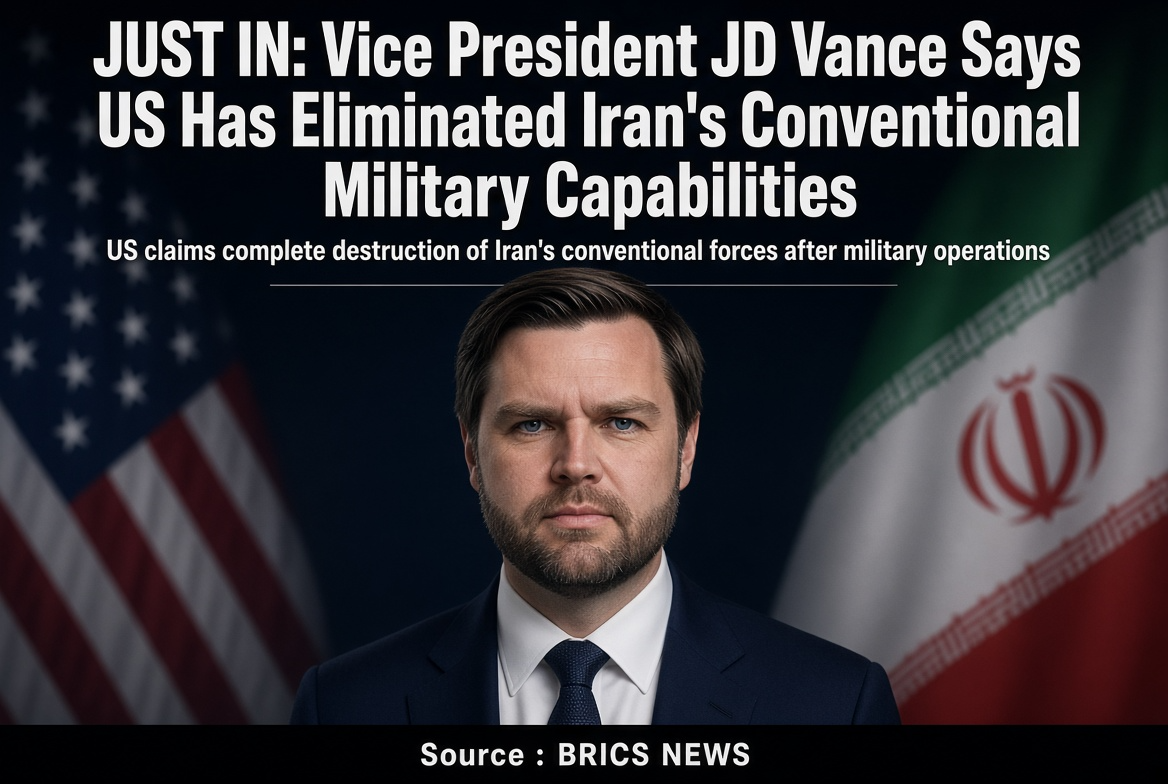
The claim was highlighted by the account BRICS News (@BRICSinfo), which posted: “JUST IN: 🇺🇸🇮🇷 Vice President JD Vance says the US has eliminated Iran’s conventional military capabilities,” accompanied by a portrait of Vance and the Iranian flag.
This assertion aligns with statements Vance has made in recent months regarding the outcomes of U.S. military operations against Iran. On August 8, speaking on Fox News Channel’s Saturday in America, Vance said: “We’ve destroyed their nuclear program. We’ve destroyed their conventional military. We’ve radically reduced their what you might call their asymmetric military abilities.”
He added that the Trump administration is assessing whether Tehran is prepared to make long-term changes for improved relations with the United States. “And if not, that’s fine, too. We’re just going to keep on applying the pressure that we can apply and getting as much oil and gas out of the Middle East so that Americans can enjoy lower gas and energy prices.”
Earlier remarks by Vance in July and March similarly described Iran’s conventional forces as “effectively destroyed” or noted that its navy “is at the bottom of the ocean” with no ability to project power as it did a year prior. These comments came amid and after a major U.S. air campaign, sometimes referred to in official statements as Operation Epic Fury, which targeted Iranian military infrastructure, naval assets, missile systems, and nuclear-related facilities.
U.S. Central Command (CENTCOM) officials have previously claimed significant degradation of Iranian capabilities, including the destruction of much of Iran’s navy and defense industrial base. However, independent assessments and some earlier intelligence estimates have suggested that while Iran’s ability to project power and launch large-scale attacks has been substantially reduced, residual capabilities—particularly in missiles, drones, and asymmetric forces—may persist.
The remarks come against the backdrop of a fragile ceasefire and ongoing diplomatic efforts. A memorandum of understanding signed earlier this year paused open hostilities, with technical talks continuing in locations including Switzerland. Oil flows through the Strait of Hormuz have partially recovered, contributing to lower energy prices, though tensions remain over verification of nuclear restrictions, sanctions, and regional security issues.
Iran has not issued an immediate public response to the latest characterization of its military status. The situation continues to evolve as both sides navigate negotiations while the United States maintains a strong military presence in the region.
About The Author