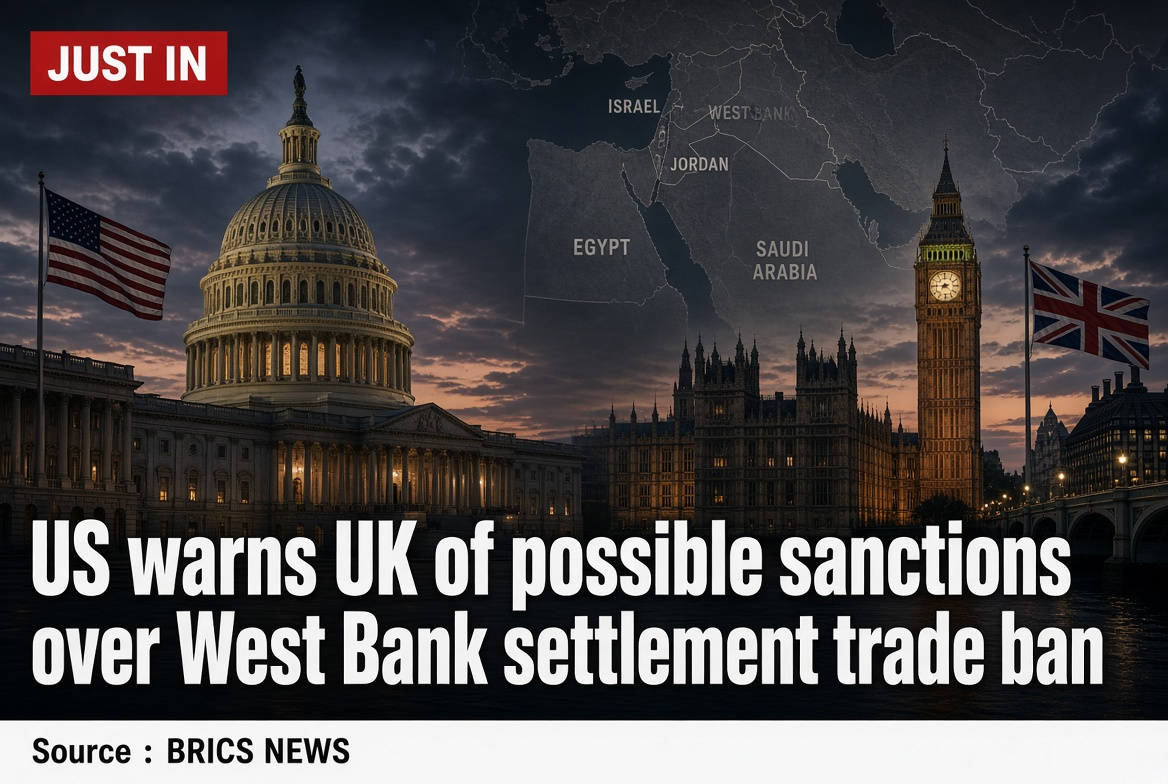
WASHINGTON D.C Oct 6, 2026 – The United States has warned that Britain and other European countries could face retaliatory sanctions for banning trade with Israeli settlements in the occupied West Bank, with a senior Trump administration official labeling the measures antisemitic.
Assistant Attorney General Harmeet Dhillon, who heads the Justice Department’s Civil Rights Division, made the comments in Washington on Tuesday. She said countries imposing boycotts on goods from the settlements were engaging in the Boycott, Divestment and Sanctions (BDS) movement. “What we call this in the United States is the BDS movement. It is anti-Semitism,” Dhillon said. “And I think every country that is doing that is going to risk, while President Trump is in power, retaliatory or corresponding sanctions potentially.”
The warning, reported by The Telegraph and The Spectator, marks a sharper U.S. line than the administration’s initial response last month. Secretary of State Marco Rubio said in September that Washington would not join the European measures and warned they could be destabilizing, but he stopped short of condemning them.
Britain announced the policy on September 8. Foreign Secretary Ed Miliband said the government would ban imports of goods from settlements it regards as illegal under international law, restrict related services such as construction and financing, and prohibit advertising of settlement property in the UK. The measures are expected to take six to nine months to enter force. London said they were aimed at settlement activity, not Israel as a whole, and cited rising settler violence and what it described as ethnic cleansing of Palestinians in parts of the West Bank.
Canada and France announced parallel steps the same day. A broader group of countries—including Denmark, Finland, Iceland, Ireland, Norway, Poland, Portugal, Spain and Sweden—issued a joint statement supporting restrictions on trade with the settlements. Settlement exports to Britain, mainly agricultural goods such as dates, wine and herbs, form only a small share of overall UK-Israel trade.
Israel responded by ordering the closure of Britain’s consulate in East Jerusalem, removing British officials from a Gaza coordination center, and barring entry to some British lawmakers. Israeli Foreign Minister Gideon Saar called the British justification “outrageous lies.”
U.S. Ambassador to Israel Mike Huckabee had already criticized the British move in September as discriminatory and warned of repercussions, including possible effects under state laws in places such as Florida that penalize companies participating in boycotts of Israel. Dhillon’s remarks go further by explicitly tying the European policies to possible federal retaliatory sanctions.
The exchange underscores a widening gap between the Trump administration and several traditional European allies on West Bank policy. Washington has not adopted similar trade restrictions and has previously revoked earlier U.S. sanctions targeting certain violent settlers.
About The Author