WASHINGTON D.C April 13, 2026 – The United States has formally upgraded its defense relationship with Indonesia to a Major Defense Cooperation Partnership (MDCP), U.S. Secretary of War Pete Hegseth announced Monday.
The announcement was made during a high-level meeting at the Pentagon, where Hegseth hosted Indonesian Defense Minister Sjafrie Sjamsoeddin. In a post on X, Hegseth stated: “It was an honor to host Indonesian Defense Minister @sjafriesjams at the Pentagon today. I was proud to announce that we are elevating our relationship to a Major Defense Cooperation Partnership, in recognition of the strength and potential of our bilateral defense ties.”
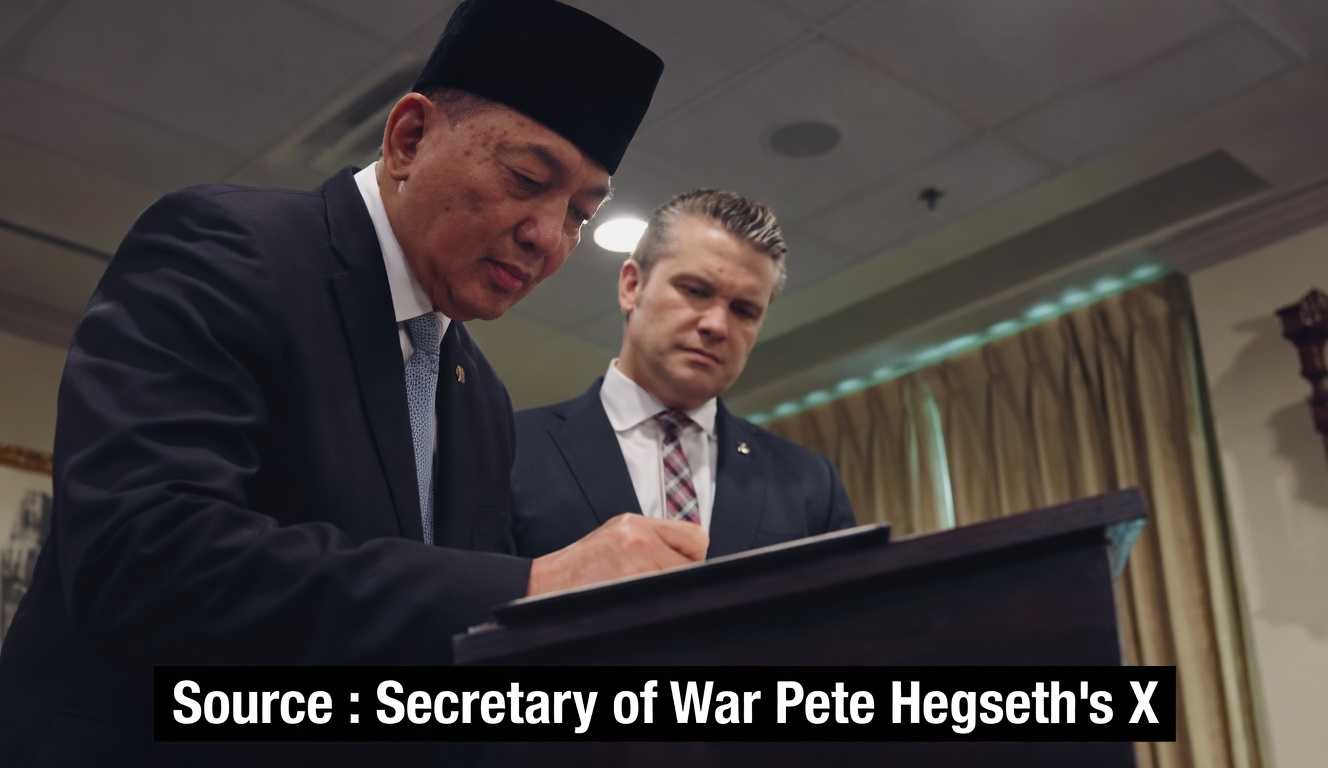
Video footage from the event shows a formal welcome ceremony outside the Pentagon, including handshakes, military salutes, and a signing of a Memorandum of Understanding (MOU). Hegseth highlighted ongoing collaboration, including Indonesia’s support in locating, returning, and protecting the remains of U.S. soldiers who fought alongside Indonesian forces during World War II.
The MDCP framework is designed to deepen cooperation across three key pillars: military modernization and capacity building, professional military education and training, and joint exercises and operational activities. The two nations already conduct more than 170 joint military exercises each year.
Indonesia, the world’s fourth-most populous nation and largest Muslim-majority country, holds critical strategic value in the Indo-Pacific. It controls the Strait of Malacca, a vital maritime chokepoint through which a large share of global trade and energy shipments—including much of China’s oil imports—passes. U.S. officials view the partnership as a step toward enhancing regional stability and interoperability with a key partner.
Indonesia maintains a long-standing policy of strategic autonomy and non-alignment. While Defense Minister Sjamsoeddin met with U.S. counterparts in Washington, President Prabowo Subianto was simultaneously in Moscow for talks with Russian President Vladimir Putin, underscoring Jakarta’s balanced approach to major powers.
The development reflects broader U.S. efforts to strengthen alliances in Southeast Asia amid ongoing geopolitical competition. Indonesian officials have described the partnership as enhancing national defense capabilities while preserving the country’s independent foreign policy.
Further details on specific agreements, including potential enhancements in technology sharing and maritime security, are expected in the coming days.
This marks a significant milestone in U.S.-Indonesia defense relations, building on decades of cooperation.
About The Author