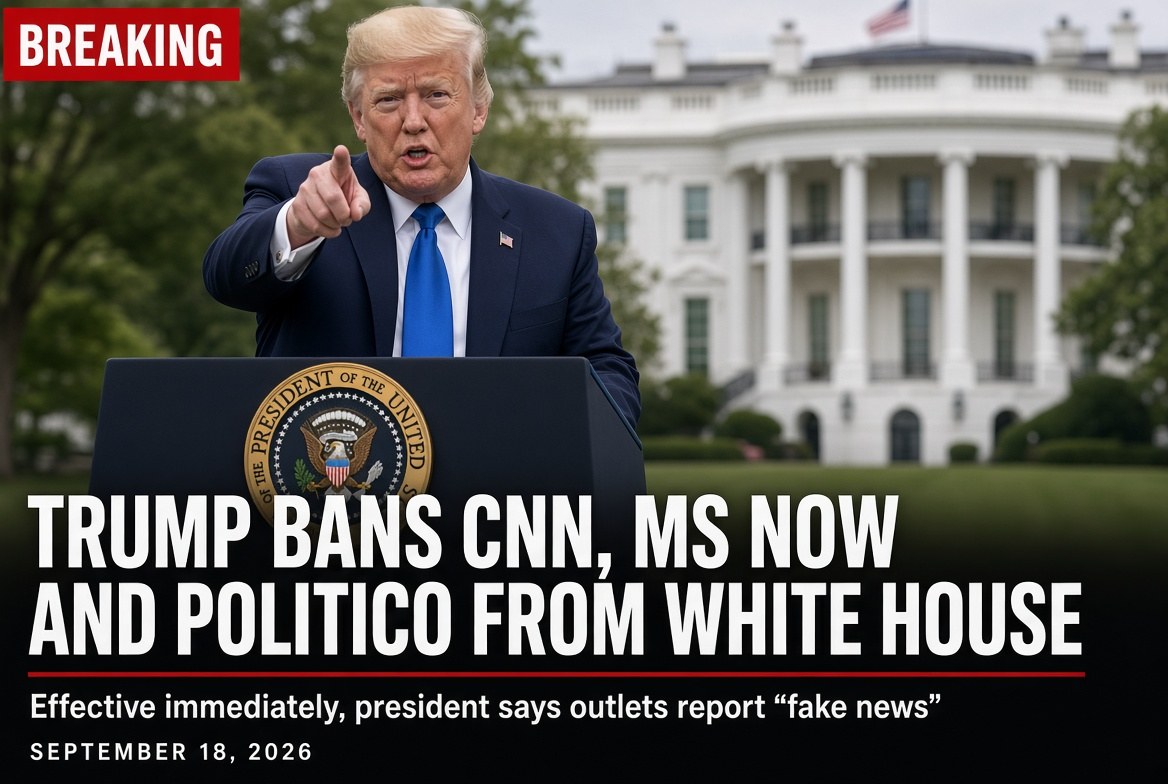
WASHINGTON D.C Sept 18, 2026 – President Donald Trump said Friday he is immediately barring CNN, MS NOW and Politico from the White House, accusing the three outlets of “constant” fake news and warning that other news organizations could be next.
In a post on X, Trump wrote that the ban was “effective immediately” and was the result of the outlets’ “constant ‘reporting’ FAKE NEWS.” He said media organizations “shouldn’t be able to constantly write or report FICTION and LIES when they’re covering the President of the United States, the Trump Administration, or the United States of America.”
He singled out Politico as “the recipients of an illegal and ridiculous $8 Million Dollar subscription, an All Time Record, directly from the United States Government, under Crooked Joe Biden, in order to keep them ‘alive.’ Seems like corruption to me!” He also mocked MS NOW, writing that the network “recently changed their name from MSNBC due to lack of viewership and credibility.”
Speaking later in the Oval Office, Trump called it “a very simple ban.” He said he did not want the outlets “in my office” and that the ban should “go as far as you can.” Asked why he announced it Friday, he said there was “no reason” tied to a single story and described the decision as cumulative. He added that he would “love it” if the outlets “could straighten themselves out.”
As of Friday afternoon, reporters from the targeted outlets were still working on White House grounds, and there was no immediate public sign that credentials had been pulled.
CNN said it “stands fully behind our White House team and their fair and accurate reporting” and argued that a ban would be “an illegal assault” on a constitutionally protected right to report “without hindrance or interference from the government.”
Politico said it “will continue to fairly report on this White House and future ones” and “will vigorously defend our First Amendment rights against any attempt to restrict them.”
MS NOW did not immediately issue a detailed public statement in early coverage.
The White House, beyond Trump’s post and later remarks, did not immediately spell out the mechanics: whether hard passes would be revoked, whether the outlets would be excluded from the briefing room, the press pool, Air Force One, or only from the Oval Office.
Federal spending records show agencies collectively paid more than $8 million in fiscal 2024 for Politico products, mainly premium subscription services such as Politico Pro and E&E News. Those services sell policy tracking, alerts and specialized reporting to government offices, law firms and other institutional customers. Similar subscription purchases exist for other news organizations.
Fact-checks have found the money was not a USAID grant to keep Politico solvent. USAID’s own payments were about $44,000 over two years. Politico has said it has never received government subsidies, grants or handouts and that most Politico Pro customers are in the private sector. Federal obligations to Politico were higher during the Biden years than during Trump’s first term; the Trump administration later moved to cancel some of those subscriptions.
MSNBC rebranded as MS NOW in November 2025 after Comcast spun the channel into Versant and separated it from NBC News. Executives said the change was meant to avoid brand confusion with NBC, not as a concession that the network lacked credibility. Viewership has declined during Trump’s second term, but that was not the stated reason for the new name.
The announcement is likely to face court challenges. A 1977 D.C. Circuit decision, Sherrill v. Knight, held that once the White House opens press facilities to journalists, access cannot be denied arbitrarily or without due process. CNN used similar arguments when the first Trump administration revoked Jim Acosta’s pass, and the network won that reporter’s credentials back.
The picture is less settled for more restricted spaces. In 2025 litigation over Associated Press access to the Oval Office and similar events, the D.C. Circuit said those inner rooms are not traditional public forums and that the White House has more discretion over who is invited in. How far Friday’s ban reaches will therefore matter in court.
Trump has long treated White House access as leverage against coverage he calls dishonest. He has already tried to limit the AP and has threatened additional outlets. Supporters argue White House access is a privilege, not a right, and point to earlier decisions by tech platforms to ban Trump himself. Critics call an outlet-wide ban an attempt to punish unfavorable reporting.
For now, the practical effect is incomplete: the president has declared a ban, the targeted newsrooms have rejected it, and their journalists were still inside the complex after the announcement. What happens next depends on whether the White House actually revokes credentials — and on how quickly the outlets go to court.
About The Author