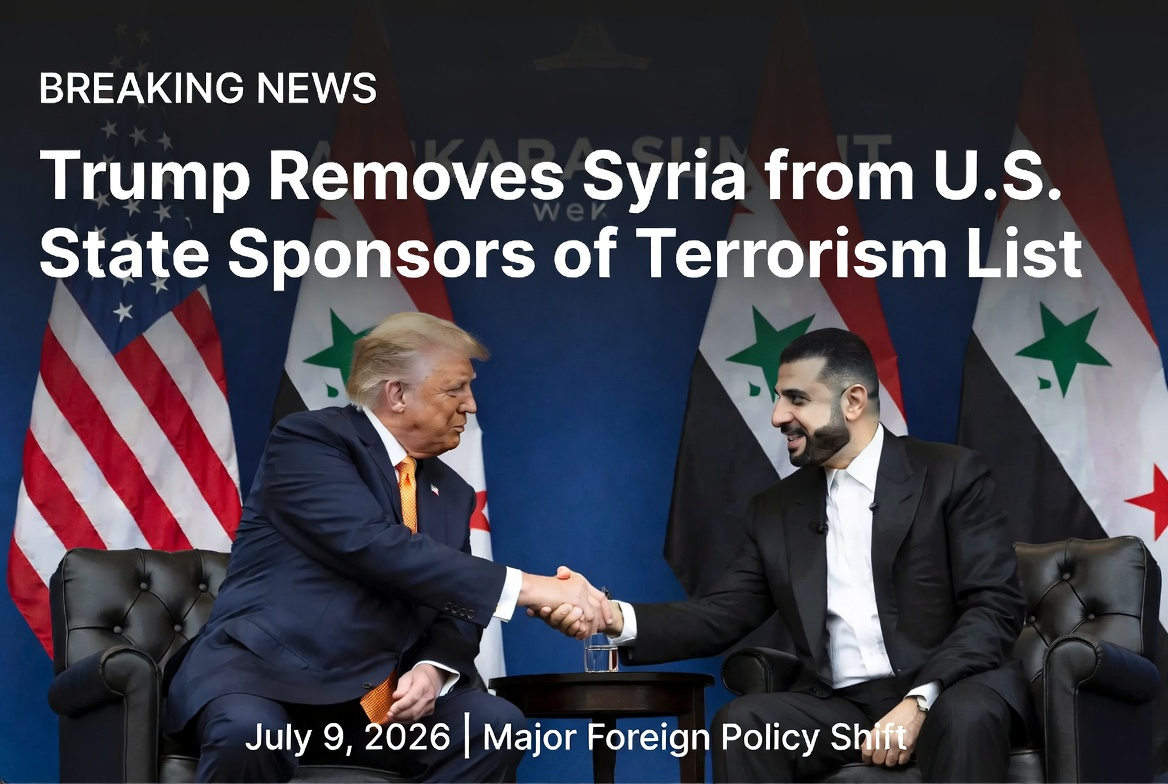
WASHINGTON D.C July 9, 2026 — In a significant shift in U.S. foreign policy, President Donald Trump announced that he is initiating the process to remove Syria from the American list of state sponsors of terrorism. The decision follows a meeting with Syrian President Ahmed al-Sharaa on the sidelines of a NATO summit in Ankara, Turkey.
Trump confirmed the move during joint remarks, stating, “I think I will, yeah… Why wouldn’t I? He’s done a great job.” The designation, in place since 1979 under the previous Assad regime, had imposed severe restrictions on U.S. foreign assistance, defense exports, and financial transactions with Syria.
The process involves notifying Congress, triggering a standard 45-day review period before the delisting can take full effect. Once completed, Syria would join only Iran, North Korea, and Cuba on the remaining list of designated state sponsors of terrorism.
The announcement comes amid efforts by al-Sharaa’s government — which took power after the fall of Bashar al-Assad — to stabilize the country, combat remaining terrorist elements, and reduce Iranian influence in the region. Al-Sharaa, formerly known as Abu Mohammad al-Jolani and a leader in the Hayat Tahrir al-Sham (HTS) group, has been credited by supporters with pragmatic governance and outreach to Western powers.
The delisting is expected to open the door to:
- U.S. humanitarian and reconstruction aid
- Potential investment from American companies in Syria’s war-torn economy
- Normalized financial channels and defense cooperation opportunities
Analysts view it as a pragmatic move aimed at supporting post-conflict recovery and countering other regional actors, though it represents a dramatic reversal given al-Sharaa’s past militant background (including a former U.S. bounty on his head during his time as an al-Qaeda-linked commander).
Syria’s inclusion on the terrorism sponsor list dated back decades and was tied to the Assad government’s support for groups like Hezbollah and its alignment with Iran. The new leadership under al-Sharaa has positioned itself as focused on national unity and fighting extremism.
Reactions have been mixed. Supporters of the decision highlight the potential for economic recovery and a more stable Syria that could reduce refugee flows and regional instability. Critics point to al-Sharaa’s jihadist history and question whether sufficient safeguards are in place regarding human rights, governance, and long-term counterterrorism commitments.
This development marks one of the most notable foreign policy pivots in the current administration regarding the Middle East, signaling a willingness to engage with post-Assad Syria to advance U.S. strategic interests in reconstruction and regional balance. Further details on the timeline and conditions tied to the delisting are expected in the coming weeks.
About The Author