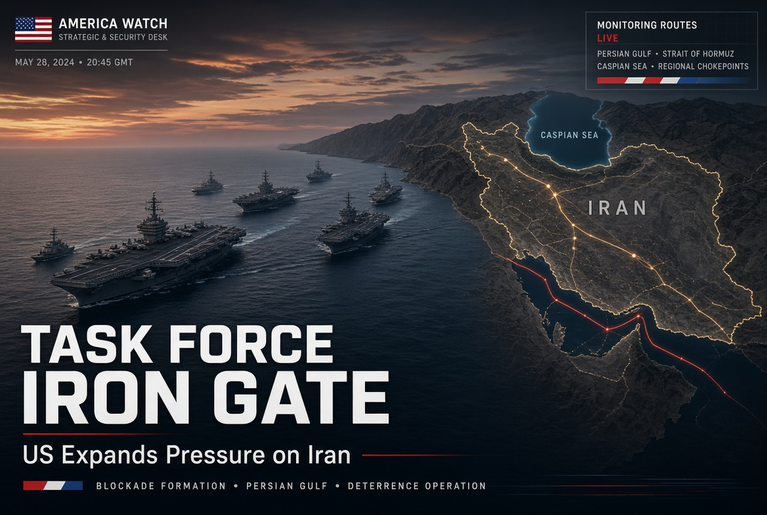
WASHINGTON D.C November 8, 2026 – President Donald Trump announced Sunday that Task Force Iron Gate is operating “in full force and effect in the Islamic Republic of Iran,” pairing the new effort with what he called “history’s greatest Naval Blockade.” The White House Rapid Response account amplified the statement by circulating a graphic of the message, which Trump signed “President DJT.”
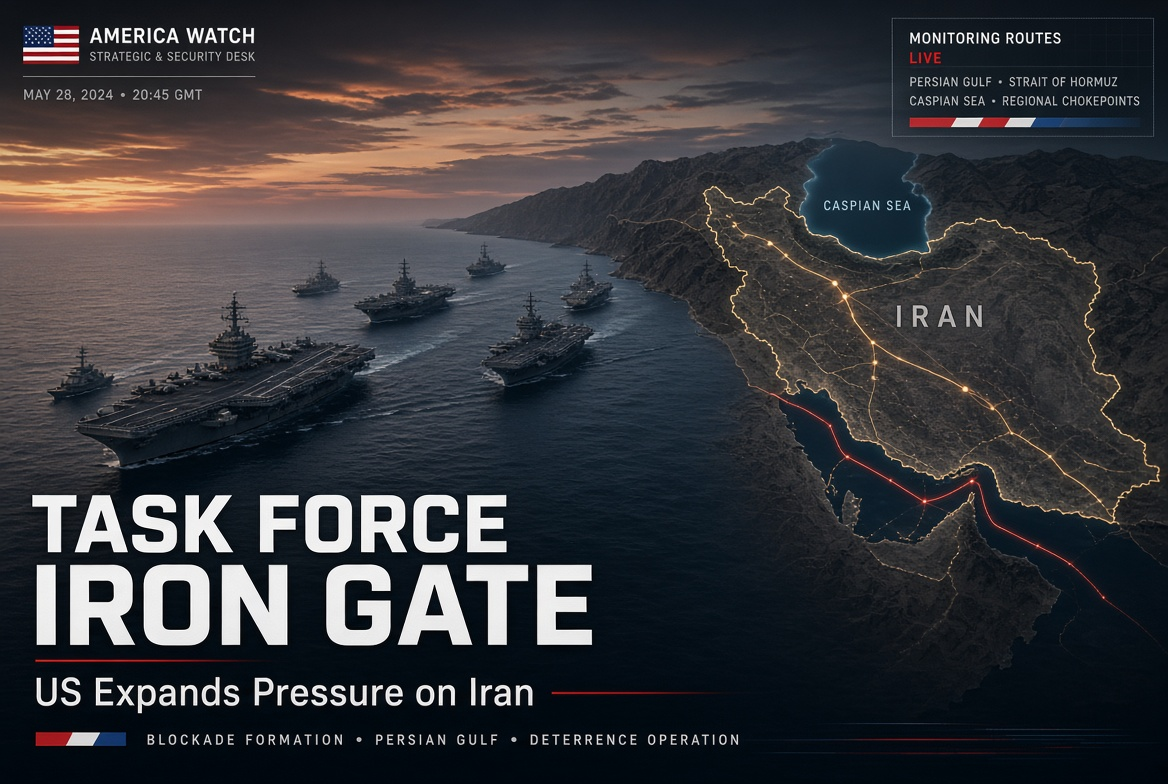
The announcement followed U.S. Central Command’s Saturday statement that its commander, Adm. Brad Cooper, had directed the creation of Task Force Iron Gate. The unit is an internal staff of approximately 20 civilian and military personnel based in Tampa, Florida. Its stated role is to coordinate with other U.S. government agencies to prevent the movement of advanced weapons systems, dual-use technologies, sanctioned materials, and illegal revenue streams across Iran’s land borders and the Caspian Sea.
Cooper said the task force “reinforces the success of our ironclad blockade against Iran at sea” and will further constrain Iran’s ability to finance terrorism, rebuild weapons factories, and replenish its military. CENTCOM stated that the naval blockade has prevented Iran from exporting more than $25 billion in crude oil in recent months, with enforcement continuing against vessels entering or departing Iranian ports. Humanitarian aid is exempted from the restrictions, according to the command.
The initiative expands U.S. efforts beyond maritime interdiction at a time of sustained tensions. Reports describe an ongoing conflict involving U.S. and Israeli strikes on Iranian targets, alongside Washington’s broader campaign of economic pressure. Analysts note that disruptions to traditional sea routes have increased attention on overland corridors through neighboring countries and Caspian Sea traffic as potential alternative pathways for restricted goods.
Iran rejected the measure. An Islamic Revolutionary Guard Corps spokesman described Task Force Iron Gate as “just a play on words” and asserted that the United States cannot achieve economic collapse through such steps. Iranian officials noted that previous U.S. predictions of rapid economic disintegration had not materialized, and they stated that measures had already been taken to maintain ties with neighboring countries. Tehran has characterized the overall pressure campaign as part of an ongoing military and economic confrontation.
CENTCOM has not publicly detailed specific interdiction methods, new authorities, or coordination agreements with countries bordering Iran. The task force remains a coordinating staff rather than a newly deployed combat unit inside Iranian territory, according to the command’s description.
The developments come as U.S. officials continue to emphasize both military readiness and potential diplomatic pathways, with Trump having indicated in separate remarks that a sufficiently strong nuclear understanding and reopening of the Strait of Hormuz could alter the trajectory of tensions.
About The Author