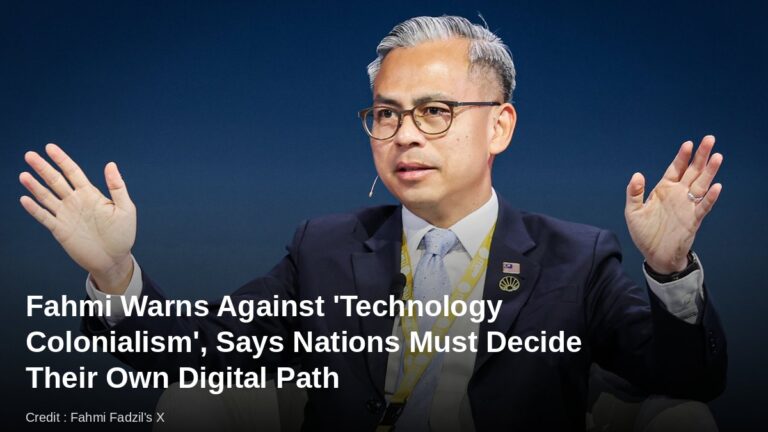
Credit : Fahmi Fadzil's X
DOHA, November 8, 2026 — Communications Minister Datuk Seri Fahmi Fadzil has warned against what he called “technology colonialism”, saying every country must be free to decide how it develops its own telecommunications and digital sector.
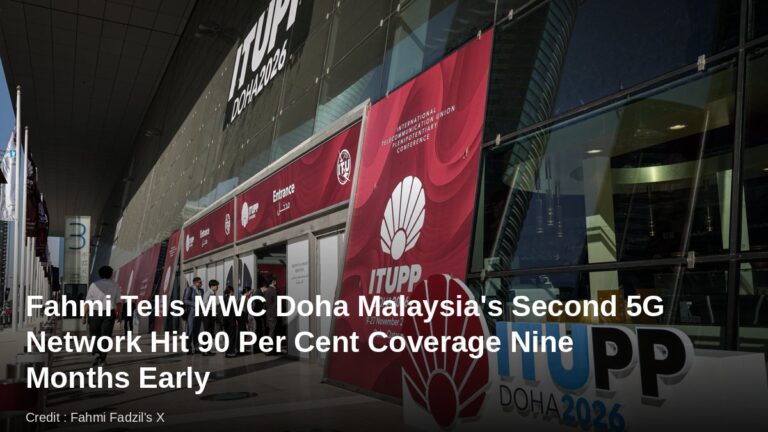
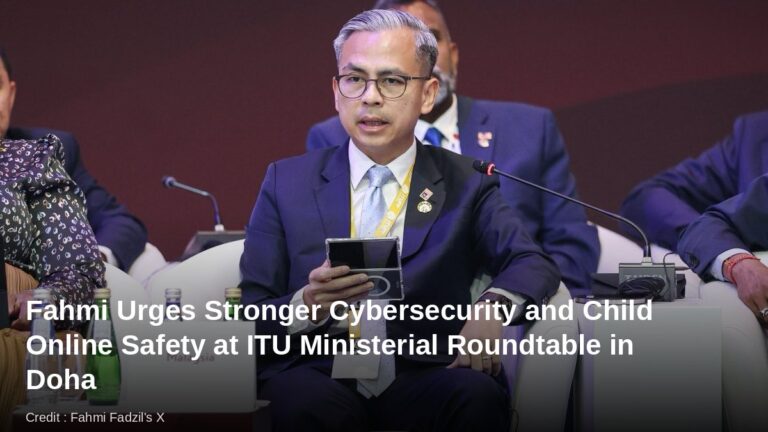
Fahmi made the remarks at a ministerial panel of the Digital Leadership Forum held in conjunction with Mobile World Congress (MWC) Doha 2026 on Sunday, Bernama reported. He is in the Qatari capital to lead Malaysia’s delegation to the International Telecommunication Union Plenipotentiary Conference 2026 (ITU PP-26).
“The sovereignty of every country in determining the direction of its own telecommunications and digital development must be respected,” Fahmi wrote on X after the session. “We should not allow ‘technology colonialism’ to exist, where more advanced countries decide what other countries can or cannot do.”
Speaking on the panel, he said: “There should not be a case of a kind of technology colonialism where if you are the first, then you dictate to others what you should or shouldn’t do, what you can or cannot do. Nations are sovereign and should be able to decide their own domestic policy,” according to Bernama.
Fahmi pointed to Malaysia’s own 5G journey as an example. The country first rolled out 5G through a single wholesale network before moving to a dual-network model. “Malaysia is unique because we did what GSMA Intelligence said not to do: roll out 5G using a single wholesale network. But we did it anyway, and I was the minister in charge of transitioning it into a dual-network model,” he said. Bernama reported that he described the transition as a challenging task that required Malaysia to handle diplomatic sensitivities while balancing domestic priorities against international standards.
He said talks on digital sovereignty should go beyond technological self-reliance to the wider principle of national sovereignty. “In this increasingly multipolar age, we need to have more conversations, more engagements, and find meeting points rather than things that split us apart,” he said.
Fahmi also said interoperability, which allows different networks and technologies to work together, would face real tests as countries pursue their own digital strategies. He noted that ASEAN’s consensus-based approach, without a central parliament and with strong respect for member states’ sovereignty, brings its own dynamics, so building trust requires countries to look beyond their borders.
On future networks, he said more attention should go to the practical use of existing networks before the industry turns fully to sixth-generation technology. “Before we talk about 6G, we have to look at who is actually using 5G or 5G-Advanced – that remains a key challenge we are actively addressing in Malaysia,” he said. In his X post, he added that Malaysia believes solutions to global technology challenges can come from any country, not only those long seen as technology leaders.
Fahmi also said emerging nations need help to bridge digital divides, particularly as the telecommunications sector prepares for quantum migration and quantum-safe communications. “There are many challenges, but there are also many opportunities for us to discover solutions together, and sometimes you might find those solutions in the unlikeliest of countries,” he said.
ITU PP-26 runs in Doha from November 6 to 11, and Malaysia is seeking re-election to the ITU Council for the 2027-2030 term, Bernama reported.
Source: Fahmi Fadzil’s X post, November 8, 2026, 8:56 PM Malaysia time; Bernama, the New Straits Times and Malay Mail, November 8, 2026.
About The Author