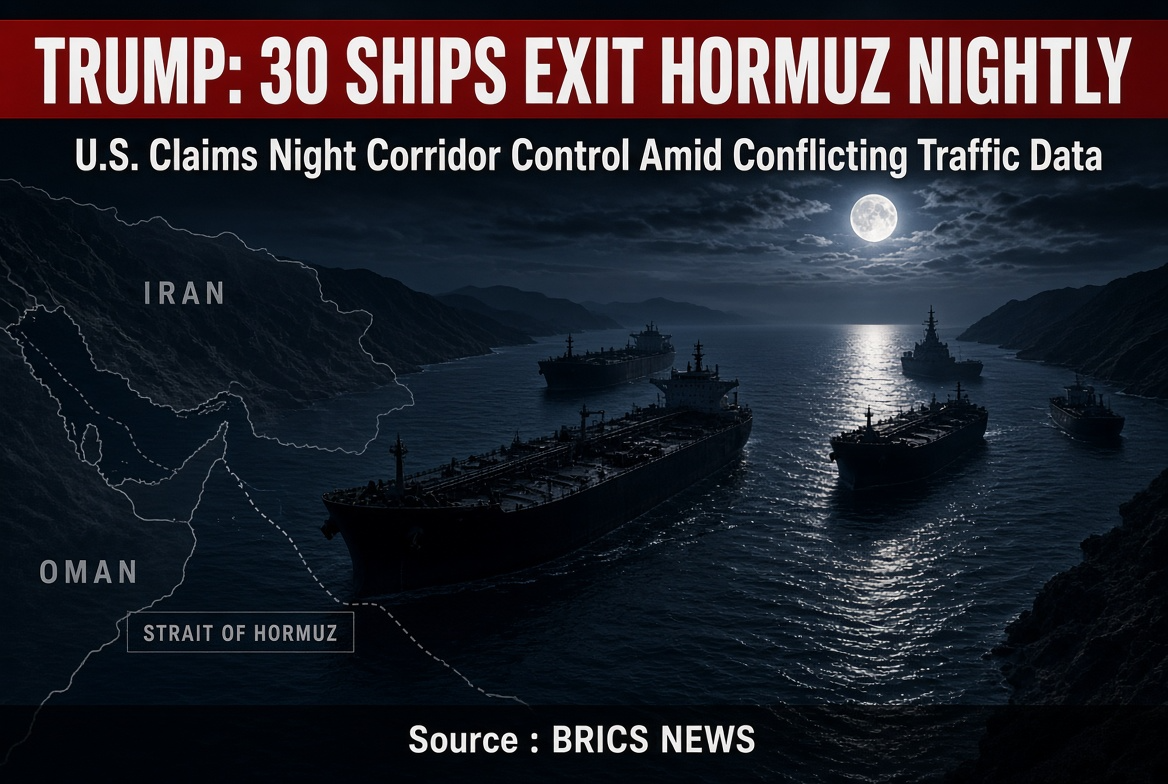
WASHINGTON D.C Aug 31, 2026 – President Donald Trump said Monday that an average of 30 ships are coming out of the Strait of Hormuz each night, asserting U.S. control over the vital oil chokepoint six months into the conflict with Iran.
The remark, reported by BRICS News, aligns with recent statements from U.S. officials who have described a nighttime corridor operation along the Omani coast. Washington says vessels transit with lights off, Automatic Identification System (AIS) transponders often disabled, and under U.S. protection after American forces degraded Iranian radar and surveillance capabilities.
U.S. officials told Axios last week that 20 to 30 tankers were passing through each night, carrying an estimated 9 to 10 million barrels of oil on some nights. The White House has cited cumulative figures of roughly 1,300–1,500 commercial vessels and 660–750 million barrels moved since May under U.S. escort. Trump has repeatedly declared the strait “open” and under American control, while stating that Iran is exporting no oil through it.
Independent maritime data tells a different story about visible traffic. Trackers including Kpler, IMF PortWatch, Windward, and others have recorded daily transits in the single digits to low teens in late August—often 3–10 vessels per day, or a 7-day average around 5—compared with pre-crisis levels of roughly 85–140 vessels daily. Many remaining movements involve smaller craft, dark-fleet tankers, or ships that later reappear after going dark.
The discrepancy stems from the nature of the operation. Industry advisories and U.S. comments describe coordinated nighttime passages in which ships black out navigation lights, minimize radar, and switch off AIS to reduce targeting risk. Commercial satellite and AIS-based counts therefore capture only a fraction of claimed transits. War-risk insurance premiums remain extremely high, further deterring ordinary commercial traffic.
The Strait of Hormuz, which carried about 20 percent of global oil supplies before the war, was effectively closed after U.S. and Israeli strikes on Iran in late February 2026 and Iran’s subsequent blockade. A short-lived June memorandum of understanding briefly raised traffic before collapsing in July. The United States has since maintained a blockade of Iranian ports while facilitating a southern “highway” for non-Iranian cargo.
Oil prices have stayed elevated and volatile, with Brent recently trading near $88–90 a barrel. Gulf crude exports are estimated at roughly half pre-war levels when including pipelines and the U.S.-protected corridor, though analysts differ on exact volumes. Iran continues to contest U.S. claims of control and has periodically declared the waterway closed.
The competing narratives—U.S. assertions of a functioning, high-volume nighttime operation versus persistently low publicly tracked traffic—have become a central feature of the six-month crisis. Shipping companies, insurers, and energy markets continue to treat the strait as high-risk even as Washington presents itself as its “guardian.”
About The Author