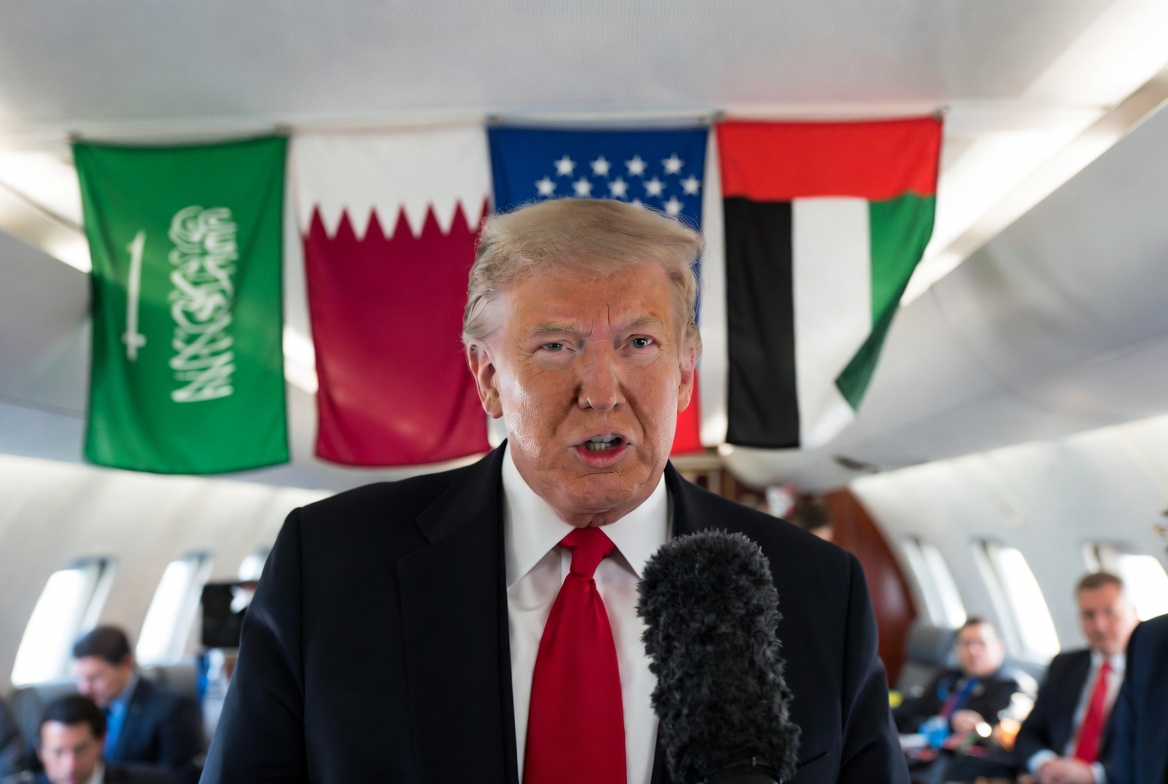
WASHINGTON D.C Aug 2, 2026 — U.S. President Donald Trump said Gulf countries played a central role in convincing him to hold off on a major military attack against Iran that had been planned for Sunday, according to remarks he made over the weekend.
Trump told reporters that leaders from Qatar, Saudi Arabia, and the United Arab Emirates urged him to pause the operation, which he described as potentially “the biggest attack since World War II.” He specifically referenced a conversation with Saudi Crown Prince Mohammed bin Salman, asking the crown prince whether he preferred a deal or an attack. The response, Trump said, favored diplomacy because “you don’t know where these attacks lead.”
In a Truth Social post Saturday night, Trump stated that the United States had been “asked by Iran, and other Middle Eastern countries” to withhold new strikes after the “perimeters of a deal” were agreed upon. The proposed framework, he said, includes the immediate and complete reopening of the Strait of Hormuz and an end to Iran’s nuclear threat. Trump emphasized that U.S. forces remain “locked and loaded and ready to go” if a deal cannot be reached rapidly.
Gulf officials had coordinated outreach to Washington in the hours leading up to the planned operation, warning of severe regional economic and security consequences if hostilities escalated further. Saudi Arabia, in particular, has faced repeated attacks on its energy infrastructure from Iranian-backed groups during the ongoing conflict that began with U.S.-Israeli strikes in late February.
The decision marks another de-escalation in a conflict that has repeatedly flared around the strategically vital Strait of Hormuz, a key oil shipping route. Trump has previously suspended planned strikes at the request of the same Gulf partners, most notably in May, when Qatar, Saudi Arabia, and the UAE successfully pushed for more time for negotiations.
As of early Monday, talks aimed at formalizing the reported framework are expected to resume, though Trump has left open the possibility of rapid military action if progress stalls.
About The Author