Source : BRICS NEWS
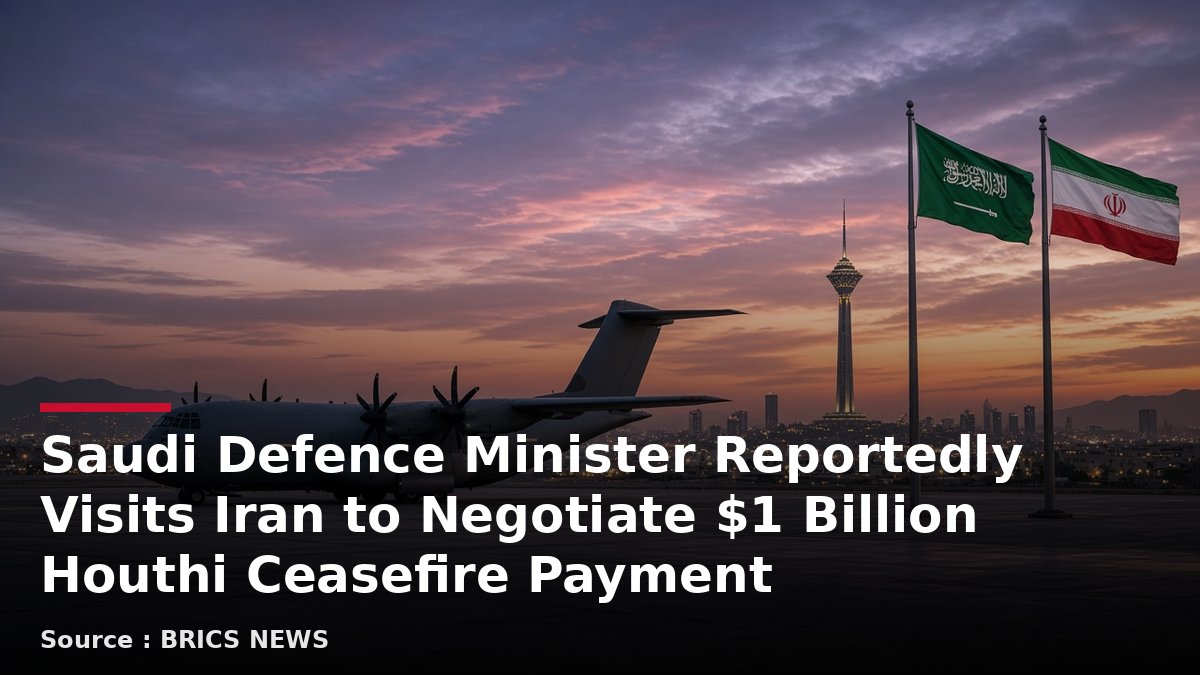
Saudi Arabia’s Defence Minister, Prince Khalid bin Salman, has reportedly travelled to Iran to negotiate a payment of US$1 billion to Yemen’s Houthi movement in exchange for a ceasefire, according to a post by BRICS News on X on October 27, 2026.
BRICS News said the Saudi minister “reportedly visits Iran to negotiate $1 billion payment to Houthis in exchange for ceasefire.” The claim has not been confirmed by Riyadh, and the figure rests on anonymous diplomatic sources cited in media reports.
The report appears to follow an article by the Israeli newspaper Israel Hayom, published on October 26, which cited unnamed Gulf diplomatic sources as saying that Prince Khalid’s surprise visit to Tehran was aimed at securing a ceasefire with the Houthis under a deal that would see Saudi Arabia transfer US$1 billion to the Iranian-backed group through Tehran. One source told the newspaper that the minister had even brought the money with him aboard the military transport aircraft on which he arrived. A Saudi official did not confirm that any money had been transferred.
The visit itself has been officially confirmed. In a statement carried by the Saudi Press Agency on October 26, the Saudi Ministry of Foreign Affairs said Prince Khalid and representatives of the countries of the Makkah Joint Defence Agreement had travelled to Tehran to meet senior Iranian officials. The ministry said the visit formed part of the pact’s continued efforts “to reduce escalation between the parties to the current crisis and to encourage dialogue and diplomatic solutions”, and to support mediation by Qatar and Pakistan.
The ministry said the Kingdom looked forward to the parties “dealing positively and practically” with the results of the visit, stressing the importance of opening channels of negotiation that would prevent a return to military escalation in the region. It made no mention of any payment.
According to The National, senior officials from Pakistan and Turkey joined the meeting in Tehran, marking the first direct engagement of its kind since the Makkah Agreement was signed in August. Israel Hayom reported that Turkish intelligence chief Ibrahim Kalin and Pakistan’s army chief, Field Marshal Asim Munir, took part in the talks. Iranian Foreign Ministry spokesman Esmaeil Baghaei described the four-way meeting as “a key development in shaping regional diplomacy”, The National reported.
The diplomatic push comes amid an escalation of Houthi attacks on Saudi Arabia. The Houthis said on October 26 that they had targeted the Kingdom’s East-West oil pipeline, and Saudi Arabia activated an emergency warning system in Riyadh earlier the same day. Market commentators have noted that Houthi strikes on Saudi oil infrastructure, together with disruption to tanker traffic in the Strait of Hormuz, have severely constrained regional oil exports.
Speaking to Israel Hayom, the Saudi official said part of the dispute with the Houthis concerned the implementation of understandings reached three years ago. Under those understandings, Saudi Arabia was to provide direct financial assistance to the group as part of efforts to reach a settlement, including funds to pay public-sector salaries in Houthi-controlled areas and to rebuild civilian infrastructure. In return, the Houthis were expected to uphold a ceasefire and halt attacks on the Kingdom.
Riyadh has publicly maintained that it will not bow to military pressure, and analysts have urged caution over the US$1 billion figure because it is based solely on anonymous sources. If a deal were reached, it could allow Saudi Arabia to restore disrupted oil production and exports, although it would not necessarily resolve the separate threat to shipping in the Strait of Hormuz.
Saudi Arabia led a military coalition against the Houthis in Yemen from 2015, and the two sides had largely observed a truce in recent years before the latest escalation. The outcome of the Tehran talks, and whether any financial arrangement forms part of them, remains to be seen.
Source: BRICS News on X
About The Author