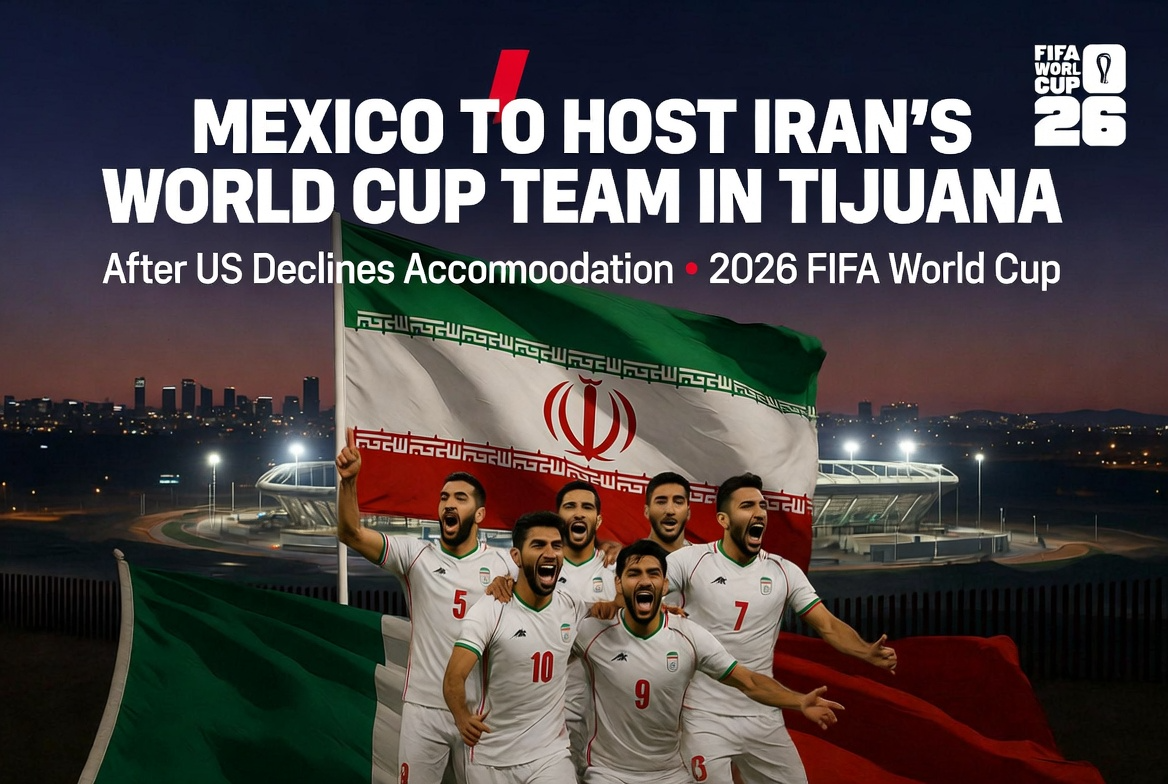
MEXICO CITY May 25, 2026 – Mexican President Claudia Sheinbaum announced on Monday that her country will host Iran’s national football team during the 2026 FIFA World Cup, allowing the squad to base itself in Tijuana and commute daily to its group-stage matches in the United States.
The decision follows Washington’s refusal to let the Iranian team stay overnight in the US for the duration of the tournament, despite Iran being scheduled to play all three of its Group G matches on American soil. FIFA approached Mexico with the request, which Sheinbaum described as straightforward.
“We have no reason to deny them the possibility of staying in Mexico,” Sheinbaum said during her daily press conference. “They asked if they could stay overnight in Mexico, and we said yes, no problem.”
Iran’s Football Federation President Mehdi Taj confirmed earlier that the team’s base camp has shifted from Tucson, Arizona, to Tijuana, a border city just south of San Diego, California. FIFA formally approved the move. The location offers modern training facilities, including pitches, gyms, and private dining, along with convenient access via direct Iran Air flights and short commutes to US venues.
Iran is drawn in Group G alongside New Zealand, Belgium, and Egypt. Their matches include:
- June 15: vs. New Zealand in Los Angeles (approx. 55-minute flight from Tijuana)
- June 21: vs. Belgium in Los Angeles
- June 26: vs. Egypt in Seattle
The team will travel into the US only for matches and required activities before returning to Mexico.
The arrangement stems from longstanding US-Iran tensions, which have complicated visa and security arrangements amid the co-hosted tournament (United States, Mexico, and Canada) running from June 11 to July 19. Originally planned for Arizona, the base relocation helps bypass potential visa hurdles while ensuring Iran can compete without disruption.
Sheinbaum framed the move as a matter of international sports hospitality, with Mexico maintaining a neutral stance. No immediate comment was available from US authorities.
This development highlights the unique logistical challenges of the expanded 48-team World Cup across three nations, where geopolitical factors intersect with sporting logistics. FIFA has emphasized that the plan ensures fair participation for all teams.
The story continues to unfold as teams finalize preparations in the lead-up to the tournament kickoff.
About The Author