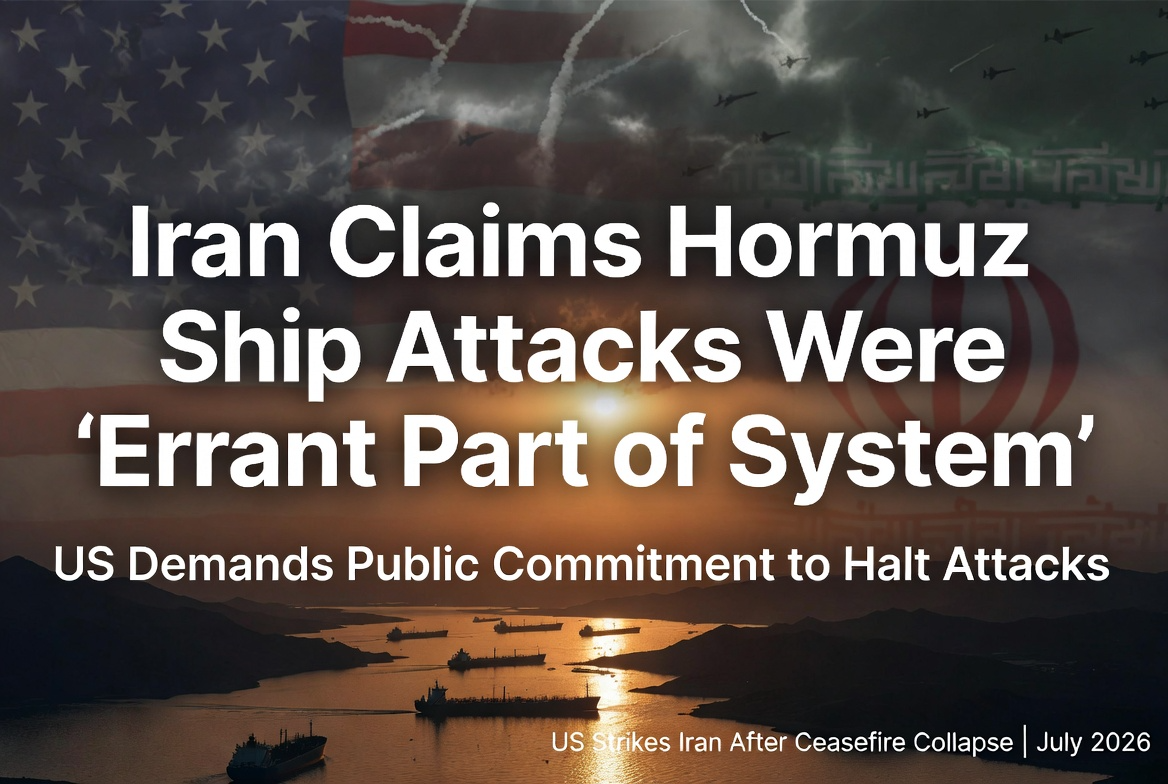
WASHINGTON D.C July 10, 2026 — Senior U.S. officials said Friday that Iran has attributed recent attacks on commercial vessels in the Strait of Hormuz to “an errant part of their system,” while Washington is pressing Tehran for a clear public commitment to stop targeting ships and keep the vital waterway fully open without tolls.
The development comes amid heightened tensions following Iranian attacks on three commercial ships earlier this week and subsequent U.S. military strikes on Iranian targets.
According to U.S. officials speaking to Reuters, Iran informed Washington that the recent incidents involving shipping in the strait resulted from an “errant part of their system.” One official described the explanation as potentially reflecting internal divisions within Iran, including a power struggle between hardliners and more pragmatic elements.
U.S. officials emphasized that any path forward requires Iran to issue a public statement acknowledging that all channels of the Strait of Hormuz are open to shipping and that attacks on vessels will cease.
“What we’re demanding is that the Iranians issue a public statement that acknowledges all channels of the Strait of Hormuz are open and they’re not shooting at ships anymore,” one senior official said. “They’re either going to give us that statement or we’re not having a good outcome for them.”
U.S. President Donald Trump has declared that a fragile June ceasefire between the two sides is over following the ship attacks.
Earlier this week, Iran targeted multiple commercial vessels transiting the strategic waterway, including the Marshall Islands-flagged LNG tanker Al Rekayyat, the Saudi-flagged crude oil tanker Wedyan, and the Liberian-flagged Cyprus Prosperity. The attacks prompted the United States to launch retaliatory airstrikes.
U.S. Central Command conducted strikes on approximately 80 Iranian military targets on July 7, followed by another round hitting around 90 targets on July 8. The operations focused on air defense systems, coastal surveillance assets, missile and drone storage sites, naval capabilities, and Islamic Revolutionary Guard Corps (IRGC) small boats to degrade Iran’s ability to threaten commercial shipping.
The Strait of Hormuz is a critical chokepoint through which a significant portion of the world’s oil supply passes. Disruptions there have immediate global economic implications.
Despite the military exchanges and the collapse of the recent ceasefire, U.S. officials indicated that backchannel discussions with Iran have continued and been somewhat productive. However, any broader de-escalation hinges on Iran providing explicit public assurances regarding freedom of navigation.
U.S. officials expressed hope that Iran will publicly acknowledge the incidents as a mistake and commit to preventing further attacks.
The situation remains fluid, with both sides continuing to exchange messages amid the fragile security environment in the region.
About The Author