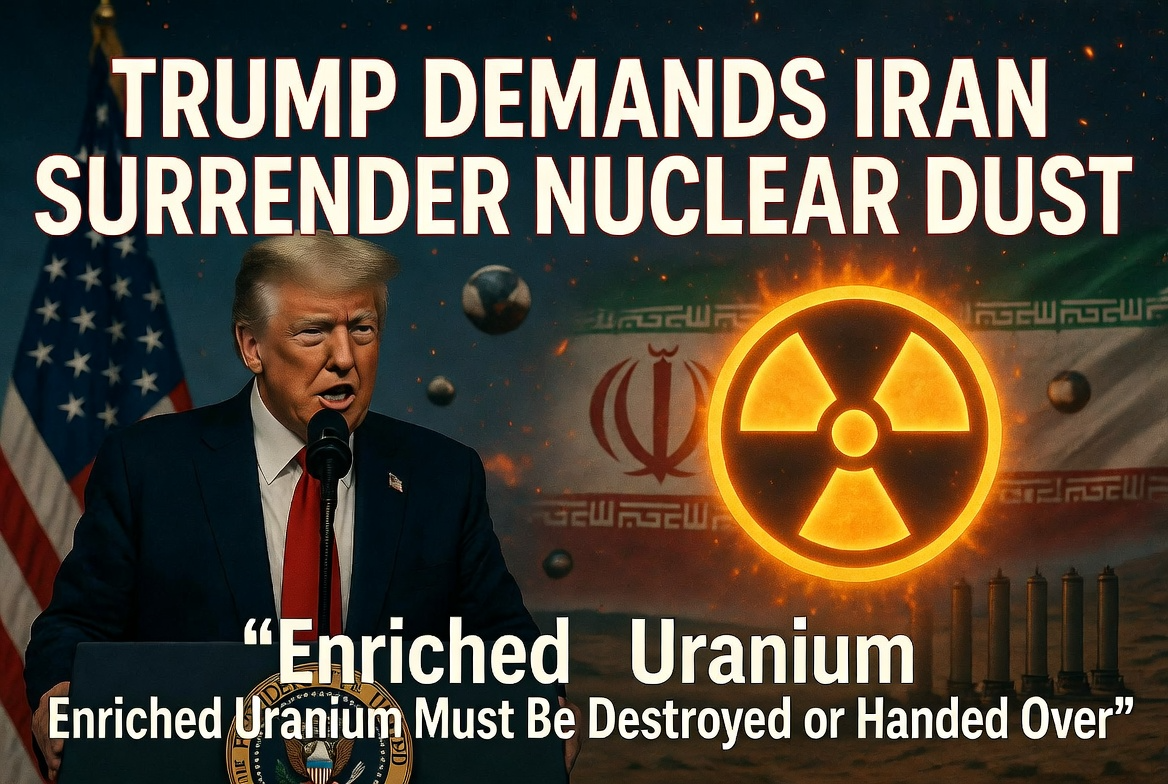
WASHINGTON, D.C. May 25, 2026 — President Donald J. Trump has reiterated his demand that Iran relinquish its stockpile of enriched uranium — which he has repeatedly called “Nuclear Dust” — as a core condition for any agreement to end hostilities and stabilize the region.
In a statement shared by the White House on X (formerly Twitter) late Monday, Trump outlined clear options for the material:
“The Enriched Uranium (Nuclear Dust!) will either be immediately turned over to the United States to be brought home and destroyed or, preferably, in conjunction and coordination with the Islamic Republic of Iran, destroyed in place or, at another acceptable location, with the Atomic Energy Commission, or its equivalent, being witness to this process and event.”
The post comes amid ongoing U.S.-Iran negotiations, mediated in part by third countries, following a series of U.S. and Israeli military strikes on Iranian nuclear facilities in 2025 and early 2026. Those operations, including U.S. strikes on Natanz, Fordow, and Isfahan in June 2025, significantly damaged Iran’s enrichment capabilities, though questions remain about the exact status and location of its remaining enriched uranium stockpile.
U.S. officials have described a potential memorandum of understanding that would include Iran handing over or verifiably eliminating its highly enriched uranium (particularly material enriched to 60%), reopening the Strait of Hormuz for safe passage, and measures to prevent future weapons development. In exchange, discussions have touched on sanctions relief and other economic gestures.
Trump has emphasized that Iran must not retain any pathway to a nuclear weapon. “We will get it. We don’t need it. We don’t want it. We’ll probably destroy it after we get it,” he has said in prior remarks.
Iranian officials have not publicly confirmed agreement to full handover of the stockpile, with some reports indicating Tehran prefers destruction in place under international oversight rather than transfer abroad. Skeptics, including some Iranian opposition voices, argue the regime will never voluntarily surrender its nuclear leverage.
The statement has drawn mixed responses:
- Supporters view it as a firm stand against Iranian nuclear ambitions following military action.
- Critics question enforcement and point to past broken promises on both sides.
- Israeli officials have been briefed and are said to insist on verifiable removal of all enriched material.
Note: The reference to the “Atomic Energy Commission” appears to be a colloquial or historical shorthand; the agency was dissolved in 1975, with responsibilities now held by the Department of Energy and the Nuclear Regulatory Commission, alongside international bodies like the IAEA.
Negotiations remain fluid, with Trump indicating a deal is “largely negotiated” but subject to final details. Further military options remain on the table if diplomacy fails, according to administration signals.
This development marks the latest chapter in efforts to contain Iran’s nuclear program, which expanded dramatically after the U.S. withdrawal from the 2015 JCPOA.
About The Author