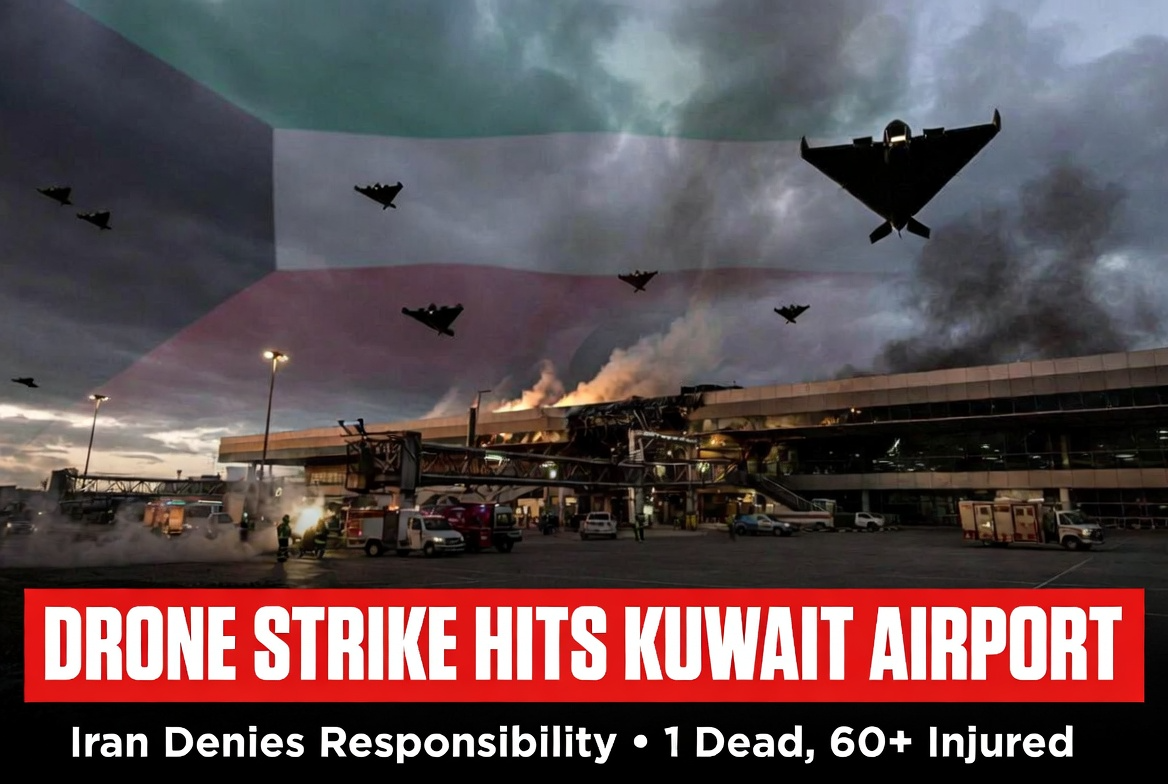
KUWAIT CITY June 9, 2026 — A deadly drone strike on Kuwait International Airport’s passenger terminal on June 3 has escalated tensions in the Gulf, killing one person, injuring more than 60 others, and briefly shutting down operations at the major hub. Kuwait and the United States have attributed the attack to Iranian drones, while Iran denies responsibility and accuses the US of a false flag operation involving a malfunctioning Patriot missile.
Kuwaiti authorities released surveillance footage showing what they describe as the moment of impact on Terminal 1. The strike caused significant structural damage to the recently upgraded facility, forced flight diversions, and injured airport workers, passengers, and bystanders. One victim was reported as an Indian national.
Kuwait’s military spokesman, Gen. Saud Abdulaziz Al-Otaibi, condemned the incident as “criminal Iranian aggression,” stating that “a number of hostile drones” targeted the civilian terminal. The country’s foreign ministry echoed the criticism, calling it a violation of international law.
Iran’s Islamic Revolutionary Guard Corps (IRGC) rejected the accusations, claiming it did not target the airport. Instead, Iranian officials asserted that the damage resulted from a US-made Patriot interceptor missile that malfunctioned while attempting to down Iranian projectiles aimed at military targets. No evidence was publicly provided to support this claim.
Tehran has framed its recent actions as self-defense in response to alleged US strikes on Iranian assets, including an oil tanker and facilities on Qeshm Island.
US Central Command (CENTCOM) strongly denied Iran’s version of events, calling it “totally false.” In a statement, CENTCOM described the airport strike as a “deliberate, calculated, and unjustified attack” by Iranian drones on civilian infrastructure. US officials pointed to debris analysis and intelligence supporting Iranian responsibility.
The incident is part of a broader pattern of exchanges following the fragile ceasefire between the US, Israel, and Iran. Earlier waves of Iranian drones targeting US forces in Kuwait were reportedly intercepted by American and Kuwaiti defenses with no casualties on the US side.
Gulf states like Kuwait, which hosts US military bases, have largely remained on the sidelines of the wider conflict but now find themselves directly affected. The attack has raised fears of further spillover, threatening civilian lives and critical infrastructure in a region long viewed as relatively stable.
Diplomatic efforts continue, with reports of ongoing ceasefire talks. However, this latest clash underscores the volatility and mutual accusations that continue to undermine de-escalation.
As investigations proceed and footage circulates, independent verification of the strike’s origin remains a point of contention in an information landscape clouded by competing narratives.
About The Author