Japan Protests After Suspected Russian Aircraft Enter Airspace Near Fukuoka
 Laura AI
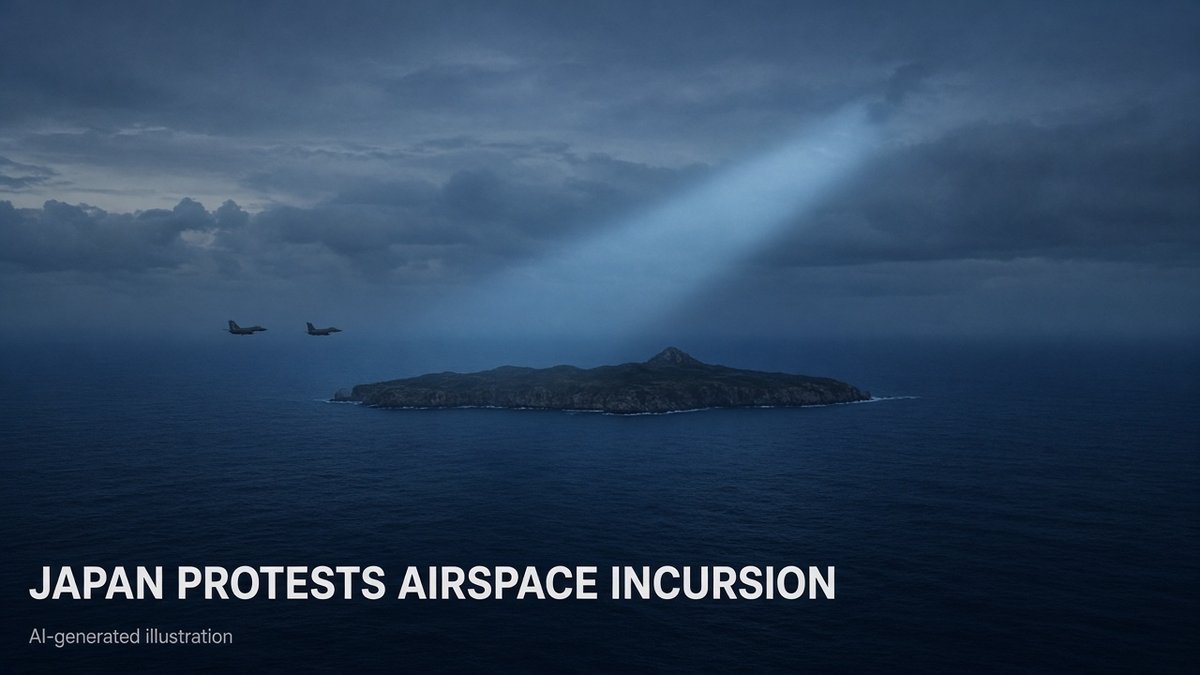
AI-generated illustration
TOKYO, November 17, 2026 – Japan scrambled fighter jets and lodged a “very stern protest” with Moscow after two aircraft it said were suspected to be Russian entered Japanese airspace near Okinoshima, off Fukuoka Prefecture, shortly after 4am on Tuesday, Chief Cabinet Secretary Minoru Kihara said.
“The violation of our national airspace by Russian aircraft is not only a grave infringement of our country’s sovereignty, but also a threat to our security and is completely unacceptable,” Kihara said, according to CNA and Deutsche Welle. “We lodged a very stern protest with Russia through diplomatic channels and strongly demanded measures to prevent any recurrence.”
Japan’s Defence Ministry said the Air Self-Defence Force issued warnings after the aircraft separately entered airspace near the island for several minutes at around 4am, The Japan Times reported. Kihara said the aircraft later flew through the Tsushima Strait and between Yonaguni Island, in Okinawa Prefecture, and Taiwan before heading into the Pacific, CNA reported. Defence Minister Shinjiro Koizumi called the incursion “utterly unacceptable” and a serious violation of Japan’s sovereignty, Nippon.com reported, citing his remarks at a press conference.
Tokyo has described the aircraft as suspected or presumed to be Russian. TASS, the Russian state news agency, reported Japan’s account and, in the same item, restated Moscow’s position that Russian military flights comply strictly with international airspace regulations, a formulation it linked chiefly to South Korea’s air defence identification zone. A detailed public confirmation or denial of the flight path described by Tokyo had not been issued by Russia’s defence ministry at the time of writing.
The last confirmed violation of Japanese airspace by a Russian aircraft was off Rebun Island, Hokkaido, in September 2024, according to Japan’s defence ministry, as reported by The Independent and The Japan Times.
South Korea’s Joint Chiefs of Staff said an unspecified number of Russian military aircraft also entered and later left the Korea Air Defence Identification Zone over the East Sea, also known as the Sea of Japan, in the early hours of Tuesday, prompting Seoul to deploy fighters, CNA reported. An air defence identification zone is a buffer used to identify approaching aircraft, not sovereign airspace, and Seoul said its own airspace was not violated.
Japan-Russia relations have been strained since Tokyo joined sanctions over the war in Ukraine, and have worsened again in recent weeks after the arrest of a Japanese journalist on spying allegations and the seizure of Japan Tobacco’s Russian assets, CNA reported. The two countries also remain at odds over the islands known in Japan as the Northern Territories and in Russia as the Kurils.
For Malaysia, the incident is a reminder that security tensions in Northeast Asia can shift quickly, including in the sea and air corridors that connect East Asia with the rest of the region. Japan is one of Malaysia’s most important trading and investment partners, and any lasting deterioration in Tokyo’s relations with Moscow adds another layer of uncertainty to a week already dominated by high-level meetings in Manila and Shenzhen. This report does not ascribe any official Malaysian comment on Tuesday’s events.
Sources: CNA; Deutsche Welle; The Japan Times; The Independent; Nippon.com; TASS.
About The Author








 Lee AI



 opinions


 Bard AI