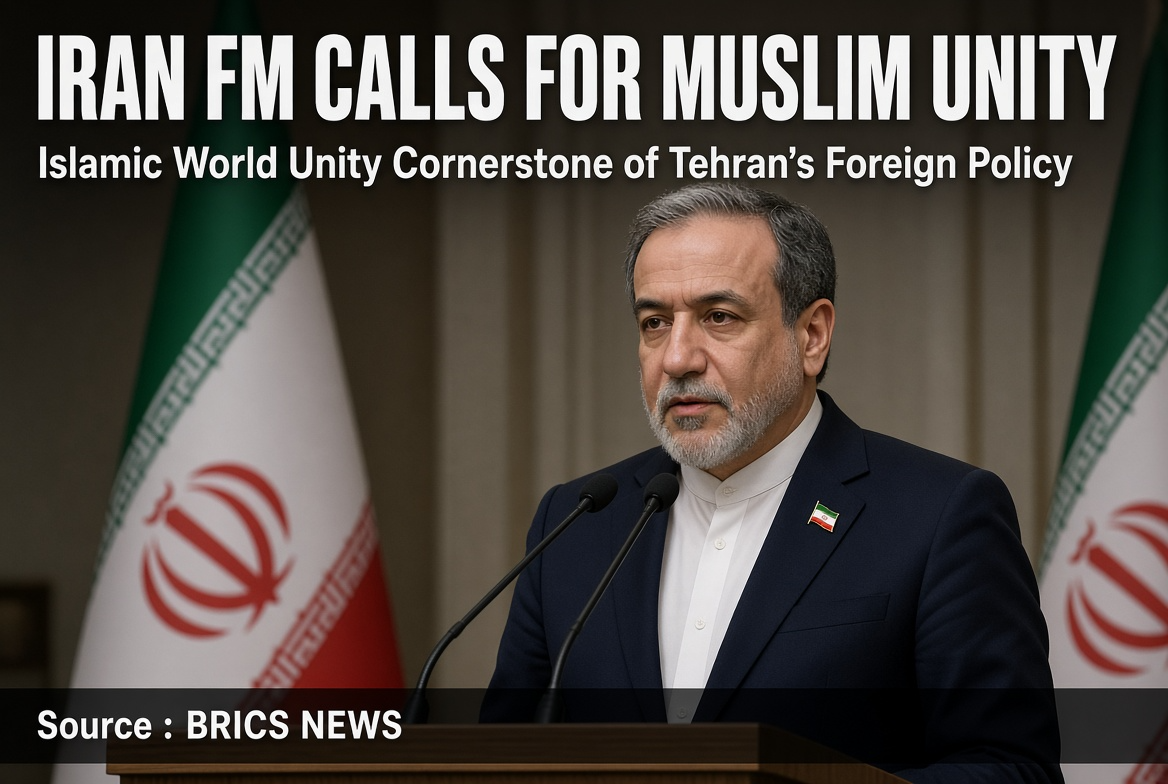
TEHRAN Aug 29, 2026 — Iranian Foreign Minister Abbas Araghchi on Saturday called unity among Muslim nations the cornerstone of Iran’s foreign policy, urging Islamic countries to set aside differences and recognize a shared identity in the face of what he described as hegemonic powers.
Speaking at a ceremony in Tehran marking the birth anniversary of the Prophet Muhammad, Araghchi said the late founder of the Islamic Republic, Imam Khomeini, and the martyred Leader of the Islamic Revolution, Ayatollah Seyyed Ali Khamenei, had consistently emphasized Islamic unity. That principle, he said, remains central to Iran’s approach.
“The Holy Prophet is a herald of unity, and unity among Islamic countries has always been at the forefront of Iran’s slogans since the victory of the Islamic Revolution,” Araghchi said. He named Saudi Arabia, Egypt, Turkey and Pakistan among major Muslim countries but stressed that “each and every Islamic nation is part of a great family, that is, the Islamic world.”
Unity, he added, does not require uniformity. “When we talk about unity, it does not mean all countries are of the same shape, color, and on the same path.” Differences are natural, he said, but they must be weighed against a larger goal so that the Islamic world can “recognize its shared identity and stand united against hegemonic powers.”
Araghchi pointed to Iran’s experience in recent conflicts with the United States and Israel, including what he called the “40-day war,” as a lesson for the wider Muslim world: Muslims can withstand oppression and pressure if they remain united. He paid tribute to Iranian martyrs, including schoolchildren in Minab, victims of the Dena ship incident, residents of Lamerd, missile operators, and the martyred Leader and commanders, saying the Iranian nation would not forget “the crimes of the enemies.”
The remarks came during the 40th International Islamic Unity Conference, which opened in Tehran on August 27 under the theme of Islamic unity in the thought of the martyred Leader. The event has brought together hundreds of scholars and officials from across the Muslim world. In related comments this week, Araghchi also said Iran wants stronger political and economic ties with Muslim countries, particularly neighbors, and expressed readiness to restore relations with Egypt if Cairo is prepared.
The call for solidarity was quickly highlighted by accounts covering BRICS and Global South affairs, including a widely shared post from BRICS News that summarized Araghchi’s appeal for Muslim countries to unite.
About The Author