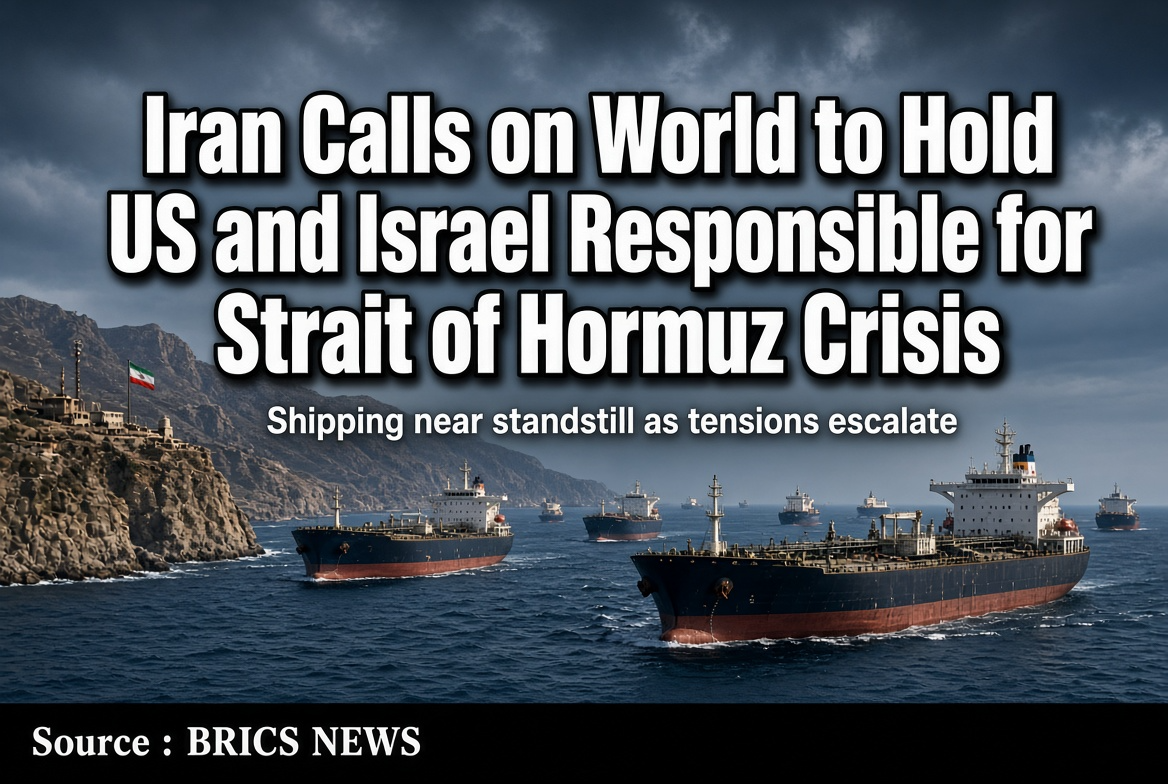
TEHRAN/ August 14, 2026 — Iran said on Friday that the international community should hold the United States and Israel responsible for the current situation in the Strait of Hormuz, according to reports circulating from Iranian sources.
The statement comes as shipping traffic through the vital waterway has ground nearly to a halt. Vessel tracking data showed almost no visible crossings early Friday after only nine ships passed through on Thursday — far below the pre-war average of more than 130 daily transits.
The remarks follow reports of attacks on two vessels belonging to the Abu Dhabi National Oil Company (ADNOC) while they were transiting the strait on Thursday evening. The United Arab Emirates blamed Iran for the incidents, describing them as a violation of international rules on freedom of navigation. Iran has not publicly commented on the specific attacks.
The Strait of Hormuz, a narrow chokepoint between Iran and Oman that normally carries around 20% of the world’s seaborne oil and liquefied natural gas, has been at the center of tensions since the United States and Israel launched strikes on Iran on February 28, 2026. Iran responded by severely restricting access to the waterway.
A June 17 memorandum of understanding between Washington and Tehran briefly raised hopes of reopening the strait, with Iran agreeing to arrange safe passage for commercial vessels. That understanding has since collapsed amid mutual accusations of violations, renewed attacks on shipping, and the reimposition of a U.S. naval blockade on Iranian ports.
Iranian officials have repeatedly insisted that management of the strait rests with Tehran under the terms of the earlier understanding and that full reopening depends on the United States meeting a series of conditions, including an end to what Tehran calls hostile actions and the blockade. On Thursday, an Iranian parliamentary committee approved the outline of a plan for the waterway that would ban transit by U.S., Israeli, and other “hostile” countries’ vessels.
U.S. officials responded by signaling intensified pressure. Treasury Secretary Scott Bessent said Washington would impose economic isolation measures “like the world has never seen before,” while Defense Secretary Pete Hegseth stated the United States could maintain its naval blockade of Iran indefinitely.
Oil markets have been watching the situation closely. Global stockpiles are being drawn down as constrained flows through the strait continue to limit supply, even as some traffic has adapted through alternative routes or dark shipping practices.
The latest Iranian call for accountability adds to a pattern of statements from Tehran placing the blame for maritime insecurity and economic disruption squarely on the United States and Israel for initiating and prolonging the conflict.
About The Author