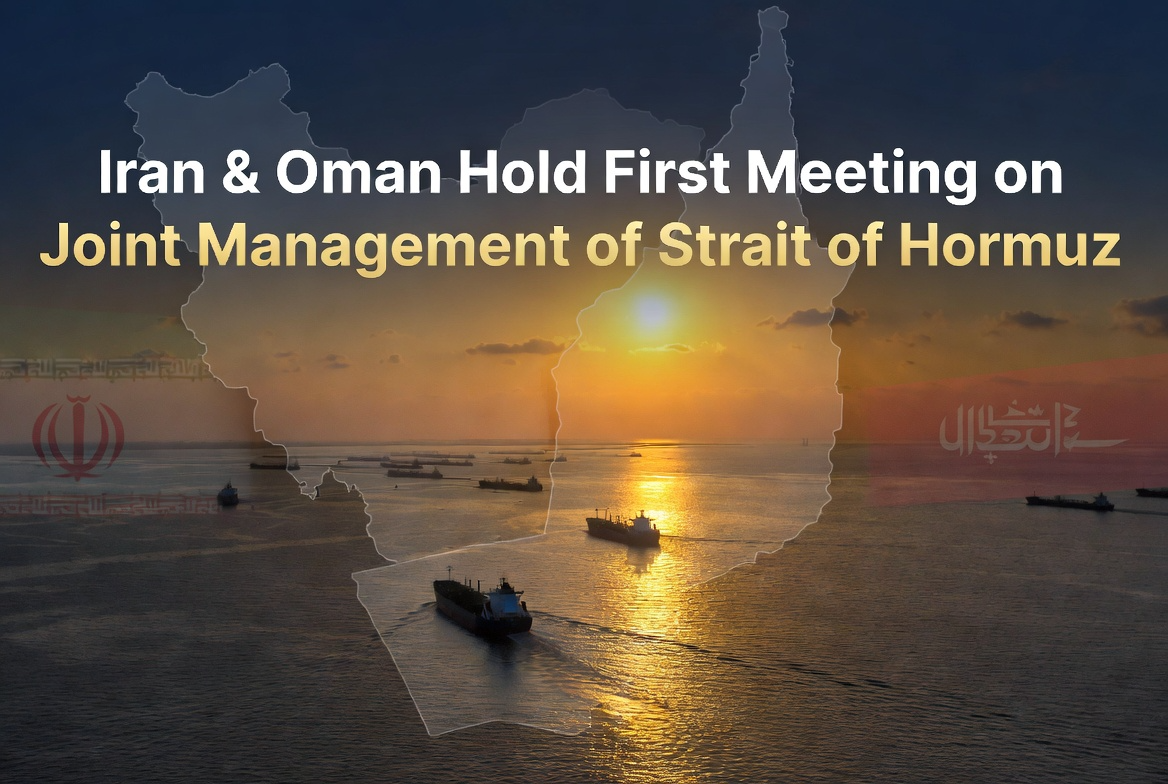
TEHRAN June 29, 2026 — Iran announced Monday that it has held its first meeting with Oman to discuss the joint management of the Strait of Hormuz, the narrow waterway that carries roughly 20% of global oil trade.
The inaugural session of the Iran-Oman Joint Committee on the Strait of Hormuz took place in Muscat. Iran’s Deputy Foreign Minister Kazem Gharibabadi met with Oman’s Minister of State for Foreign Affairs Abdulaziz Al-Hinai. The two sides reviewed current navigation issues and began discussions on the future administration and maritime services in the strait.
This step follows directly from Paragraph 5 of the Islamabad Memorandum of Understanding signed between the United States and Iran in mid-June 2026. That clause requires Iran to engage in dialogue with Oman “to define the future administration and maritime services in the Strait of Hormuz, in discussion with other Persian Gulf littoral states in line with the applicable international law and the sovereign rights of coastal states.”
The meeting marks the first concrete implementation of that provision after weeks of tension, shipping disruptions, mine-clearing operations, and recent exchanges of strikes between U.S. and Iranian forces.
The Strait of Hormuz, located between Iran to the north and Oman’s Musandam Peninsula to the south, remains one of the world’s most critical maritime chokepoints. During the 2026 conflict, Iran restricted or threatened to close the waterway, leading to sharp spikes in oil prices and global supply concerns. The U.S.-Iran MOU reopened commercial traffic under a 60-day toll-free period while establishing a framework for longer-term arrangements.
Oman, a neutral Gulf state that shares sovereignty over the strait with Iran, has emerged as the key diplomatic partner for these talks. Both countries have agreed to form a joint working group between their foreign ministries to continue negotiations on navigation rules, maritime services, and associated costs in accordance with international standards.
The development signals Iran’s intent to formalize greater influence over transit through the strait alongside Oman, while the U.S. has maintained its opposition to any unilateral tolls or restrictions on international shipping.
Further consultations with other Persian Gulf states are expected as part of the process. Shipping traffic has already begun recovering, with reports of dozens of verified crossings in recent days amid ongoing demining efforts.
Iranian state media and officials framed the meeting as a step toward regional cooperation and respect for the sovereign rights of coastal states. Oman has remained characteristically low-key but has participated constructively in the dialogue.
The outcome of these talks will be closely watched by global energy markets, shipping companies, and governments dependent on stable oil flows from the Persian Gulf.
More developments are expected in the coming weeks as the joint working group begins its work.
About The Author