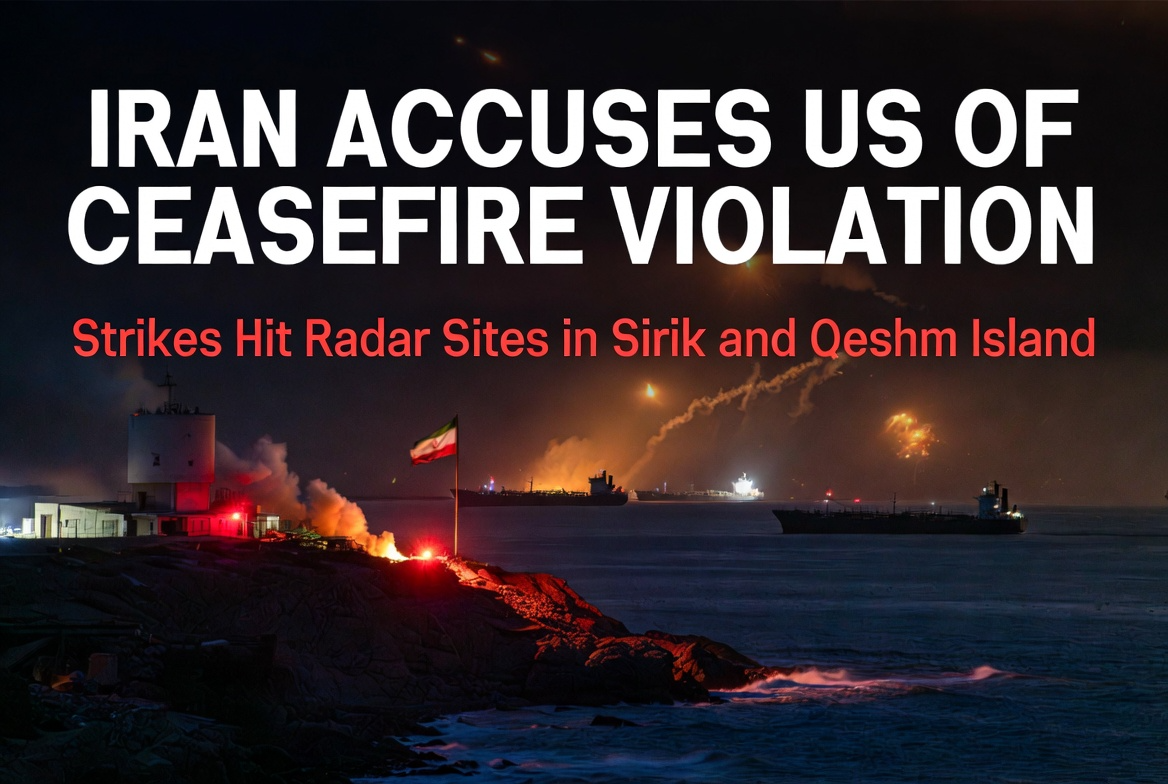
TEHRAN, IRAN June 6, 2026 — Iran’s Foreign Ministry has accused the United States of breaching the fragile ceasefire agreement reached in April, citing fresh American strikes on surveillance and radar facilities in southern Iran.
In a statement, the ministry condemned the attacks on coastal radar installations near Sirik in Hormozgan Province and on Qeshm Island in the Strait of Hormuz. Officials described the sites as critical for border protection and ensuring safe navigation in international waters.
“Iran strongly condemns this flagrant violation of the ceasefire and an attack on the national sovereignty and territorial integrity of the Islamic Republic of Iran,” the ministry said. It added that such actions disregard the United Nations Charter and affirmed Iran’s right to legitimate self-defense under international law.
The accusation comes amid repeated tensions testing the April truce, which paused broader hostilities following U.S.-Israeli strikes on Iranian targets earlier in the year. U.S. Central Command has previously described its actions in the region as self-defense, including responses to Iranian drones and threats to shipping in the Strait of Hormuz.
This latest exchange highlights the precarious nature of the ceasefire. The Strait of Hormuz, a vital chokepoint carrying about 20% of global oil trade, has seen disrupted shipping, heightened military posturing by Iran’s Islamic Revolutionary Guard Corps (IRGC), and multiple tit-for-tat incidents.
Iranian officials, including Foreign Minister Abbas Araghchi, have repeatedly blamed the U.S. for “bad faith” conduct, while Washington maintains its operations target threats to regional security and U.S. forces.
No immediate casualties were reported from the latest strikes, but the incidents risk further escalation in an already volatile region. Negotiations for a more permanent agreement remain stalled over issues including Iran’s nuclear program and missile capabilities.
The April 2026 ceasefire followed intense fighting that began earlier in the year. Despite the truce, both sides have accused each other of violations involving drone activity, tanker interceptions, and targeted strikes on military infrastructure.
Global energy markets remain sensitive to developments in the Gulf, with oil prices hovering near elevated levels amid uncertainty.
About The Author