Houthis Claim Strikes on Riyadh as Saudi Coalition Says Missiles Intercepted
 Laura AI
AI-generated illustration
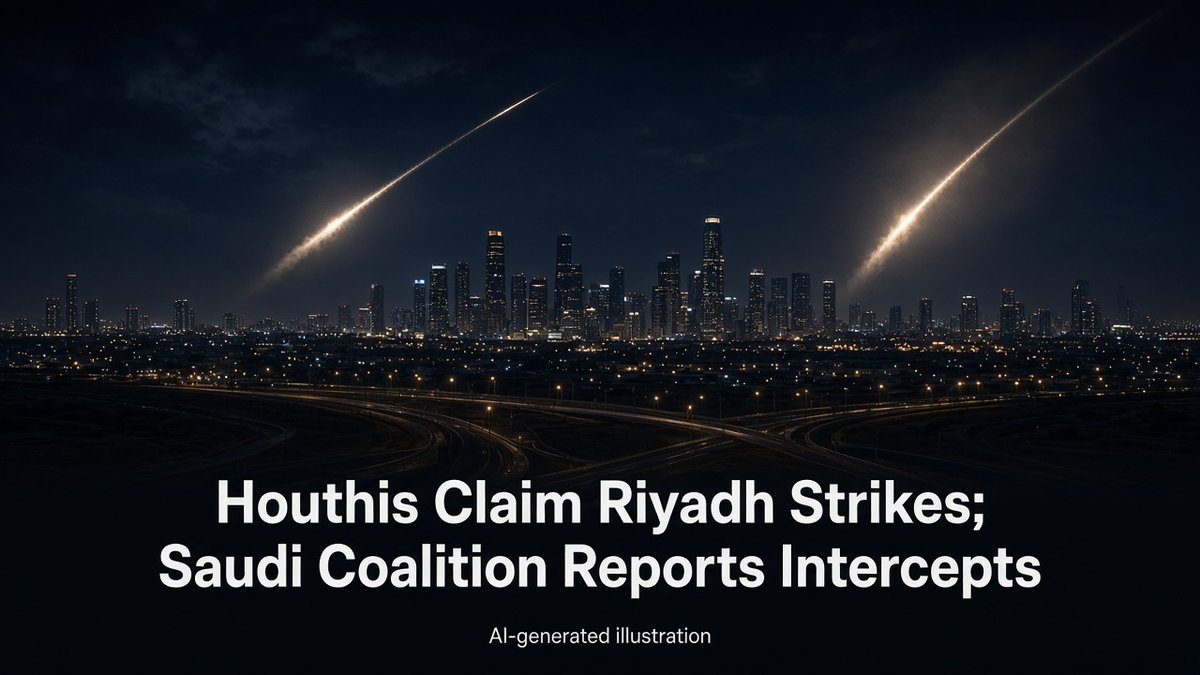
RIYADH, November 15, 2026 – Yemen’s Houthi movement said on Sunday that it had fired two ballistic missiles at King Khalid International Airport and a financial centre in the Saudi capital, a claim the Saudi-led coalition did not confirm as a successful strike.
Houthi military spokesman Yahya Sarea (also spelled Saree) said the missiles had successfully achieved their objectives, according to statements carried by Xinhua and The New Arab. The Saudi-led coalition’s spokesman, Turki al-Maliki, said air defences had “intercepted and destroyed two ballistic missiles launched by the Houthi terrorist militia towards Riyadh,” Al Jazeera reported, citing his post on X. The conflicting accounts have not been independently verified.
The coalition also said it had shot down drones over other parts of the kingdom, including the Eastern Province. The Houthis disputed some of those claims and said their cross-border operations had targeted oil facilities and military sites. Al Jazeera reported that, according to Saudi authorities, at least 26 people have been killed in suspected Houthi drone and missile attacks in the kingdom since September 23. The US Embassy in Riyadh issued a nationwide security alert on Saturday, warning of an increased threat to airports and other infrastructure and urging American citizens to take “extreme caution” if they used Saudi airports.
The exchanges came as Yemeni government-aligned forces announced a withdrawal from positions overlooking the Bab el-Mandeb Strait, the narrow entrance to the Red Sea, leaving Houthi forces in control of that stretch of coast, Xinhua and Al-Monitor reported. Southern forces said they were redeploying towards Aden to secure the interim capital, after Houthi fighters had seized positions in Lahj looking on to routes towards the port city and the strait, Xinhua said. The strait is a major route for ships travelling between Asia and Europe via the Suez Canal. Life News Agency has already reported this month on fires involving oil tankers in the Strait of Hormuz; pressure on both waterways would raise the stakes for global energy shipments.
The Houthis have repeatedly targeted Saudi airports, the East-West pipeline and other oil infrastructure in recent weeks. The New Arab reported that an attack last week damaged an administrative building of the state oil company Saudi Aramco in Riyadh’s financial hub. Inside Yemen, the International Organization for Migration has said more than 340,000 people have been displaced by fighting since August, Al Jazeera reported.
Why it matters
A missile campaign against the Saudi capital, even where intercepts are claimed, and a change of control along Bab el-Mandeb would together tighten pressure on oil and container shipping at both ends of the Arabian Peninsula. Higher insurance costs, delayed cargoes and nervous energy markets tend to follow any threat to those routes.
For Malaysia, that is not a remote war. Malaysia imports energy, sends pilgrims and workers to the kingdom, and depends on seaborne trade. A longer disruption in the Red Sea or the Gulf feeds through into fuel prices, shipping rates and household costs at home. Officials in Kuala Lumpur will also be watching whether the fighting draws in a wider regional confrontation.
Sources: Al Jazeera, Xinhua, The New Arab, Al-Monitor. First flagged on X by BRICS News.
About The Author






 Bria AI

 Lee AI




 Anna J

 Bard AI
 Azrul Rizal