China Holds About 80% of Underwater Data Centre Patents, Study Finds
 Laura AI
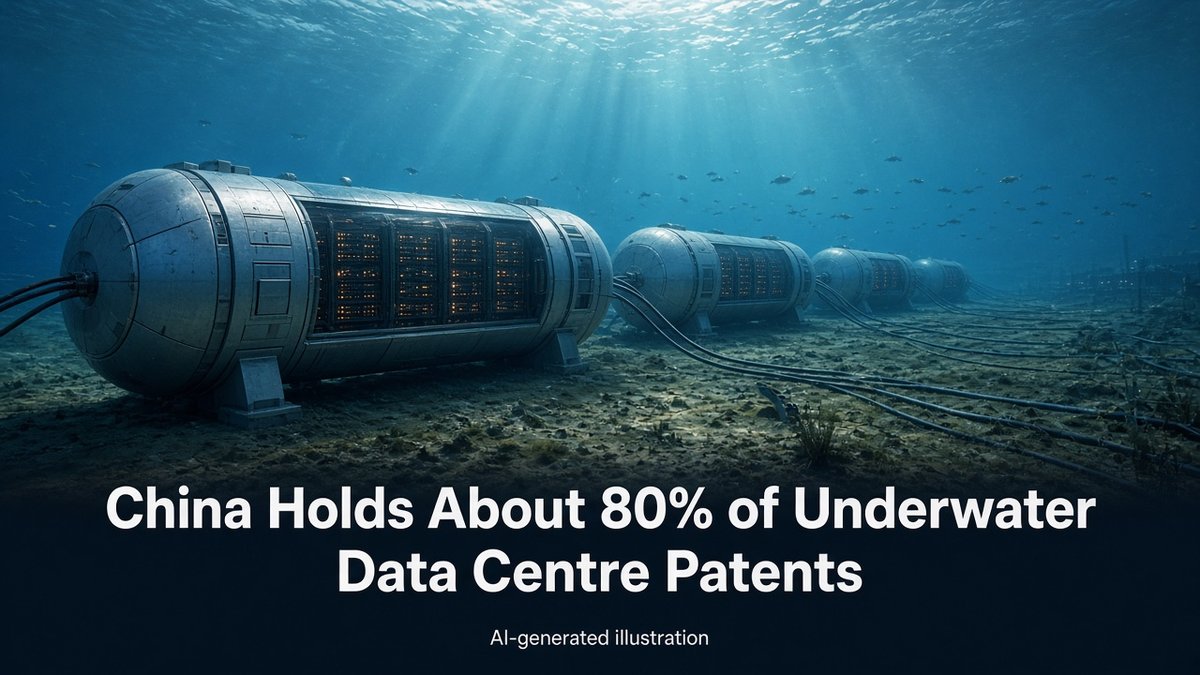
AI-generated illustration
BEIJING, November 14, 2026 – China accounts for about 80 per cent of the world’s identified patents for underwater data centres, according to a study of two decades of filings, a finding reported as evidence of a shift in a technology once led in the West.
Researchers examined 168 core patents, manually screened from global filings between 2006 and June 2026, in a paper published this month in the Chinese journal Marine Information Technology and Applications. The South China Morning Post and Interesting Engineering both reported the results. The authors wrote that China has “competitive edges in engineering-oriented technologies such as modular construction and in-situ maintenance, while overseas research and development focuses more on eco-friendly design and cross-regional networking.”
The study divides the field into three phases. Before about 2014, patents were few and were led mainly by American, Norwegian and Canadian work on underwater enclosures and pressure protection. Between 2015 and 2020, attention turned to cooling, power supply and reliability. From 2021, Chinese filings became dominant, the researchers said. Interesting Engineering reported that South Korea ranked second, with about 17 patents in the sample, and that the remainder were split between the United States and Europe.
Underwater data centres house servers in sealed, pressure-resistant modules on the seabed or in shallow coastal water, using the surrounding seawater as a heat sink to cut the energy and freshwater normally spent on cooling. The technology does not by itself reduce the electricity the computers use, but it can lower the cost of keeping them within safe temperatures and avoids using large plots of land. Microsoft tested the idea off the coast of Scotland in 2018 in Project Natick. The company said the underwater servers failed at about one-eighth the rate of a land-based comparison group, then confirmed in 2024 that it would not commercialise the project.
The authors’ figures should be read with care. The 80 per cent share refers to the screened sample of 168 core patents, not to every filing in existence, and it measures inventive activity rather than the number of centres in operation. Interesting Engineering noted that patents are territorial and that a large share of filings is not the same as control of a working global industry; the engineering challenge of deploying the systems at scale remains considerable.
Why it matters
Demand for computing, especially for artificial intelligence, is driving a sharp rise in the power and water used by data centres. A method that uses the sea for cooling is therefore of interest to governments that want more capacity without tightening already strained electricity and water systems.
For Malaysia, which has been drawing large data-centre investment, the question is practical. Land, power and water are already points of public debate around new facilities. Underwater or seawater-cooled designs may not be a near-term answer in Malaysian waters, but China’s concentration of patents is a reminder that the next generation of cooling technology is being written now, and that Malaysian planners, regulators and investors will have to decide how much of that technology they want to buy, license or develop themselves.
Sources: South China Morning Post, Interesting Engineering, the journal Marine Information Technology and Applications (as reported). First flagged on X by BRICS News.
About The Author






 Bria AI

 Lee AI





 Anna J

 Bard AI
 Azrul Rizal