Source : @BernamaBiz
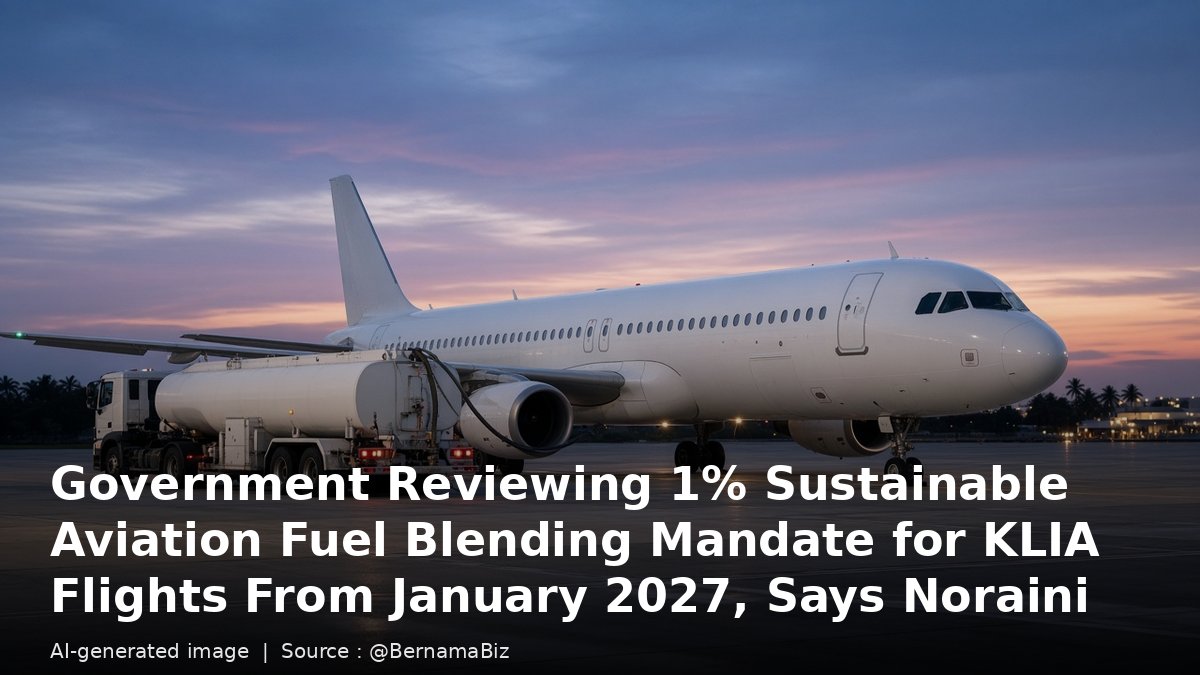
KUALA LUMPUR, November 4, 2026 – The government is reviewing its plan to require a one per cent blend of sustainable aviation fuel (SAF) for international flights leaving Kuala Lumpur International Airport (KLIA) from January 2027, Plantation and Commodities Minister Datuk Seri Noraini Ahmad said on Wednesday, according to Bernama.
She said the review takes into account current geopolitical developments that are affecting the global energy market, and that her ministry is holding engagement sessions with stakeholders to plan how the mandate would be put in place.
“The government acknowledges the challenges currently faced by the aviation industry, particularly rising operating costs and financial pressures,” she was quoted as saying by Bernama.
Noraini was speaking in the Dewan Rakyat while winding up the committee-stage debate on the Supply Bill 2027 and the motion on the 2027 development expenditure estimates for her ministry.
Malaysia already producing SAF
The minister said Malaysia has entered the commercial production phase for SAF, with the EcoCeres plant in Johor operating since October 2025 under a licensed capacity of 420,000 metric tonnes a year.
A second facility, the Petronas biorefinery in Pengerang, Johor, is expected to begin operations in the second half of 2028 with an annual capacity of 650,000 metric tonnes, she said.
“The two projects are expected to provide a combined production capacity of more than one million metric tonnes annually by 2028. This will indirectly strengthen Malaysia’s position as a regional SAF production hub,” Noraini said, as reported by Bernama.
Sustainable aviation fuel is made from renewable or waste-based feedstocks such as used cooking oil and can be blended with conventional jet fuel, helping airlines cut the carbon emissions of their flights without changing their aircraft. A blending mandate would require fuel supplied for the covered flights to contain a set share of SAF.
Biodiesel upgrades towards B30
In a related development, Noraini said the government is also strengthening the country’s biodiesel infrastructure to support its target of raising the biodiesel blending rate to B30, or 30 per cent palm-based methyl ester, by 2030.
She said approval has been given under the First Rolling Plan of the 13th Malaysia Plan (13MP) to upgrade blending facilities at four strategic petroleum depots, in Sandakan, Tawau and Sepanggar in Sabah, and in Bintulu, Sarawak. Under the Second Rolling Plan of the 13MP, blending facilities at two more depots in the Klang Valley will also be upgraded.
Replanting for smallholders
On the palm oil sector, the minister said the ministry expects 1,500 independent smallholders covering 5,900 hectares to benefit from the Oil Palm Smallholders Replanting Programme (TSPKS) 2.0 next year, while 740 smallholders covering 11,110 hectares are expected to benefit from the Oil Palm Replanting Financing Programme (PTSS).
Agrobank is among the financial institutions offering financing under these programmes, and Bank Rakyat has agreed to take part in the latest one, she said.
“The Plantation and Commodities Ministry will assist in facilitating the applications, as our target is to achieve a four per cent oil palm replanting rate. The current rate is already above three per cent, and we want to ensure that this replanting target is achieved,” Noraini said.
The Dewan Rakyat later approved the ministry’s allocation under Budget 2027, covering both operating and development expenditure, by a majority vote after 16 Members of Parliament took part in the debate. The sitting resumes on Thursday.
Source : Bernama
About The Author