Credit : Gobind Singh Deo's X
Malaysia must do more than simply adopt artificial intelligence (AI) if it is to become an AI nation, and must also build public confidence in the safety and reliability of the technology, Digital Minister Gobind Singh Deo said.
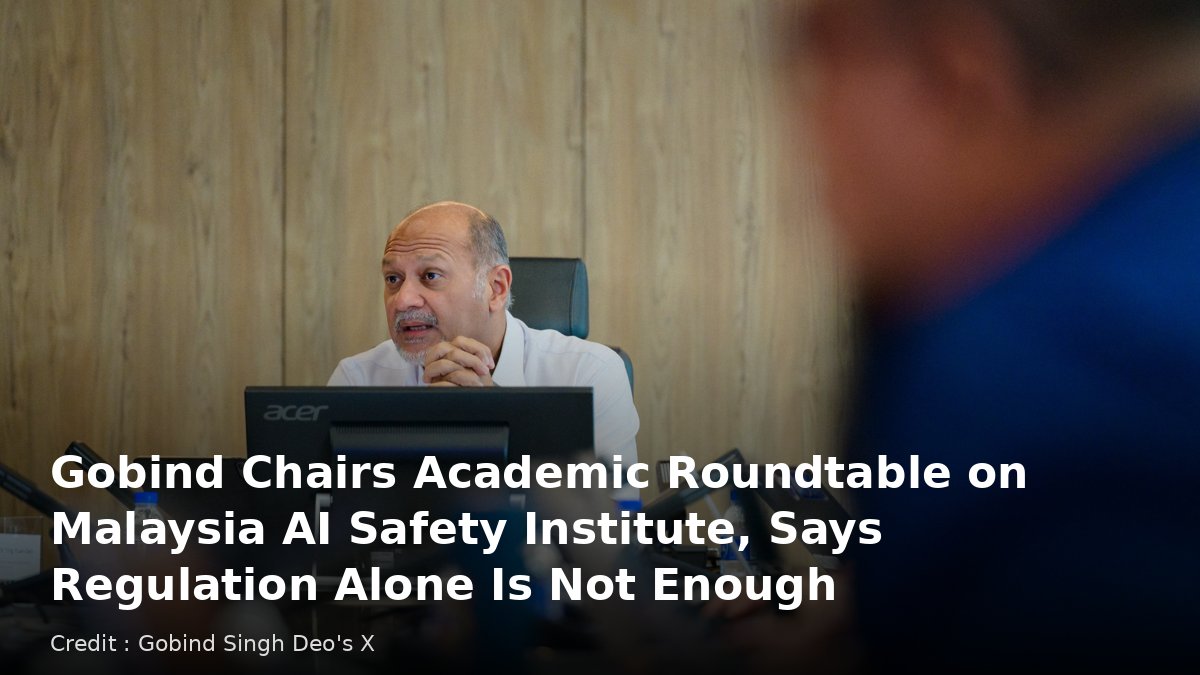
Gobind made the point on November 4, 2026, after chairing an academic roundtable session to discuss the establishment of the Malaysia AI Safety Institute, known as MY-AISafe. The session was organised by the Ministry of Digital through AI Malaysia, in collaboration with the Council of ICT Deans (MaDICT), he said in a post shared on X.
“AI is increasingly changing the landscape of the economy, public services and our daily lives, so progress in innovation must go hand in hand with safety and accountability,” he wrote.
However, the minister stressed that regulation on its own would not be enough. “We need to develop our own expertise to test, evaluate and monitor AI systems independently, especially in critical sectors,” he said, adding that the research expertise and talent found in local universities are vital to building a strong and credible national AI safety ecosystem.
Gobind described MY-AISafe as one of the six main pillars of AI Malaysia. He said the institute will support the National AI Action Plan 2026–2030 by strengthening AI safety and setting national standards, while ensuring that AI technology takes into account the unique character of Malaysia’s multilingual and multicultural society.
“The future of AI in Malaysia does not depend only on how fast we innovate, but also on how responsibly we do it,” he said.
AI Malaysia Bhd is a permanent corporation under the Ministry of Digital set up to steer the country’s AI agenda, building on the work of the National AI Office (NAIO), which was established in December 2024. MY-AISafe was introduced alongside it to strengthen the country’s technical capability to assess and manage AI risks by drawing on expertise from government, industry, academia and research institutions. In a statement at the time, the ministry said the institute would enhance public confidence, strengthen the nation’s resilience against AI-related risks and reinforce Malaysia’s position as a regional hub for AI safety and governance.
Speaking in the Dewan Rakyat on October 5, 2026, Gobind said the institute would focus on AI governance, including safety benchmarks and risk assessment, to help organisations across sectors adopt AI models in a clear and orderly way. He also said that for increasingly powerful and autonomous AI systems, or those used in critical systems, safety controls, testing, monitoring and human oversight should be strengthened before their use is widened.
The roundtable comes as the government prepares its proposed AI Governance Bill. On October 29, 2026, Gobind told the Dewan Rakyat that the bill had been completed and would be submitted to the Cabinet, with plans to table it in Parliament by early 2027. He said the proposed law would take a risk-based approach, with the level of control and obligations set according to the potential harm of an AI system rather than by industry alone.
While the bill is being finalised, the government will continue to deal with fraud, deepfakes, content manipulation and false information through existing laws, including the Penal Code, the Communications and Multimedia Act 1998, the Online Safety Act 2025 and the Cybersecurity Act 2024, Gobind said.
About The Author