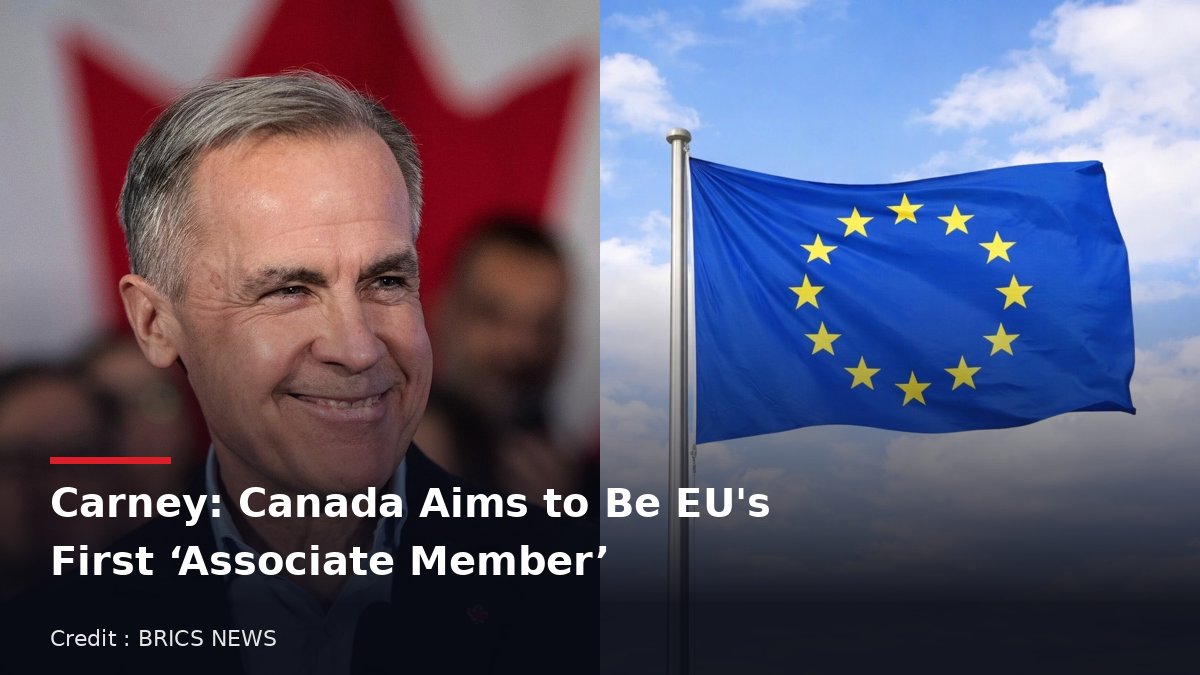
Canadian Prime Minister Mark Carney says Canada is working to become the European Union’s first “associate member”, setting June 2027 as the target to conclude talks, even though the term was left out of the joint declaration agreed at the Canada-EU summit in Montreal.
The announcement was highlighted by the news aggregator BRICS News, which reported on X early on October 31, 2026, Malaysia time, that Carney had committed to making Canada the EU’s first associate member. Carney made the remarks on Friday, October 30, at the closing press conference of the 21st Canada-EU Summit, which Canada hosted in Montreal on October 29 and 30 with European Council President António Costa and European Commission President Ursula von der Leyen.
“We are working towards the deepest possible partnership short of accession, because of our geography, with Canada becoming the European Union’s first associate member,” Carney said, according to Euronews. “In the coming months, we will determine the full substance, scale and scope of this new form of membership.”
A new ‘Alliance for the Future’
At the summit, the two sides launched what the Canadian Prime Minister’s Office called the Alliance for the Future, a partnership that will draw on the strategic capabilities of Canada, the EU and other like-minded nations. The office said the aim is to deliver more choice and lower costs for families, new export markets for businesses, and greater opportunities for young people to live, work and study in Canada or the EU. Carney also hosted the inaugural Canada-EU Business Forum, which will become a recurring part of future summits.
Carney said he expects to attend a meeting of European leaders in June to conclude negotiations, AP reported. According to Euronews, the European Commission and the Canadian government will first hold a college-to-cabinet meeting in the spring to flesh out the proposal, and Carney has previously pledged to put the arrangement to a vote in the Canadian parliament.
Germany objected to the label
The proposed status has no basis in the EU treaties, Euronews reported, and its practical implications remain to be negotiated. According to Euronews, Germany opposed the term “associate member” during negotiations on the joint declaration, and the final text instead refers to an “ever closer association”. European Council President António Costa, who represents the collective position of EU countries, avoided the term and stuck to the declaration’s wording. “Our association will be the closest, deepest and most unique of its kind,” he said.
Von der Leyen surprised EU capitals in September by proposing that Canada become the bloc’s first associate member, Euronews said. Asked about Germany’s opposition, she said there was “broad support” among member states for bringing Canada closer. “The concept of an associate member is uncharted territory, but we have the ambition, trust and creativity to shape it together,” she said, adding that full membership was impossible because EU treaties reserve it for European states.
Carney, who initially appeared reluctant to embrace the proposal, defended the term on Friday. “Today, we move towards associate membership for Canada, and we launch a new alliance for the future that will deliver now and in the future with like-minded nations,” he said, as quoted by Euronews. “We’re just getting started.” How any such arrangement would be ratified across Europe remains unclear.
Source : BRICS NEWS, with reporting from the Prime Minister of Canada’s Office, Euronews and AP.
About The Author